

Kottayam 'Arjuna Nritham' artiste ushers women to art form in revolutionary move

Mail This Article


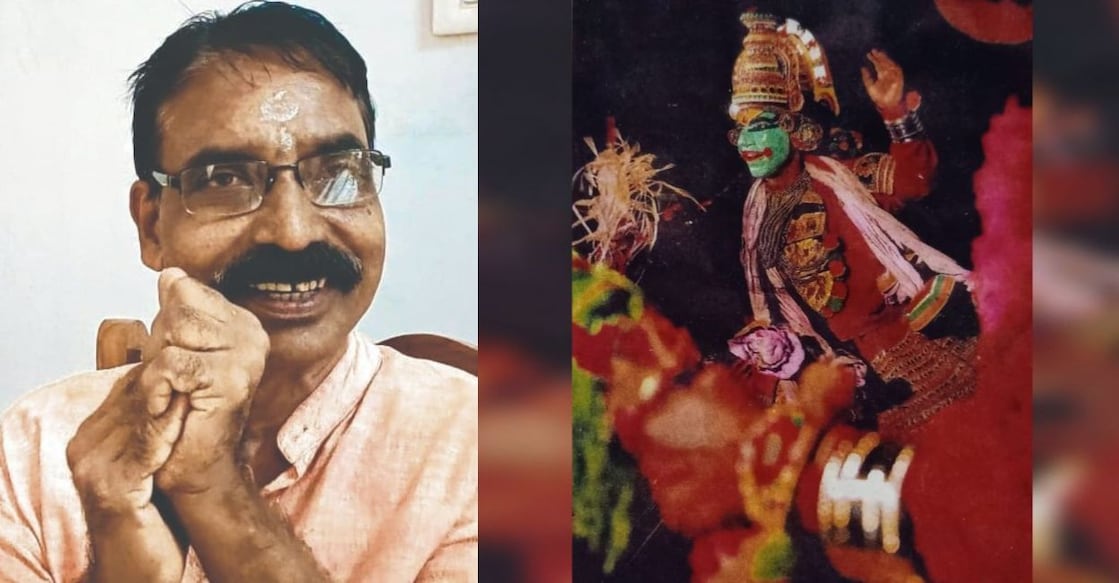
For Kurichy Nadesan, 67, every performance of Arjuna Nritham is an act of faith, not just in the goddess before whom it is offered, but in the belief that a dying art form can still find a new lease of life.
Bringing the form out of temples and before wider audiences has been central to Nadesan's work. But the effort to build the next generation of performers suffered a serious blow during the COVID-19 pandemic, which forced the Arjuna Nritha Kalalayam to suspend its training programme. The institute had offered free training to keep the art accessible, and Nadesan is determined to restart it. This time, he says, the doors will be open to women as well. "Some of them have already enquired about it," he says.
A classical art form that is prevalent in the temples of Kottayam and Alappuzha, Arjuna Nritham, also known as Mayilpeeli Thookkam, is mainly performed in the Devi temples of South Kerala. The word “Nritham” means dance, yet Arjuna Nritham transcends that category—it is both a ritual offering and a folk narrative performance.
Nadesan is one of the few exponents of Arjuna Nritham in Kerala. Unlike Kathakali or Theyyam, Arjuna Nritham is familiar only to limited audiences, and Nadesan has spent his life trying to change that. His connection to the tradition runs deep. His father, Kurichy P S Kumaran, founded Arjuna Nritha Kalalayam in 1970 specifically to keep this dance form from disappearing. Nadesan inherited not just the craft but the responsibility to keep it alive.

His commitment to the art was recognised when he received the Kerala Sangeetha Nataka Akademi Award (2007), a Senior Fellowship from the Central Government, and both an award and a fellowship from the Kerala Folklore Academy. He has also received several cultural awards from various organisations as well.
The dance itself, as Nadesan explains it, traces back to an episode in the Mahabharata. After the Pandavas' victory in the Kurukshetra war, the goddess Bhadrakali sent word reminding Yudhishthira of their mother Kunti's forgotten promise: a human sacrifice in exchange for their deliverance from exile. It was Arjuna who stepped forward willingly. Adorned with peacock feathers gifted by Lord Muruga, he stood before the goddess and moved her so deeply with his devotion that she spared his life. In gratitude, Arjuna danced before her, which became known as Arjuna Nritham.
The facial makeup is symbolic; green for heroism, red and black for focus and the divine. Unlike structured classical forms, Arjuna Nritham leaves room for improvisation, giving it an aliveness that feels unscripted. In temple settings, performances run through the night, each segment retelling a chapter of Arjuna's devotion, ending at dawn with the quiet hymn of the Mangalam.
"An artist won't be there forever, but the art will thrive for generations," Nadesan says.
 Add as a preferred source on Google