

Mail This Article


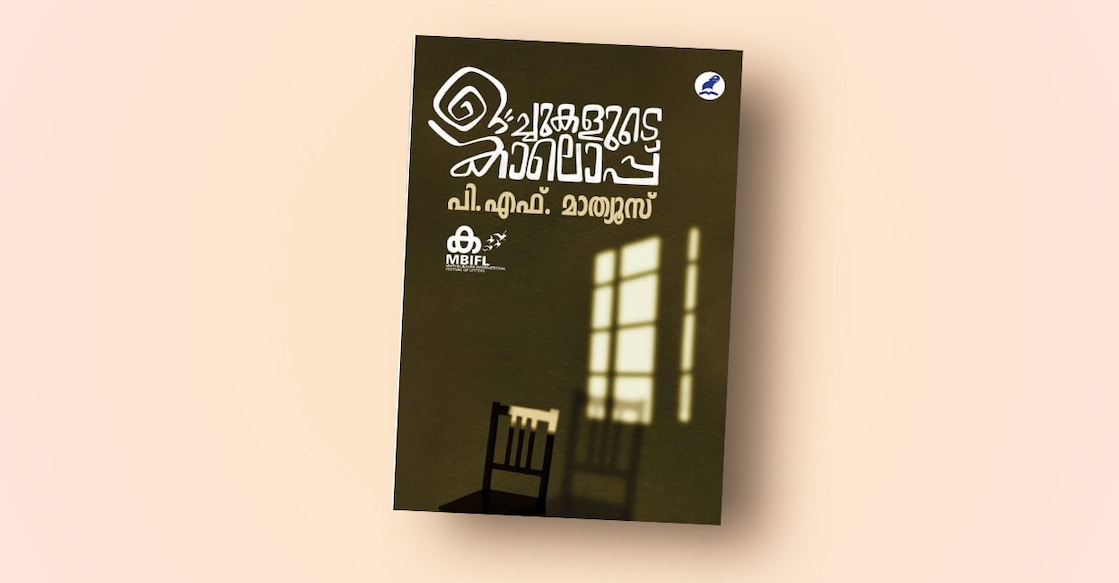
PF Mathews’ creative philosophy is famously driven by the eye. In his collection of essays, Ochukalude Kaloppu (The Footprints of Snails), the writer, screenwriter, and independent thinker explains his craft as a delicate dance of writing, memory, and sight—with sight taking undisputed precedence. Mathews has spent decades arguing that fragmented, disjointed visuals can captivate an audience just as powerfully as structured narratives, a theory proven by avant-garde cinema and rare, daring works of literature.
The rebellion against plot
For Mathews, art demands a complete overhaul of conventional sensibilities. He began his literary journey by rebelling against the traditional structure of the Malayalam short story, which historically insisted on a neat beginning, middle, and end. The era of treating form and content as separate entities is long dead. Form is the art; language is the literature; style is the very soul of the work. Yet, Malayali readers remain stubbornly addicted to hunting for "gravitas" or a heavy, moralistic storyline, a tendency Mathews considers a dangerous pitfall in art appreciation.
The paradox of Anton Chekhov
To champion his philosophy of simplicity, Mathews elevates the Russian master Anton Chekhov above other widely-worshipped literary giants. Chekhov’s genius lay in his ability to extract profound narratives from the sheer triviality of daily life, a quality beautifully illustrated in Raymond Carver’s famous short story about Chekhov’s final moments. However, Mathews seems to overlook a crucial detail: Chekhov’s work was not merely an exercise in the mundane. While Chekhov liberated Russian literature from the suffocating weight of excessive melodrama and philosophical posturing, his stories endure because they possess genuine, unforgettable narrative depth. Masterpieces like The Bet, which Mathews conspicuously leaves out, are proof of this.
The reader’s disappointment
Mathews seamlessly bridges his defence of Chekhov with a defence of his own controversial novel, Kadalinte Manam (The Scent of the Sea). He asserts that the novel was born from a desire to write about the ordinary citizen—the invisible demographic unit of a census. The protagonist is modelled after the average Malayali, a person who constantly trims and shapes their personality to fit the expectations and criticisms of society. While one must respect the intellectual seed of Kadalinte Manam, it is impossible to ignore the sheer disappointment it caused a vast section of readers. Mathews might argue that a novelist’s true calling is to deny readers what they crave, but this intellectual justification offers cold comfort to a reader who finishes a book with a sense of complete emptiness.
Double standards in cinema and literature
The essay collection inadvertently exposes Mathews' own creative contradictions. When criticising mainstream cinematic storytelling, he praises a legendary sequence from Satyajit Ray’s Pather Panchali. After Apu’s family abandons their ancestral home following Durga's death, Ray shoots a scene of a snake slithering into the ruined, overgrown house. Mathews waxes eloquent about the "gravitas" of this visual, interpreting it as a profound metaphor for nature reclaiming its territory. But by doing so, Mathews falls into the very trap he warns readers against—he is looking for, and celebrating, heavy thematic weight. A good film does not become great simply because of a single, highly symbolic scene; the magic of cinema eludes such clinical definitions.
The echo of OV Vijayan
This intellectual flip-flop is even more pronounced when Mathews discusses the legendary OV Vijayan. He admits that Vijayan's works, far from being light or trivial, carry a haunting, timeless philosophical resonance. Vijayan took specific moments of human life and infused them with a deep, echoing gravity that allowed his works to be reinterpreted across generations. If Mathews holds this resonant depth in such high regard, why does he mock the Malayali reader for seeking that very same "gravitas"? Is the author challenging the readers' conventional aesthetics, or is he simply caught in a web of his own theoretical contradictions?
Book details
Title: Ochukalude Kaloppu
Author: PF Mathews
Publisher: Mathrubhumi Books
Price: ₹180
