

Mail This Article


There was a time when spotting a Toyota Prado or Mitsubishi Pajero cruising down a Dubai highway was almost an immediate sign of success for a mid-level expatriate. In Malayali circles, such car owners were affectionately known as ‘Prado Muthalalis’.
For years, these Japanese SUVs were among the preferred status symbols of Keralite business owners and professionals in the UAE. That picture, however, is changing.
A drive along Sheikh Zayed Road today reveals an increasingly diverse automotive landscape, with Chinese brands becoming a common sight on the UAE's roads. And behind the wheel of many of these cars are Malayalis. At Khorfakkan Port, meanwhile, cargo vessels regularly unload shipments of vehicles that are increasingly finding buyers across the Emirates.
Jetour, Geely, MG, Changan, Haval, Chery, BYD, Zeekr, Xpeng, Omoda, Jaecoo and Exeed — names that were largely unfamiliar to UAE motorists a few years ago have now become part of the country's automotive vocabulary.
Chinese automakers have rapidly expanded their presence in the UAE, challenging established Japanese, European and American brands.
The shift is particularly striking given the scepticism that initially surrounded Chinese vehicles. Buyers once questioned their reliability, resale value and the availability of spare parts and after-sales service.
Today, many of those concerns appear to be fading, with buyers increasingly visiting showrooms for test drives and some popular models reporting strong demand. Industry data suggests that Chinese manufacturers accounted for nearly a third of new-car sales in the UAE by 2025.
More than 15 brands
More than 15 Chinese automotive brands currently operate officially in the UAE, offering everything from affordable sedans to premium SUVs, hybrids and electric vehicles.

Major dealerships have also expanded their presence in the segment. Al-Futtaim, for instance, has strengthened its network for BYD, while Chery Group has built an extensive showroom and service network across the Emirates.
The expansion of sales and after-sales networks has helped address one of the key concerns that once discouraged buyers — access to servicing and spare parts. Long warranty periods have also become an important selling point, with some manufacturers offering coverage extending up to 10 years.
The vehicles also come equipped with technology and safety features that were once largely associated with more expensive models, including 360-degree cameras, panoramic sunroofs, adaptive cruise control and advanced driver assistance systems (ADAS).
From budget cars to serious contenders
Chinese vehicles are not newcomers to the Gulf market. Brands such as Chery began attempting to establish a presence in the region around 2004, initially with compact hatchbacks and budget sedans.
But the Chinese automotive industry has undergone a significant transformation since then. The latest models are increasingly competing in segments traditionally dominated by established Japanese and European manufacturers. The Jetour T2 is one example.
By 2025, the SUV had emerged as the UAE's third best-selling vehicle model, behind the Toyota Hilux and Nissan Patrol, according to industry data. Its sales reportedly increased 98 per cent year-on-year, helping Jetour rise to fourth among the country's leading automotive brands in less than two years.
Price and features
Price remains one of the biggest attractions. Entry-level Chinese sedans in the UAE start at around AED 50,000, while mid-range SUVs, hybrids and electric vehicles are available in the AED 50,000 to AED 150,000 range.
Premium models can cost more than AED 200,000. But price is only part of the appeal. Chinese manufacturers have increasingly competed by offering a long list of features at prices that can undercut comparable models from established brands.
Depending on the model, buyers can get features such as 360-degree cameras, panoramic sunroofs, adaptive cruise control and ventilated seats. Higher-end electric vehicles offer technologies such as 800-volt charging systems and LiDAR-based driver assistance.
The shift in perception: Malayalis share their experiences
Pramod Madhavan, a Dubai-based electrical engineer originally from Kasaragod, admits he was once a staunch critic of Chinese automobiles. However, a single test drive changed his perspective entirely.
For Pramod, who has lived in the UAE for 14 years, his Jetour T2 is simply 'cheap and best'. Upgrading from a Korean SUV that he drove for 13 years, covering over 500,000 kilometres, Pramod notes that the T2 has offered impeccable road grip, substantial build quality, and zero mechanical issues over two years of use.
He also praises the dealership's premium valet service, where a trailer collects his car from his doorstep for routine maintenance and returns it once finished. Pramod is already eyeing an upgrade to the upcoming T700 model.
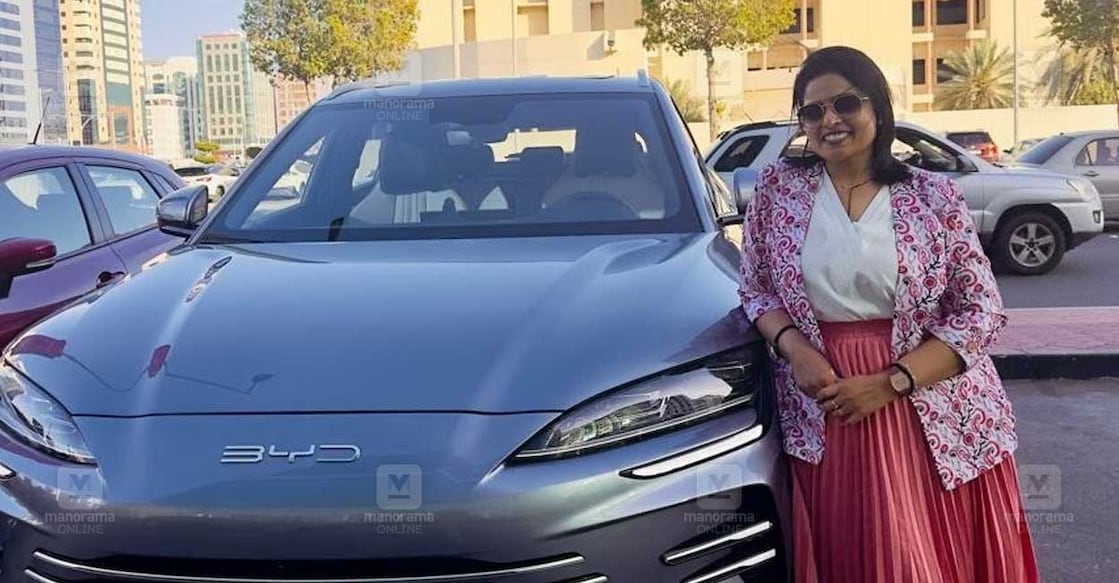
Similarly, Palakkad native Kavitha Ravindranath, who works at a private firm in Abu Dhabi, opted to lease her hybrid BYD Song Plus from Al-Futtaim for a monthly fee of AED 2,250, bypassing high upfront insurance costs.
Commuting over 2,000 kilometres every month, she finds the fuel efficiency remarkable. A single tank of fuel allows her to complete up to three round trips between Abu Dhabi and Dubai. While she misses having a dedicated charging point at her residence to fully utilise the pure EV mode, she remains thoroughly satisfied with the comfort, ride quality, and safety standard of her hybrid.
For Shamsul Nameer, an IT sales account manager from Kasaragod residing in Abu Dhabi, his 2025 Jetour T2 has been an exceptional investment. Purchased with a 20 per cent down payment and a bank loan for AED 139,000, the SUV averages around 11 to 12 kilometres per litre. With a 10-year warranty and free servicing up to 40,000 kilometres, Shamsul had no hesitation. He previously owned an MG GS and has already clocked 35,000 kilometres on his T2.
While most compatriots naturally default to Toyota or Nissan, Shamsul wanted something unique. He argues that the equivalent spend on a traditional Japanese brand would never yield features like a panoramic sunroof, ventilated seating, and a robust turbo engine packaged in such a commanding aesthetic.
Among the earliest adopters of Chinese luxury in the region is Ajmal Azad, who purchased a Changan CS75 back in 2016 for just AED 55,000 — a model that today commands nearly AED 130,000. Ajmal found the Changan to be remarkably heavy and stable on fast-paced highways compared to lighter alternatives, though he experienced some parts delays during the pandemic.
Recently, his passion for cutting-edge technology led him to upgrade to a 2025 NIO electric car. Backed by the Abu Dhabi government, the NIO offers an incredibly smooth, silent ride. Instead of waiting an hour for a standard charge, Ajmal utilizes NIO's revolutionary battery-swap stations at ADNOC petrol stations, swapping out a depleted battery for a fully charged one in mere minutes.
A direct maritime bridge from China to the UAE
This automotive surge is backed by heavily streamlined logistics. The maritime connection between the two nations was highlighted when a massive Roll-On Roll-Off vessel docked at Sharjah's Khorfakkan Port, delivering 6,068 BYD electric and hybrid vehicles in a single shipment. The newly established direct sea route from Shenzhen's Xiaomo Port to Khorfakkan slashes transit times by three to five days, ensuring that the surging demand across the UAE and the wider Middle East is met with minimal delay.
The shift is not confined to the UAE; the entire GCC region is riding the Chinese automotive wave. In 2025, Jetour alone sold over 70,000 vehicles across the Middle East, capturing an impressive 8.5 per cent share of the highly competitive Gulf SUV market. This growth is bolstered by China's colossal manufacturing capabilities and an 88 per cent spike in vehicle exports recorded in mid-2026.
Lingering questions versus long-term trust
Naturally, some questions remain. How well will these high-tech electronic systems and batteries hold up after five years in summer temperatures soaring past 50 degrees Celsius? What will the resale values look like? Will spare parts remain easily accessible for newer, niche brands?
Nevertheless, with manufacturer-backed multi-year warranties and robust roadside assistance packages, consumer confidence continues to climb. The Malayali expat, once incredibly proud of holding the steering wheel of a Prado, is now navigating Sheikh Zayed Road in a Jetour or a BYD — writing a brand-new chapter in the Middle East's automotive history.
