

Thrissur forest watcher who nursed & befriended an injured wild tusker

Mail This Article


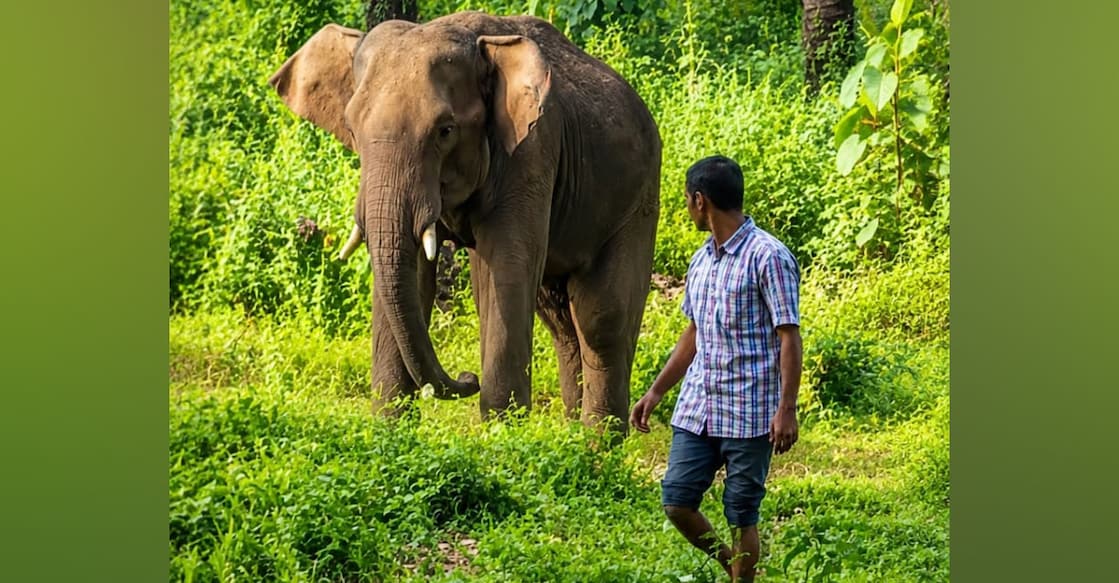
For 49-year-old forest watcher Wilson Pallassery, the forest has been a familiar part of life for as long as he can remember. Over the years, he has encountered several wild animals, but the story of an injured tusker named Badran remains particularly close to his heart.
A couple of months ago, Wilson and fellow RRT officials came across Badran in the Athirappilly range, at Ezhattumugham, Erumathadam. The elephant was injured and was initially staying in the water.
After plantation workers alerted the Forest Department about an injured elephant, a team comprising Section Forest Officer Sabu J D, watchers Sudeer and Wilson, and Nature and Wildlife Conservation Trust chairman Hariprasad tracked the animal and cared for it. "Initially, the elephant was staying in the water. When he spotted us, he charged at us. We made noise and he withdrew. Then he charged at us again. Despite his initial behaviour, he soon calmed down, so we understood that he was not aggressive," Wilson said. The animal was darted, following which doctors examined his injury and prescribed medicines.
For about a month, Wilson gave Badran food and medicines three times a day, as prescribed by the doctors. Within a few days, the elephant became familiar with him.
"We gave him medicines by hiding them inside pineapples and other food. He soon started recognising my voice, responding whenever I called his name and coming close to me," Wilson said.
The bond, however, did not last long. Before his injury had completely healed, Badran moved away towards the Vettilappara region and later died in the Malayattoor forest division.
"Badran was well for some time, but his injury, which was on the inner thigh, was grievous. We assume he sustained it while fighting with other wild tuskers," Wilson said.
SFO Sabu said Badran had to be darted again in Malayattoor to administer medicines, but by then, the infection had turned septic.
"The last time I saw him was when my wife and I were going to a function. A fellow department official told me that he had come close to the area, so I went to see him. Later, they told me that he had died. It was painful," Wilson said.
"Staff from both the Vazhachal and Malayattoor divisions were involved in caring for the animal. He used to come running when he heard the RRT vehicles. He loved pineapples. Wilson took very good care of him," Hariprasad said.
According to Wilson, injuries can make life difficult for elephants in the wild. "Once elephants get injured this way, the herd won't accept them either," he said.
For Wilson, understanding wild animals comes naturally. He grew up just about 100 metres from the forest. His father was a supervisor at Plantation Corporation of Kerala (PCK), while his mother was as a tapping worker at PCK. Many of his neighbours, friends and residents in the area were forest officials. "Hence, this life is not new to me," he said.
His experience has also taught him that human activity can sometimes aggravate elephants. "Most wild tuskers become aggressive when we interrupt their routine. During summer, they cross roads in the afternoon to reach sources of water. Vehicles or crowds can hinder them. This is what provokes the animal," Wilson said.
Wilson's experience is not limited to elephants. He has also been involved in rescuing snakes, deer and other animals. He credits Sabu, now an SFO at the Puthur Zoological Park, as one of his inspirations.
"My inspiration is Sabu sir. I have learnt so much from him, including rescuing animals, getting inside forests and climbing mountains," Wilson said.
Working in the forest also means constantly staying alert. Wilson said elephants can frequently shift their locations, making it difficult for forest staff to predict where they might encounter a herd.
"If we spot a herd in a particular area one week, they may shift elsewhere. We have to observe and be careful. We always have to have an escape route ready," he said. According to Wilson, fencing around forest fringes, regular patrolling by forest staff and cooperation from local residents help reduce the chances of conflict.
