

‘Misa’ drama on Emergency oppression faces moral policing; DYFI to stage it again at state conference
Mail This Article


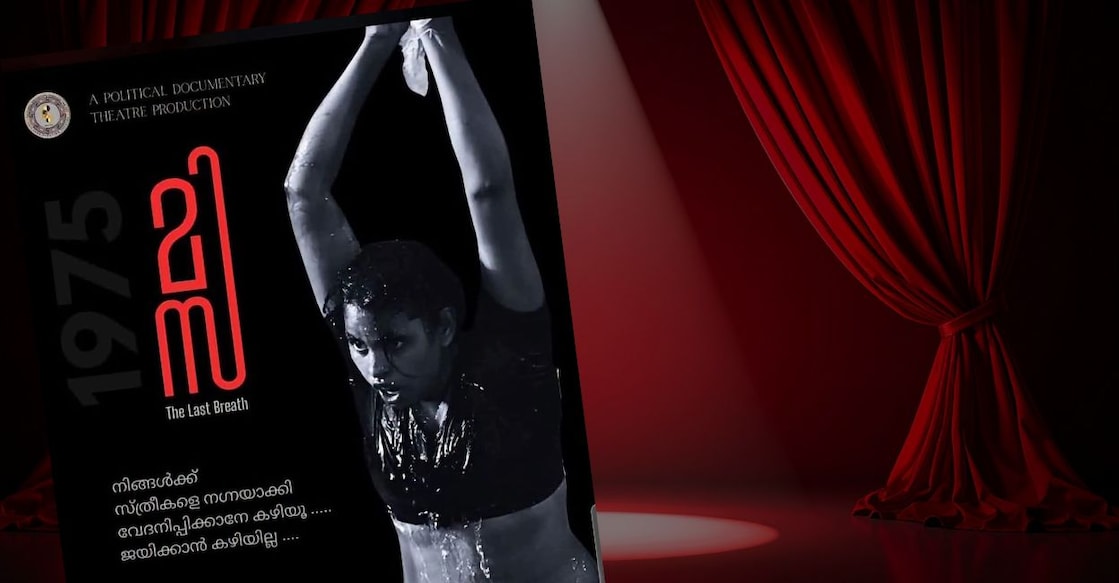
Kozhikode: A play titled 'Misa: The Last Breath', which portrays the story of theatre activist and writer Snehalatha Reddy and the state repression she faced during the 1975 Emergency, has sparked controversy after some people criticised its costumes and certain scenes as being “against moral standards” following its staging at the Democratic Youth Federation of India's (DYFI) state conference being held in Thrissur.
Against the backdrop of the controversy, the DYFI has decided to stage the play again at the venue of its state conference on Saturday evening.
The play, produced by Kozhikode-based Chilangha Floating Theatre, had come under criticism on social media after short clips featuring certain scenes and costumes were circulated. The theatre group alleged that a small portion of the performance had been taken out of context and circulated in an obscene manner.
Beginning with the exploitation faced by women workers in sugarcane plantations and factories, the play examines different forms of state violence, from the Emergency period to the present.
Some social media users alleged that the actress’s costume and certain scenes were inappropriate and contrary to moral standards. Political opponents also widely circulated the criticism on social media.
MLA and DYFI state secretary V K Sanoj and theatre activist Chinnu Chilanga, who plays the central character Snehalatha Reddy, said the criticism stemmed from a failure to understand the political context of the play.
Sanoj said there was nothing surprising about 'Misa' and its scenes continuing to unsettle “moralists” of later generations. He described the Emergency of 1975 as a dark chapter in the history of the country’s democratic freedoms and said Snehalatha Reddy’s life represented the brutal state repression faced by those who questioned authority and pursued artistic expression.
Chinnu Chilanga said she had expected criticism but did not take it personally. She said the play conveyed a clear political message and added that the message had reached those for whom it was intended.
The play had previously been staged at eight venues, including programmes organised by farmers’ organisations and DYFI district conferences, without attracting similar controversy. “It was at the ninth venue, the DYFI district conference, that some people suddenly became concerned about morality,” Chinnu said.
“An actor’s tools are the body and the voice. It is through the body and voice that actors communicate with people. Looking at art through the lens of morality is the result of distorted thinking,” she said.

She also alleged that the criticism had a political motive. “None of this can weaken us,” she said.
Actor and activist Joy Mathew also came out in support of the theatre group, stating that the controversy reflected the persistence of the kind of moral policing that had previously targeted works of art such as the Yakshi sculpture by Kanayi Kunhiraman at Malampuzha. Those familiar with theatre would understand the importance of the human body as a medium of expression. Referring to Jerzy Grotowski’s concept of “Poor Theatre”, he said the body was central to theatrical communication and that nudity, when required by a production, need not have a sexual purpose.
He said audiences needed artistic awareness to understand such performances in their entirety rather than viewing isolated scenes through a moralistic lens.
