

Kanhangad's 43-year-old landmark bus stand building unsafe, finds NIT report; council sits on it for 2 months

Mail This Article


Kasaragod: Kanhangad's landmark four-storey Old Bus Stand building is unfit for continued occupation, and it should be either demolished or reconstructed, according to a structural audit report by the National Institute of Technology, Calicut.
The 43-year-old building has suffered severe damage, including cracks to its columns, beams and concrete slabs, with rust eating into the steel inside, and chunks of concrete falling from ceilings in several shops and offices. Yet, nearly two months after receiving the report on August 5, the LDF-controlled municipal council has yet to decide the building's future or inform its scores of occupants, including government offices, Press Forum, shops and an educational institution.
Municipal chairperson V V Rameshan, who runs a khadi shop from the same dilapidated building, did not respond to phone calls.
When contacted, Works Standing Committee chairman Pathummathul Fousiya T said a special council meeting would be convened to discuss the report and that all 47 councillors would collectively decide on the future of the building. She did not give a timeline for the meeting. Fousiya also declined to share details of the report.
However, Onmanorama has accessed the full report, submitted to the municipality on August 5. The findings are stark: NIT Calicut has said the building, in its present condition, should not continue to be used, and recommended "rehabilitation, demolition or reconstruction" as possible courses of action.
The NIT study was conducted by three faculty members of its Department of Civil Engineering: Dr Rohan Bhasker, Dr Kondalraj R and Dr Ranjith K. They inspected the building first on February 26, and carried out a more detailed inspection, including tests to assess the strength of the concrete, on July 8. The study was commissioned by municipal secretary Girish M K on January 6.
Severe corrosion, exposed reinforcement
The NIT report said the deterioration is pronounced in structural elements exposed to the outside environment. The NIT study noted that the building was located just 2 km from the Arabian Sea, and that proximity to the sea had aggravated corrosion of the reinforcement. The concrete cover has spalled away at several locations, leaving steel reinforcement exposed to the elements and accelerating corrosion.
The ground floor columns, beams and slabs were among the severely damaged portions identified during the inspection. The team also tested the strength of the concrete at nine locations and found the concrete was weaker than the prescribed 25 megapascals (MPa). The tests were conducted using a rebound hammer, a non-destructive test.
Steel sheets hide damaged slab
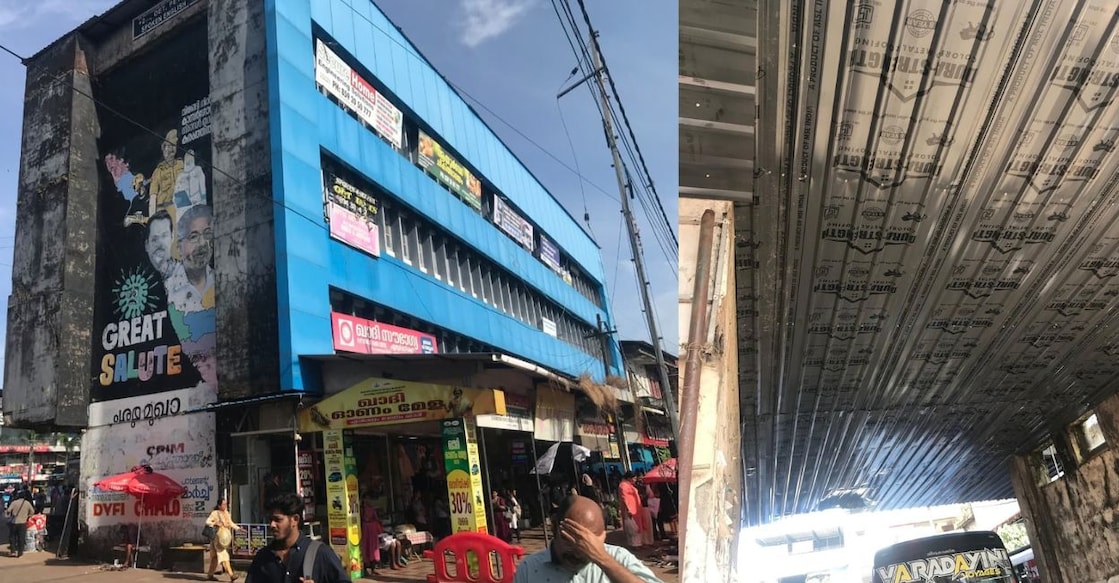
One of the more revealing observations in the report concerns the steel sheets installed beneath damaged portions of the building.
NIT said steel sheets were installed to prevent concrete from falling and injuring people. But the institute also noted that the sheets had concealed the extent of deterioration and prevented inspection and timely corrective action.
The slab along the bus exit route was particularly badly damaged. During the first inspection on February 26, NIT found the slab's reinforcement fully exposed and severely corroded. By the second inspection on July 8, the slab had been covered with steel sheets.
The report says this portion of the building had therefore become inaccessible for assessing the full extent of its deterioration.
Wall at bus entry poses safety concern
The NIT team also identified a potentially dangerous condition at the bus entry route. The outer wall built above the cantilevered portion of the entry route was severely damaged. The reinforcement inside the supporting beam and slab was fully exposed and had suffered significant deterioration.
A crack was visible along the full length of the wall at mid-height. The wall also appeared to have a slight outward inclination.
The NIT report said the condition could be linked to reduced stiffness of the supporting beam and increased deflection.
The combination of the cracked and slightly inclined wall and the severely deteriorated beam and slab supporting it posed a potential safety concern for both the structure and people in the vicinity, it said.
Not just the structure
NIT found severe damage to non-structural elements on both the front and rear of the building and warned of the possibility of falling debris or localised failure. Sunshades at several locations showed severe cracking, with reinforcement exposed and corroded.
The inspection also found rooms affected by dampness and water ingress. A room on the third floor showed extensive dampness, deterioration of plaster and peeling paint caused by prolonged water ingress.
The municipality already knew the building was deteriorating. The NIT findings come after repeated signs of deterioration at the old bus stand.
In November 2024, concrete fell from the roof near a police aid post, narrowly missing a six-year-old child. The incident prompted the municipality to decide to have the building's structural strength examined.
In December 2025, an iron support belonging to a sunshade fell at the bus stand, again narrowly missing a passer-by. A similar concrete-spalling incident had occurred in the same area a year earlier, according to news reports.
The municipality finally approached NIT Calicut in January this year. By the time the institute submitted its report on August 5, however, the building had already been subjected to years of deterioration.
The old bus stand is no longer handling bus operations. The Regional Transport Authority earlier this month shifted bus services to the new Alamippally bus stand, citing safety concerns over the old building.
But the building still houses offices of the Scheduled Caste and Scheduled Tribe Development Departments, bakeries, a lottery stall, a pharmacy, textile shops and other retail outlets. And people stand in the shade of the building waiting for buses that come by.
