

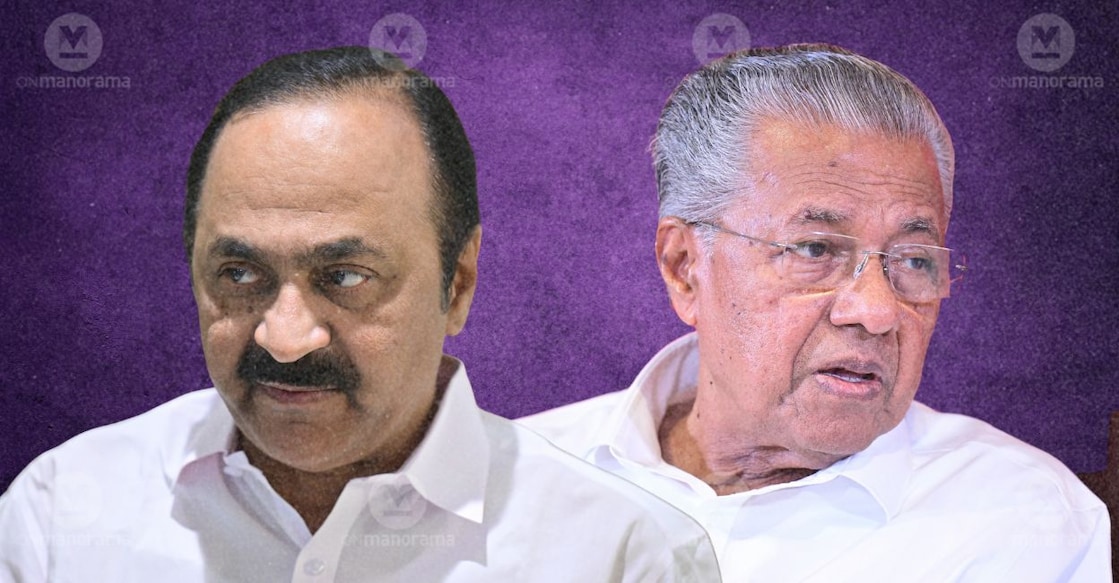
Both CM Satheesan and former CM Pinarayi Vijayan opt to sidestep uncomfortable questions about KIIFB
Mail This Article


The previous LDF government's innovative model to fund social infrastructure in Kerala, Kerala Infrastructure Investment Fund Board (KIIFB), is as good as dead. But, as was expected, it is KIIFB's ghost that seems to be troubling the ongoing session of the Kerala Assembly the most.
On Wednesday, the issue was brought back as an adjournment motion by former finance minister K N Balagopal. He wanted the day's proceedings to be temporarily suspended to discuss the future of KIIFB. Chief Minister V D Satheesan, who seemed to acquire the destructive energy of a medieval marauder the moment KIIFB is mentioned, said there was no need. Yet, the CM, the former finance minister and former Chief Minister Pinarayi Vijayan placed their arguments before the House at length.
Right at the start, the Chief Minister addressed the primary concern of the LDF. If KIIFB is shut down, what will happen to KIIFB's development projects? The CM said that all existing KIIFB works costing ₹25,000 crore would continue. In addition to these, projects that have been tendered but have still not begun will also be persisted with. In all, KIIFB projects worth ₹31,761 crore will continue.
Once this primary concern was set aside, there were the usual charges of the rulers and the stock defence of the former rulers. In the end, what remained were certain unanswered questions on both sides.
There were four big posers from the CM. One, why did the former government allow KIIFB to function as a "separate empire" on which the Finance Department had absolutely no control? Two, why did KIIFB go for 'masala bonds' at rates of interest that was considerably higher than domestic offerings?
Three, why were 1000 acres in Kannur, described as "value-degraded land" by a High Court expert committee, acquired by KIIFB? What was the purpose of such an acquisition? Further, what was the need to acquire another 4000 acres in Kannur?
Four, why did Kerala's annual plan outlay stagnate at ₹30,000 crore for three years in a row? Was it not the consequence of the fiscal burden imposed by KIIFB?
Pinarayi and Balagopal had no answers for any of these. Pinarayi did, however, respond to the land acquisition charges. He said that "quarrying-like' activities were common in certain areas of Kannur. The High Court expert committee had recorded craters of one to 10 metres depth on the land from where granite was quarried. "This is a traditional practice in the area. We can witness a number of houses in the area, " Pinarayi said. Moreover, he said it was extremely difficult to acquire land anywhere near the other major airports in Kerala: Thiruvananthapuram, Kochi, Karipur and Kozhikode.
The former Chief Minister was, however, silent about the need for 4000 acres in Kannur in addition to the 1000 acres initially acquired. He also did not say why such a vast area was acquired for high prices. The Sudha Pillai Committee, which did a comprehensive analysis of KIIFB's functioning, said that in the last six years only 12.93 and 50 acres within the 1000 acres were allocated for specific purposes: for the Higher Education Department and for a Science and IT park. Even these are largely left underutilised.
The Opposition, on the other hand, had one critical question. Will the UDF government abandon or go ahead with the case in the Supreme Court in which the former LDF government had challenged the Centre's decision to deduct KIIFB's debts from Kerala's open market borrowing limit. The LDF government saw this as an encroachment into the state's fiscal autonomy. "We have received legal opinion that the Centre's move was unconstitutional. The renowned jurist Fali S Nariman had said that KIIFB's borrowing cannot be considered as the State government's debt," Pinarayi said. Balagopal, too, said that Kerala would gain an additional ₹28,000 crore if the Supreme Court accepted Kerala's argument. The CPM leaders were, in effect, asking whether the CM had the spine to take on the Centre like they had.
Satheesan did not bother to respond to this. The case is now in front of the Supreme Court's Constitutional Bench. If the verdict is favourable, and KIIFB is allowed to borrow outside the Budget like central government entities like the National Highway Authority of India, it will be a massive political defeat for Satheesan.
The CM has repeatedly said that KIIFB had lost its value after its debts were included in the state's annual borrowing limit. The moot question is: If the SC finds the Centre's move unconstitutional, will Satheesan admit that KIIFB's value has been restored?
