A dispatch from the Colombo Literary Festival

Mail This Article


When I was asked a few months ago to come back to Sri Lanka in July for the inaugural edition of a literary festival in Colombo, I grabbed the opportunity with both hands. The Colombo Literary Festival, a collaborative effort between the heavyweights of the publishing industry in Sri Lanka, with the support of the authorities, corporates and a large and enthusiastic team of volunteers has been an incredible success.
Inaugurated by the intellectual colossus that is Shashi Tharoor, this on-going festival has a large number of discussions, workshops and cultural programs in Sinhala, Tamil and English. What has particularly struck me is the openness with which the country is addressing the issues of the past.
Colombo, a clean, green and modern city, that is easily the most livable metro in South Asia, was a very different place in 1983, when it witnessed a horrific bout of anti-Tamil communal violence. Since I personally did not expect those dark days, called Black July, to be a major topic of discussion, I was surprised when Prime Minister Harini Amarasuriya spoke about it, as well as the deplorable burning of the Jaffna library in 1981.
Speaking of 1983, the prime minister said that the country witnessed “horrors that led to years of conflict,” adding that this was also a time that books were burnt. She noted how the Jaffna library, which held "irreplaceable books and literary works, was completely burned to the ground.” Amarasuriya added, “this in a way, underscores, I think, the importance of establishing and promoting a culture that appreciates and values literary works, books, authors and publishers.”
Most people think the violence of 1983 only affected Tamils, but some Malayalis also faced the wrath of the irate mobs. A businessman with roots in Malabar lost 5 cars, his posh home and business that was built over two generations in that violence. His family was protected from personal physical harm by their Sinhalese neighbours. The family, Sri Lankan citizens, rebuilt their lives from scratch from 1983 onwards to once again become wealthy.

In her speech, Prime Minister Amarasuriya said that history textbooks would teach children about the Jaffna library, the 1983 riots and the violence in the south of the country in the late 1980s.
The youth of Sri Lanka which has turned up in large numbers for the festival is the country’s greatest asset. I dare say that those people in the 25 to 34 age group comprise the best generation this country has had since independence. They are largely free of communal hatred and have a global and cosmopolitan outlook. These young people remind of India’s own youth that just recently reminded us of what it means to be citizens of the world’s largest democracy.
Unfortunately though, many members of the youth of Sri Lanka are leaving the country for the very same reasons that young Malayalis are leaving Kerala.
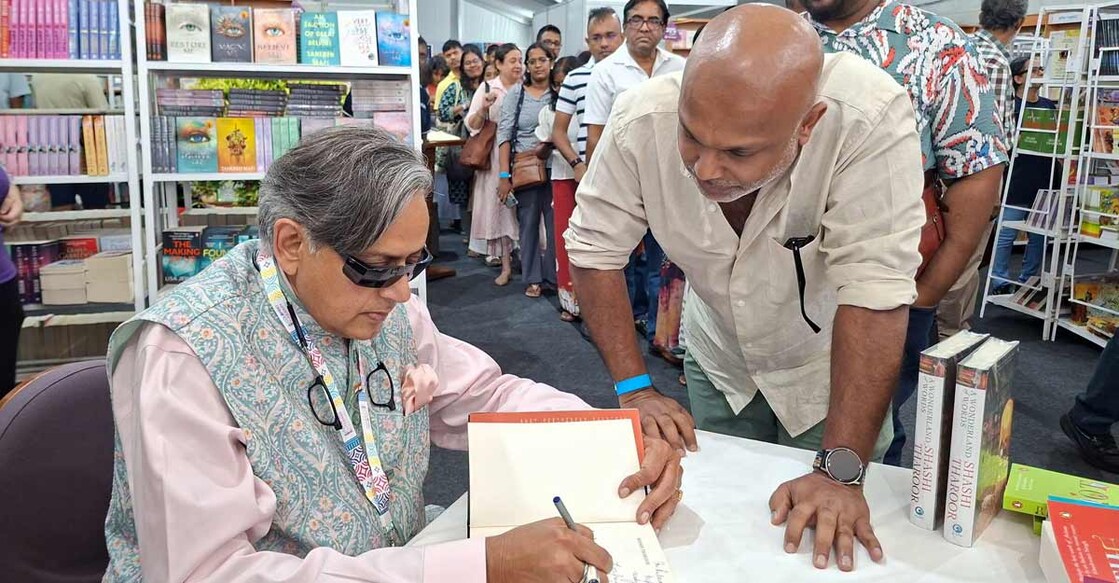
In this on-going literary festival, the Thiruvanthapuram MP, Tharoor, has been drawing large crowds and readers patiently waited in long queues to get their copies of his books autographed. Among other illustrious authors at the festival is Firat Sunel, who has served as the Turkish ambassador to India, and absolutely loves India, and Kerala in particular, with his works being translated in Malayalam.
I have been impressed the most with the way Sri Lanka is looking to position itself as the meeting point of cultures and dialogue for the least integrated part of the world- South Asia. It is here that members of the civil society from India, Pakistan, Bangladesh can meet as friends and discuss ideas in a cordial atmosphere. The island nation, which is still healing from the wounds of the civil war, shows how reconciliation is possible even after the worst kind of human conflicts.
This festival could really pave the way for Colombo to become the literary and cultural hub of South Asia.
As I look at the red-tiled roofs, coconut trees and white puffy clouds, I think of a statement that has been attributed to Arundhati Roy that Sri Lanka is Kerala without relatives! For many Malayalis, this could very well be the reason to come and spend more time on this paradise island.