

Tarique Rahman’s rise to Bangladesh PM after 17 years in exile
Mail This Article


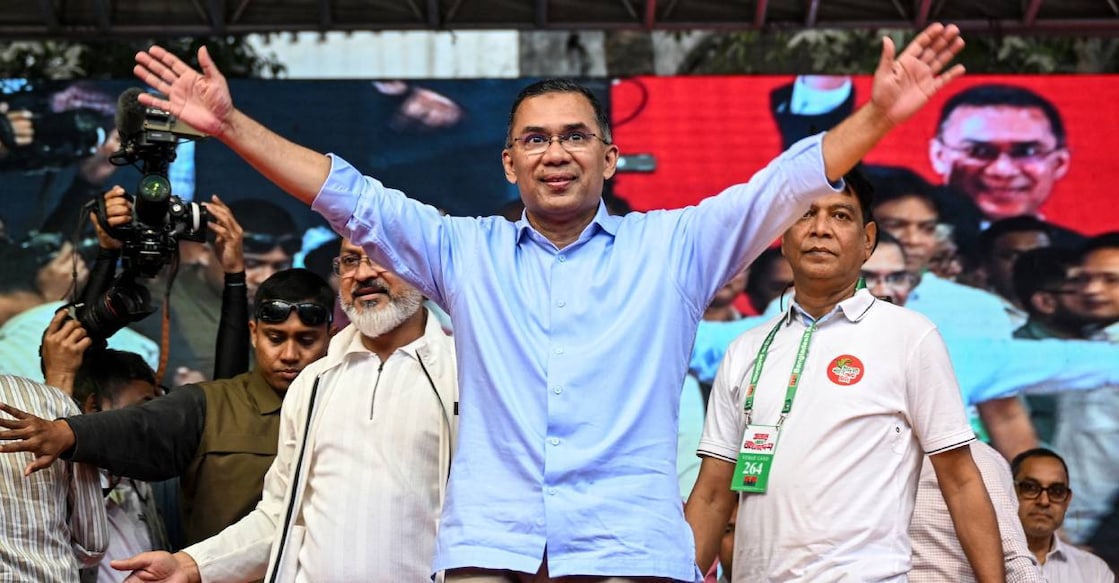
After spending 17 years in self-imposed exile in London, Tarique Rahman has emerged as a key political figure in Bangladesh, with the party founded by his father poised to return to power after two decades.
The 60-year-old leader’s Bangladesh Nationalist Party (BNP) won 209 of the 297 parliamentary seats, while the right-wing Jamaat-e-Islami, considered close to Pakistan, secured 68 seats, reported PTI. The Awami League led by Sheikh Hasina was barred from contesting the election, which recorded a voter turnout of 59.44 per cent.
The outcome marks a dramatic comeback for the BNP, which had been sidelined during the 15-year rule of Hasina’s Awami League government that collapsed following nationwide student-led protests in August 2024.
The BNP was established by Rahman’s father, Ziaur Rahman, a former military ruler who later became a politician. After his assassination in 1981, the party was led for nearly four decades by Rahman’s mother, Khaleda Zia.
Five days after returning to Bangladesh in December amid a grand public reception, Rahman suffered a personal loss when Khaleda Zia passed away after a prolonged illness.
He assumed leadership of the BNP in his mother’s absence at a time when the party was struggling politically ahead of the elections. The rapidly changing political situation left him little time to grieve privately.
Though often described as a product of dynastic politics, Rahman’s political upbringing gave him strategic insight. He is credited with guiding the party through a complex political landscape and positioning it strongly ahead of the polls.
Soft-spoken by nature, Rahman drew large crowds while leading the campaign. Since returning, he has adopted a conciliatory tone, avoiding inflammatory remarks and promoting restraint and reconciliation, despite long-standing hostilities with the former Awami League government. The BNP’s landslide victory has now cleared the way for him to become the next prime minister.
Born on November 20, 1965, in Dhaka, Rahman witnessed the country’s liberation struggle in 1971. He was arrested along with his mother and brother and released on December 16, 1971, when Bangladesh gained independence from Pakistan.
He studied international relations at the University of Dhaka but later dropped out and entered business, focusing on textiles and agro-based ventures. In 2009, he became the BNP’s Senior Vice-Chairman and gradually took charge of reorganising the party.

During the Awami League rule, Rahman faced several corruption and criminal cases and was convicted in absentia in some. He received a life sentence in connection with the 2004 grenade attack on Hasina’s rally that killed 24 people and injured many others.
Rahman consistently denied the allegations, calling them politically motivated. He was later acquitted in all cases during Muhammad Yunus’ interim administration following Hasina’s removal.
In 2018, when Khaleda Zia was imprisoned on graft charges, Rahman was appointed Acting Chairman of the BNP. After her death, he formally took over as party chief.
Political analysts view the election outcome as a remarkable turnaround for Rahman, who left Bangladesh in 2008 citing medical reasons after his release from detention under a military-backed caretaker government. However, they also note that public optimism has been accompanied by lingering doubts.
"I have a plan for the people of my country and for my country," Rahman said after returning in December, referring to Martin Luther King’s words, "I have a dream."
He later outlined his vision, promising to rebalance Bangladesh’s foreign relations to attract investment without excessive dependence on any single country. His agenda includes expanding financial assistance for poor families through “family cards,” diversifying exports beyond garments by promoting industries such as toys and leather, and introducing a two-term or 10-year limit for prime ministers to prevent authoritarianism.
In various interactions, Rahman admitted that governing a nation of 170 million people would be challenging, especially in rebuilding a weakened economy.
Observers have pointed out that maintaining discipline within the BNP will be a major test. Over the past 18 months, party workers have faced criticism for alleged extortion and seizure of rivals’ businesses. Reports indicate that around 10,000 activists were expelled during this period, and some were accused of filing false cases against opponents.
During the BNP’s 2001–2006 rule under Khaleda Zia, Rahman was often portrayed by critics as an aggressive power broker who ran a parallel authority structure despite holding no official post—a claim he has denied.
However, many analysts believe that his years in exile, spent in a country with a mature democratic system, have transformed him.
“This is not that Tarique we heard of or seen before,” said a Hindu community leader who met him recently, describing how Rahman shared witty remarks and explained his vision for the nation.
Rahman married cardiologist Dr Zubaida Rahman, daughter of a former navy chief, in 1994. The couple has a daughter, Zaima Zarnaz Rahman.
 Add as a preferred source on Google