

Trump says US near goals in Iran war, hits out at allies as Hormuz crisis deepens
Mail This Article


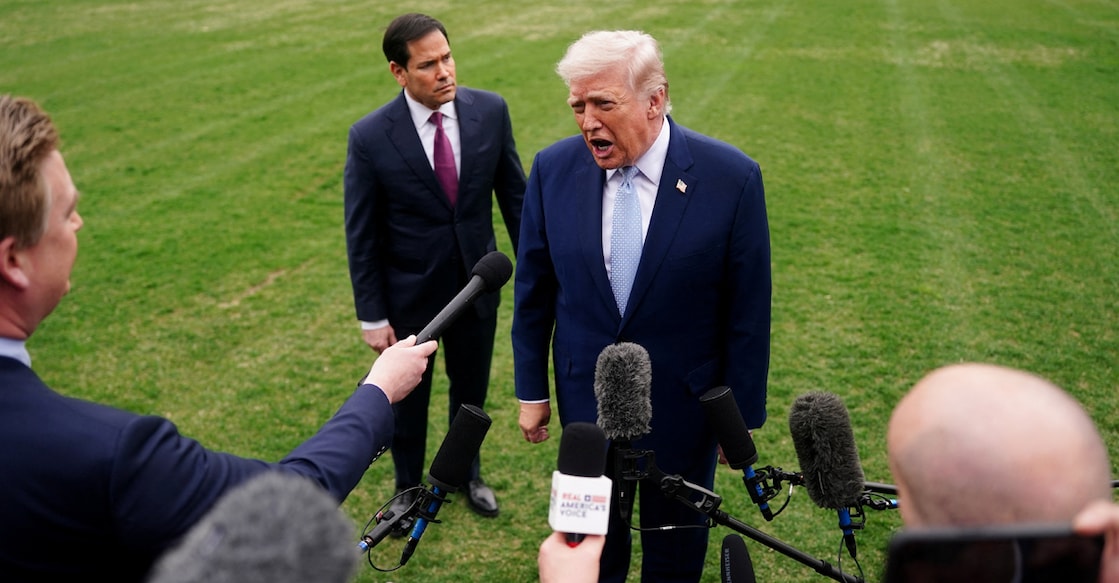
US President Donald Trump on Friday signalled a possible scaling down of American military involvement in the ongoing Iran war, saying Washington was "very close" to achieving its objectives, even as the Pentagon moved to deploy thousands more Marines to the Middle East.
In a post on Truth Social, Trump said responsibility for securing the Strait of Hormuz- a critical global energy chokepoint- should fall to countries that depend on it.
"The Hormuz Strait will have to be guarded and policed, as necessary, by other Nations who use it- The United States does not," he said. "If asked, we will help these Countries in their Hormuz efforts, but it shouldn't be necessary once Iran's threat is eradicated."
Despite the remarks, US military preparations in the region are intensifying. According to officials cited by Reuters, around 2,500 Marines are being deployed along with the USS Boxer amphibious assault ship and accompanying warships. Their precise role remains unclear, and no decision has been taken on deploying troops inside Iran.
The developments come amid growing criticism from Trump, who accused NATO allies of "cowardice" for refusing to join efforts to reopen the Strait of Hormuz- a narrow waterway through which roughly 20 per cent of global oil and liquefied natural gas supplies pass. The route has been largely disrupted since the United States and Israel launched strikes on Iran nearly three weeks ago.
The conflict has already killed more than 2,000 people, mostly in Iran and Lebanon, while triggering severe disruptions to global energy markets. Oil prices have surged by around 50 per cent since the war began on February 28, raising fears of a broader economic shock.
In a bid to stabilise supply, the Trump administration announced it would waive sanctions on Iran to allow the sale of approximately 140 million barrels of oil stranded on tankers since the outbreak of hostilities. A similar easing of restrictions had earlier been granted for Russian oil.
Fighting continued to intensify on Friday. Israel said it launched two large waves of airstrikes targeting weapons production facilities and ballistic missile infrastructure in Tehran and central Iran. In response, Iran fired multiple missile barrages at Israel, triggering air raid sirens in Tel Aviv and Jerusalem.
Debris from an Iranian missile landed just outside Jerusalem's Old City- a site sacred to Christians, Jews and Muslims- though no casualties were reported.
Regional energy infrastructure has also come under attack. Kuwait's state oil company reported multiple drone strikes on its Mina Al-Ahmadi refinery, causing fires in some units- the latest in a series of strikes on Gulf energy facilities.
-
9 HOURS 4 MINUTES AGO
Thrissur home delivery case: Chavakkad police seek nod to exhume newborn’s body

While several US allies have expressed willingness to support "appropriate efforts" to secure maritime routes, countries such as Germany and France have insisted that hostilities must first cease. German Chancellor Friedrich Merz is expected to discuss the situation with Trump over the weekend.
Meanwhile, the United Kingdom has authorised the United States to use its bases to carry out strikes on Iranian missile sites targeting shipping in the strait.
Khamenei's health in question
As Muslims around the region tried to celebrate Eid al-Fitr, which ends the fasting month of Ramadan, and Iranians marked Nowruz, the Persian New Year, new Iranian Supreme Leader Mojtaba Khamenei issued a message of defiance.
Khamenei, who has not been seen in public since the Israeli attack that killed his father and predecessor Ayatollah Ali Khamenei on the war's first day, said Iranians had responded with unity and resistance and "dealt a disorienting blow to the enemy".
A US intelligence official, speaking on condition of anonymity, said the statement raises questions about Khamenei's condition, as his father traditionally marked the New Year with a video address. The official said Khamenei's extended absence raises questions about his condition and who is running the country.
US and Israeli officials say Iran can still hit back, even though weeks of bombing have severely weakened the government and depleted its stock of missiles and drones.
Iran's Revolutionary Guards said they had attacked Haifa and Tel Aviv with multi-warhead missiles and used drones to attack weapons stocks at US bases, including Sheikh Isa air base in Bahrain. No comment was immediately available from US forces.
The semi-official Iranian news agency Tasnim said intelligence minister Esmail Ahmadi was killed, the latest of dozens of leading figures assassinated by Israel.
"We have nobody to talk to," Trump said. "And you know what? We like it that way."
 Add as a preferred source on Google