

How Lionel Messi and Scaloni turned Argentina into World Cup's comeback specialists

Mail This Article


When Argentina and Spain meet in the FIFA World Cup final, it will be a clash between the tournament's most ruthless attack and its most disciplined defence.
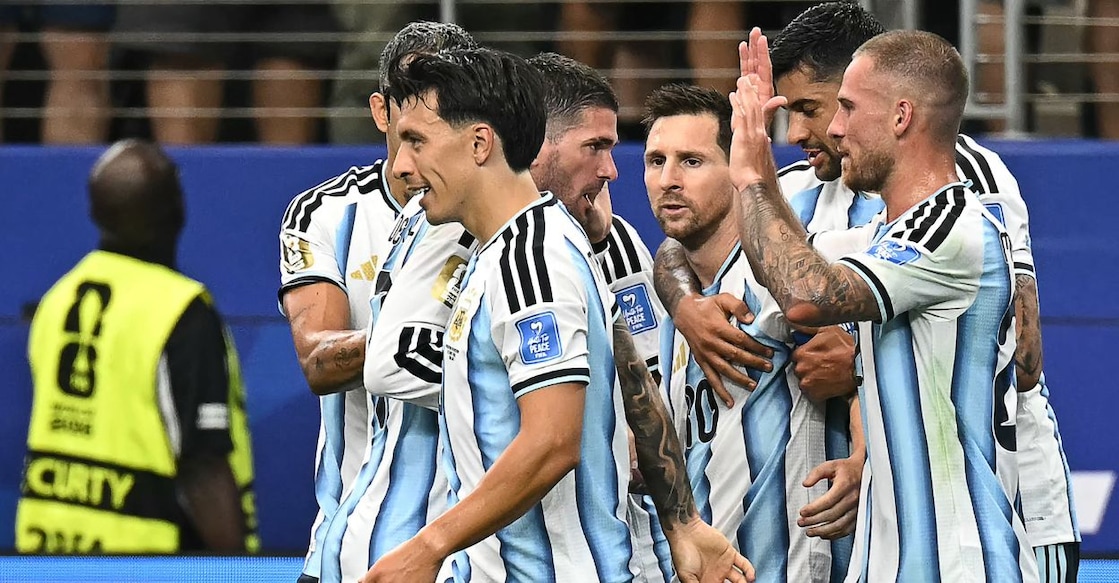
Argentina have scored a tournament-high 19 goals, while Spain has conceded just once and kept six clean sheets in seven matches. Yet beyond those contrasting numbers lies another compelling storyline. Argentina have emerged as the World Cup's comeback specialists, repeatedly recovering from losing positions through tactical adaptability, relentless attacking intent and, above all, the influence of Lionel Messi.
Lionel Scaloni's side has rarely enjoyed a smooth passage through the knockout rounds. They were pushed to the limit by a resilient Cabo Verde before edging a 3-2 thriller. Against Egypt, they overturned a two-goal deficit to win 3-2. A similar pattern unfolded against Switzerland, where they recovered after falling behind to secure a 3-1 victory, before staging yet another comeback against England in the semifinal to prevail 2-1.

Each comeback has had its own story, but all have shared one common thread: Scaloni's willingness to alter his team's shape and approach according to the demands of the game.
That tactical adaptability was on full display against England. Argentina began in a midfield diamond within a 4-4-2 formation. But once England retreated into a deep defensive block after taking the lead in the 55th minute, the South Americans shifted gears.
England crowded their defensive third and denied Messi space between the lines. Argentina controlled possession and tried to penetrate, but the openings never appeared. Scaloni's response was decisive. The introduction of Nico Gonzalez in the 63rd minute stretched England's defensive line, with the winger dragging Anthony Gordon wider, thereby creating pockets of space for Messi to exploit.
Rodrigo De Paul also pushed higher up the pitch, adding another layer of pressure on England's defence. The fresh legs of Argentina's substitutes began to stretch England's compact shape, and Messi immediately started finding the openings.
The equaliser perfectly illustrated Argentina's tactical switch. Messi orchestrated the move from the right before setting up Enzo Fernandez for the finish. Their winner followed a similar pattern, with Messi once again initiating the attack from the right before Lautaro Martinez headed home.

The contrast between the two halves was striking. In the opening 45 minutes, Messi was often forced to drop deep to collect possession as England closed down every passing lane. Argentina also adopted a more physical approach to disrupt England's build-up play. After the break, however, they found greater fluency, increased the tempo and attacked with far more aggression.
Argentina's late surges have become a defining feature of their campaign. Twelve of their 19 goals have come after the 75th minute- including 9 of their 11 knockout goals. The Albiceleste often conserve energy during the early stages, read the rhythm of the contest and then exploit the fatigue of opponents in the closing phases. Crucially, Scaloni's substitutions have consistently aligned with the tactical demands of the moment.

That pattern was evident again in the quarterfinal against Switzerland. Argentina frequently directed their attacks towards either flank, deliberately overloading one side of the pitch to create space in central areas and on the opposite wing.
Messi was given considerable positional freedom, while Julian Alvarez played an equally important tactical role. The striker repeatedly dropped deeper into midfield, disrupting Switzerland's man-marking structure and creating uncertainty among the defenders over whether to follow him or hold their shape.
Messi constantly searched for pockets of space, and his quick turns and one-touch movements repeatedly unsettled the Swiss defence. Argentina also adjusted their structure according to the phase of play, shifting from a 4-4-2 to a 4-2-3-1 when defending transitions and often morphing into a 3-2-4-1 when attacking.
The match changed dramatically after Breel Embolo was sent off in the 72nd minute. With Switzerland reduced to 10 men, Argentina stretched the pitch further and forced the Swiss players to cover larger distances. As fatigue set in during extra time, the spaces began to appear.
Argentina capitalised ruthlessly. They struck in the 112th minute and added another in the 120th, turning a tense quarterfinal into a 3-1 victory and reinforcing the pattern that has defined their World Cup journey: when they fall behind, they rarely panic.
The round of 16 against Egypt was perhaps the best example of Argentina's ability to stay composed under pressure. Trailing 2-0, the South Americans came alive after the 75th minute, with Messi orchestrating the comeback.
Cristian Romero pulled one back from a Messi cross before the captain redeemed his first-half penalty miss by cutting inside and scoring with his trademark left foot. Then, in the second minute of stoppage time, Enzo completed the turnaround, sealing a remarkable 3-2 victory.
Fernandez's influence on Argentina's campaign has often gone unnoticed amid Messi's brilliance. The midfielder has completed 448 passes in the tournament, second only to Leandro Paredes' 496 among Argentine players. The 25-year-old has also registered 294 high-intensity runs and ranks fifth in the tournament for offers to receive the ball, with 342, underlining his importance in linking defence and attack.
Argentina's underlying numbers further reflect their dominance. They boast the tournament's highest expected goals (xG) tally of 15.38, illustrating the quality of chances they have consistently created. Spain, however, are not far behind with an xG of 14.96, setting up a fascinating battle between two of the competition's most efficient attacking sides.
Possession has also been one of Argentina's biggest strengths. They have completed a tournament-high 4,324 passes, a testament to Scaloni's structured build-up play and the midfield's ability to dictate the tempo.
Argentina's defence has not been flawless—they have conceded seven goals—but their ability to recover after setbacks has been remarkable. Rather than losing their shape, the backline has remained organised, allowing Scaloni's side to regain control before launching another wave of attacks.
That resilience will face its toughest examination against Spain. Like Argentina, La Roja thrive on possession and are second only to the South Americans in completed passes. Much of their rhythm flows through Rodri, whose control of midfield and ability to dictate play make him the heartbeat of Luis de la Fuente's side.
Sunday's final also revives a fixture that many football fans were denied earlier this year. The long-awaited Finalissima between the South American and European champions was cancelled, but the World Cup has now delivered an even grander stage, with Argentina and Spain set to battle for football's biggest prize.
 Add as a preferred source on Google