

No right hand, Mohammed Basil lets his legs talk, sprints to Commonwealth silver
Mail This Article


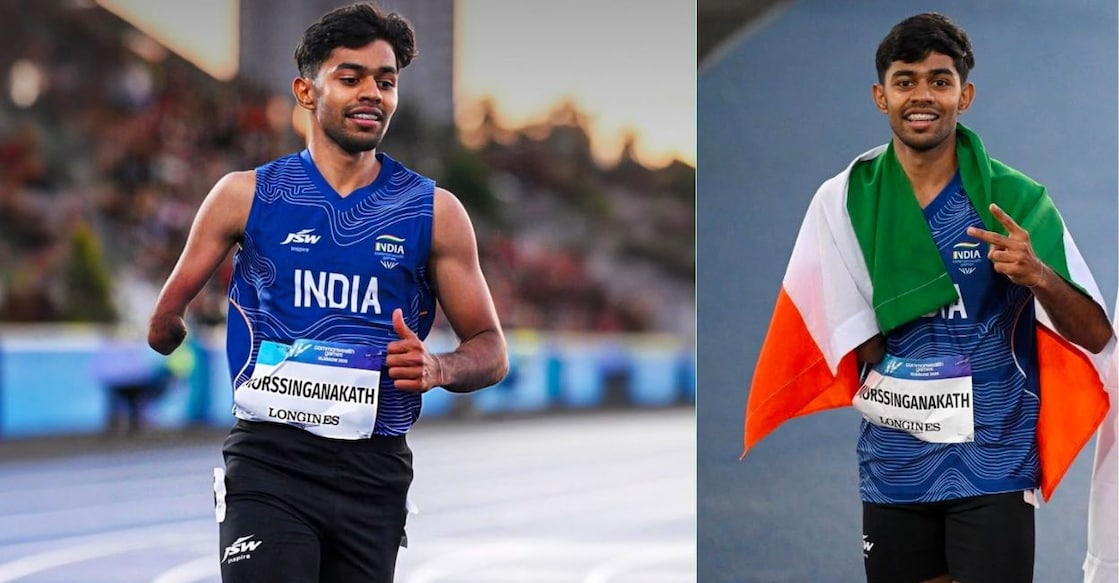
When Mohammed Basil crossed the finish line in the men’s 100m T47 para-athletics final at the Commonwealth Games in Glasgow, celebrations broke out at Kalathingal House, near Pallapram in Ponnani, Malappuram.
Joy, laughter and relief swept through his family home. In Glasgow, however, the 21-year-old was already thinking about how much faster he could have run. Basil, who competes in the T47 category for athletes with an upper-limb impairment, clocked a season-best 10.83 seconds to finish second. His teammate Dilip Mahadu Gavit won gold in 10.71 seconds.
For Basil, the silver marked a breakthrough on the international stage. “It is my first international medal. I am so happy,” he said.
The result nevertheless left him wondering what might have been. His time was well short of his personal best of 10.63 seconds — a performance that would have put him ahead of Gavit in Glasgow.

His childhood coach, Mohammed Anas, was among the first people Basil called after winning the medal. “He called me after the win. I was so happy and we shared our joy. Then he told me that the cold weather in Glasgow had affected his performance,” Anas told Onmanorama. “I also gave it a thought. Yes, had it been his personal best, it could have been gold,” he said.
But Anas, who has watched Basil’s progress from close quarters, believes the silver is only the beginning. Basil’s journey as an athlete began while he was in Class 7 at Umeri English School in Veliancode.
“From Class VII onwards, he became more involved in sports. He was interested in football and started playing the game more,” said Anna T A, the school’s former principal and current vice-principal. It was on the football field that Anas first noticed Basil’s speed. “While playing football, he ran very fast. I noticed it. Then I ensured that he participated in athletics too,” he said.
“Even while chasing the ball, he would leave everyone behind.” Throughout much of his school career, Basil competed against able-bodied athletes. He regularly finished on the podium at CBSE athletics meets and later won gold in the 100m at the CBSE National Athletics Championship in Pune.
After school, he joined the Sports Authority of India centre in Thiruvananthapuram, where he gained greater exposure to para athletics. Basil soon began making his mark on the national circuit. In 2023, he won silver at the National Para Athletics Championship and at another championship organised by the Paralympic Committee of India.
Two years later, the medals turned gold. In 2025, he won the 100m at the Khelo India Para Games and the Indian Open Para Athletics Championship, emerging as one of the country’s fastest T47 sprinters. His path to Glasgow, however, was far from assured.
In the months before the Commonwealth Games, Basil went through a difficult spell. He failed to finish at the World Para Athletics Grand Prix in New Delhi and clocked only 11 seconds at the National Championship, raising concerns about his form.
He recovered at the final Commonwealth Games qualifier in Bengaluru, where he ran a personal best of 10.63 seconds to secure his place in the Indian team. Behind that performance were years of training and considerable financial strain on his family. “Financially, it was a struggle. We did not get much support from anywhere,” recalled his father, K Sirajudheen.
Basil was born without his right hand. His brothers, Sal Sabeel and Mohammed Shamil, have hearing impairments. Throughout his sporting journey, the family remained his strongest source of support.
Sirajudheen said Basil’s teachers, coaches, and neighbours also played an important part in his progress. “He has got a good coach and all the facilities at SAI now. His training is going well and he spends most of his time there,” he said.
For Basil, the silver medal belongs as much to those who supported him as it does to him.
“My family has my father, mother and two brothers and me. They are very supportive. They also suffered a lot every day because of me. Both of my brothers are disabled. It is difficult for our family. This medal is dedicated to my family and my coach,” he said.
Anna remembers initially worrying about Basil when he joined Umeri English School. That feeling quickly disappeared as she watched him participate fully in school life. “When I first saw him after he joined the school, I felt a little sorry for him. But very soon he became just like every other child. He never let his disability define him,” she recalled.
Glasgow gave Basil his first Commonwealth Games medal. His immediate reaction — happiness over the silver, followed by the belief that he could have run faster — showed where his ambition now lies.
