

New skipper and his young India turn setback into comeback on English soil
Mail This Article
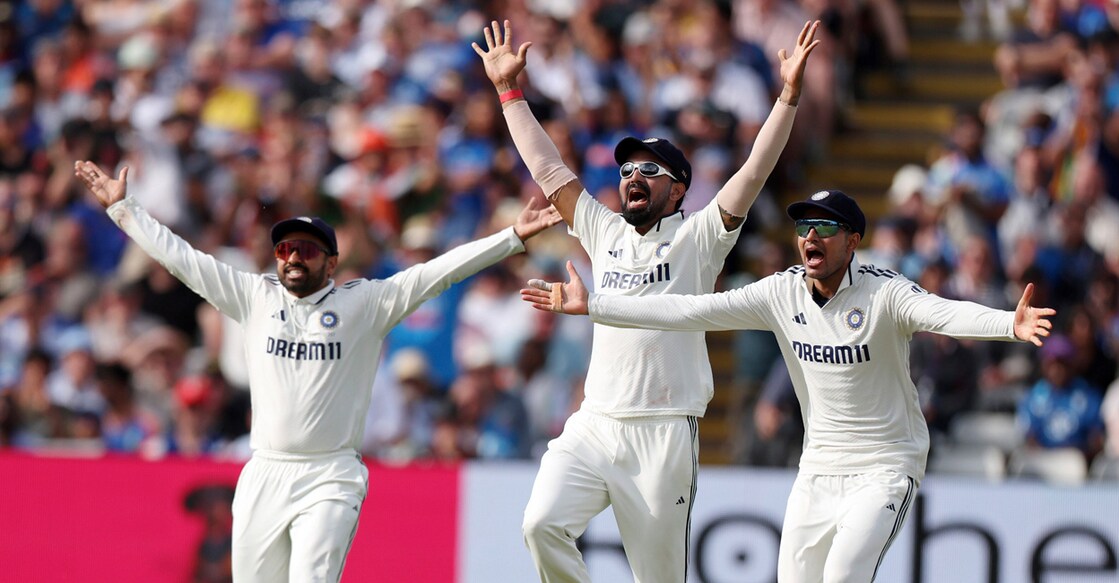
India struck back strongly after losing by five wickets in the first Test of the ongoing series at Headingly, Leeds, to win the second match at Edgbaston, Birmingham by a margin of 336 runs. As in the first Test, the margin of victory did not do justice to the calibre of teams engaged in the contest, nor to their relative strengths and respective performances in these games. With the honours shared evenly after the first two Tests, the rest of the series appears wide open, and any hope that England may have entertained about an easy walkover has vanished completely.
The reasons given -- for the shocking loss in the first Test where India had not only taken a narrow first innings lead but also kept a last innings target of 371 runs -- were shoddy fielding which saw India drop close to 10 catches, lack of sting in the bowling that helped England reach the target by scoring at a rate exceeding 4.5 runs in an over on a last day track and poor batting by the lower order batsmen that resulted in India losing their last six wickets for 24 runs in the first innings and 31 runs in the second.
It was really impressive that India attended to each of these aspects in depth and took corrective action to bounce back in style to clinch a win in the second Test.

It is not in doubt that India dropped too many catches at Leeds, especially in the first innings. Yashasvi Jaiswal was the culprit in chief, dropping four catches, three in the slip-gully cordon and one in the deep. Ravindra Jadeja too exhibited butter fingers, dropping a couple to make it a completely miserable outing on the field. The sad fact was that both Jaiswal and Jadeja possess a reliable pair of hands and can be expected to hold on to a catch 99 times out of 100. But, unfortunately, they both had poor days at Leeds, and England capitalised on their lapses to get out of some tight situations.
When Virat Kohli, Rohit Sharma and Ravichandran Ashwin announced their retirement from Test cricket, one fact that did not attract the attention of most observers was the void left by them in the Indian slip cordon. These three veterans used to man the slip-gully region during their time in Test cricket after Ajinkya Rahane and Cheteshwar Pujara, two of the best fielders in this region, were dropped from the squad. The absence of Kohli, Rohit and Ashwin saw India take the field at Leeds with a brand new set of players in the slip and gully region- KL Rahul, Gill, Jaiswal and Karun Nair. Unfortunately for Jaiswal, he was the unlucky one whose inexperience got exposed.
This brings one to the question of specialisation of fielding positions. Like positions in the batting order, there is an element of expertise when it comes to fielding in positions close to the bat. As Greg Chappell observed pithily, a good slip fielder should not only possess a good catching technique but should also harbour an intense desire for the ball to come his way, besides having a mindset that is active, alert and filled with anticipation. It is neither fair nor proper to shift a player, however fit and athletic he is, to a position in the slip-gully cordon and expect him to catch everything that comes his way from day one onwards. So, one needs to be patient with the present set of fielders in this area till they find their groove.
It should be remembered that India has won a Test series on foreign soil only when they had a good set of fielders in catching positions close to the bat. The victories in 1971 were helped in no small measure by the set of amazing fielders that the side had, comprising Eknath Solkar at forward short leg, Ajit Wadekar at first slip, Venkataraghavan at gully and Abid Ali at leg slip, all of whom were capable of clinging on to even half chances. Similarly, the success during the first two decades of this century had a lot to do with the presence of catchers of the calibre of Rahul Dravid, VVS Laxman, Ajinkya Rahane and Virat Kohli in the slip-gully region.
When it comes to bowling, though Indian bowlers did well to restrict England to a total of 465 in the first innings of the first Test, they were strangely ineffective in the second outing, when Jasprit Bumrah, the lynchpin of the attack, had a rare bad day.
In the recent past, Indian bowling has revolved so much around the persona of Bumrah that there were grave apprehensions about the quality of the bowling when the side was forced to take the field for the second Test without having him in the playing eleven. The million-dollar question was whether India had another strike bowler in their ranks to run through the opposition and win matches.
The name of Mohammed Siraj was the one that came to mind immediately, as he had shown on many occasions that he was capable of bowling match-winning spells. However, these were too infrequent and he had been looking too jaded of late, probably on account of playing in all formats of the game, with very little break in between. But he rose to the occasion and came up with a splendid performance, taking six wickets in the first innings at Edgbaston. But the real surprise package was Akash Deep, who bowled with incision and venom on his first appearance in a Test in England to pick up 10 wickets. To be fair, he had not disappointed in the few opportunities he had got in the past. The spell he bowled in the second innings when he had the England top order in tangles, was nothing short of outstanding and showcased his potential to develop into a match-winning bowler. Siraj and Akash carried forward the torch and proved that India can win Test matches even without Bumrah in the side.
History tells us that India have won Test matches abroad only when there were good strike bowlers in the side. It was the magic of Chandrasekhar that won us the series in 1971, while Kapil Dev led from the front in 1986. Zaheer Khan and Sreesanth had teamed up well during the success in England in 2007, while Bumrah and Siraj were the heroes of the win over Australia in 2020-21. Hence, team management will do well to look at the prospect of playing Kuldeep Yadav, whose unorthodox left-arm spin can bamboozle even the best of batsmen on any wicket, rather than packing the side with all-rounders.
On the batting front, skipper Gill took the responsibility on his capable shoulders to ensure that India had enough runs on board to deny England any chances of a win. It was a humungous effort from the captain, who broke innumerable records as he followed his double hundred in the first innings with a century in his second. He has also effortlessly moved into the crucial No. 4 position in the order, from where he can anchor the side’s innings, like Sachin Tendulkar and Virat Kohli in the past. While lauding Gill for his splendid efforts, one should not forget the knocks played by Jaiswal and Jadeja in the first innings and Rahul, Rishabh Pant and Jadeja in the second. The fact that all the top and middle order batsmen are in top form should bring a smile on the face of the team management, who do not possess the luxury of having sufficient bench strength in this area, and also force a rethink of the prevailing strategy of giving priority to all rounders while choosing the playing eleven.
India can look back with plenty of satisfaction and pride after the second Test for the manner in which the side bounced back after the defeat in the first game. This new look team under the young captain has shown the gumption and fortitude to take setbacks in their stride and stage a comeback in the shortest time possible. This positive outlook and fighting spirit augur well for Indian cricket.
Congratulations to skipper Shubman Gill and his side for a brilliant win! You have done the nation proud!
 Add as a preferred source on Google