

A throne of his own making: Gambhir wanted to be above captain. Now, face the brickbats
Mail This Article


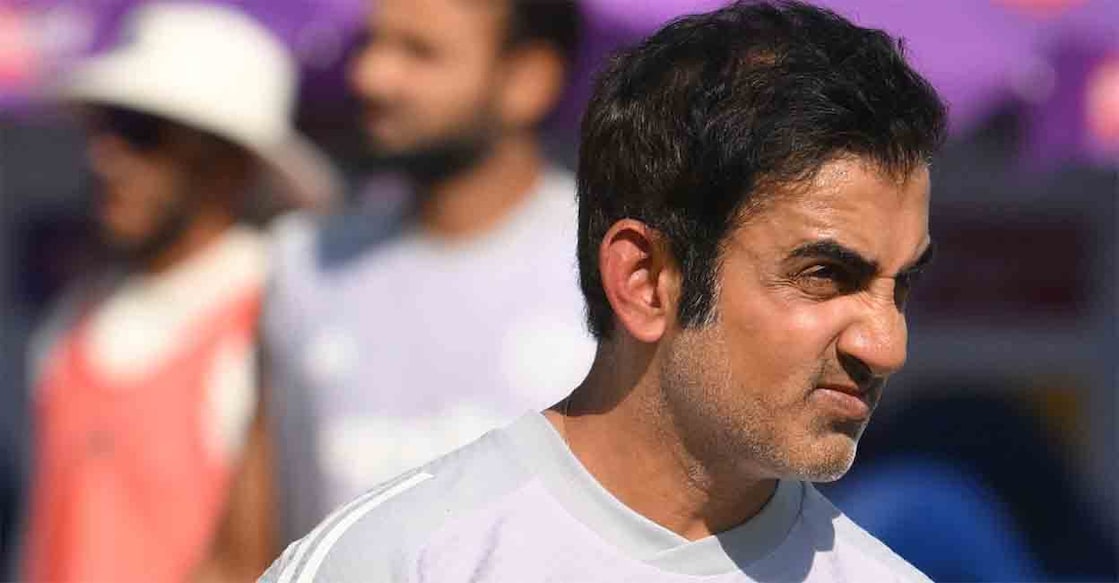
A few days ago, a prominent Parliamentarian from Kerala claimed that the person who had the “hardest job” in the country after the Prime Minister was Gautam Gambhir, the chief coach of the national men's cricket side.
Gambhir, on his part, thanked the MP through a post on X (formerly Twitter). But he also stated that “when the dust settles, truth and logic about a coach’s supposedly 'unlimited authority' will become clear; till then I am amused about being pitted against my own, who are the very best”.
This exchange raised a few eyebrows and led to discussion in the social and print media about the powers of a coach and whether Gambhir's current frustrations came to the fore through these words.
It was the eminent historian and sociologist Ramachandra Guha who once famously said that the position of the captain of the Indian cricket team was second only to that of the Prime Minister of the country, judging not only by the importance and power it bestowed on the individual but also on account of the hopes that he carried on his shoulders while donning this role.
Guha made that observation in the 1980s, before the advent of satellite TV and the sale of advertising rights for the game, which catapulted the Board of Control for Cricket in India (BCCI) into an uber-rich organisation and turned cricketers into millionaires.
The influx of corporate money into this sport through the Indian Premier League (IPL) added more glitz and glamour to players, turning them into icons and overtaking even Bollywood heroes in terms of popularity and fan following.
As time went by, the importance of the skipper of the national team grew by leaps and bounds. During the last century, Board officials and the national selectors took it upon themselves to establish a system of checks and balances, preventing the captain from arrogating too much power to himself.
However, the environment changed once Sourav Ganguly took over the reins in 2000. Ganguly’s reign at the helm coincided with the rise of Jagmohan Dalmiya as the all-powerful administrator of Indian cricket.
Dalmiya’s unstinting support for Ganguly ensured that the latter faced no obstacles in any matter, including team selection. This was the first time in the history of Indian cricket that a captain could ride roughshod over selectors and groundsmen and get the players of his choice in the side and wickets of his preference to play on.
To be fair to Ganguly, he moulded the side into a fighting unit and motivated the team to demonstrate ruthlessness and killer instinct, traits that had hitherto been absent. But he also rubbed plenty of powerful people the wrong way during his days at the top. Not surprisingly, Ganguly was eased out of captaincy once Dalmiya ceded power to the rival faction in the BCCI.
Mahendra Singh Dhoni took over the captaincy of the national team after short tenures in this post by Rahul Dravid and Anil Kumble. During his stint, he developed a close friendship with Srinivasan, who had by then established himself as the top honcho of the BCCI.
Dhoni led the side to title triumphs in the ICC T20 World Cup in 2007, the World Cup in 2011 and the Champions Trophy in 2013, besides taking the Test side to the pole position for the first time ever in 2009-10. Dhoni’s stature as a player and captain and his close rapport with Srinivasan vested him with an aura that few dared to challenge. And those foolish enough to attempt this landed with egg on their faces, as Mohinder Amarnath discovered to his consternation.
Virat Kohli, who succeeded Dhoni, was not merely a superstar but also a forceful and demanding captain. He was fortunate that, for a long period coinciding with his captaincy, the BCCI was rudderless due to falling foul of the Supreme Court's directions on organisational restructuring.
He was required only to handle the committee appointed by the Court, or most often its chairman, a former bureaucrat, who was only too keen oblige the demands of the skipper. Kohli found his powers slipping away once elected officials of the BCCI returned, and he chose to step aside gracefully rather than fight a battle against heavy odds.
By the time Rohit Sharma took over as captain, the power structure within BCCI had changed drastically and more importantly, it was closely aligned to the top leadership of the ruling political party in Delhi. He chose to keep his focus solely on the game, which helped him achieve good results on the field. This, together with the support of former cricketers and media from Mumbai, helped him have a smooth stint for most of his tenure.
Shubman Gill, currently the captain of Test and One-Day Internationals (ODIs), is too new to the job and is just finding his feet. Suryakumar Yadav (SKY), the T20 skipper, is a single-format player, which limits his rise in the hierarchy. Besides, given his age, he is seen as only a short-term option and bound to be replaced sooner than later.
India were rather late in appointing a full-time professional coach to help the national side. Prior to 2000, the norm was to appoint former players, considered close to the establishment, as coaches for a year. It did not matter that many of them lacked qualifications or expertise to take on this mantle, except for their record as cricketers, which was often average, and their proximity to the decision-makers in the BCCI power structure.
It was during Ganguly’s tenure as captain that India experimented with having a full-time professional coach for the national side. John Wright, the former New Zealand batsman selected for this role, struck an excellent rapport with Ganguly, which helped the side improve its performance substantially.
Greg Chappell, who succeeded Wright, had a much-publicised spat with Ganguly. The coach won the round, more because Ganguly’s fortunes were on a nosedive after Dalmiya was dethroned in the BCCI. But Chappell got the boot when India lost in the first round of the 2007 ICC World Cup. Gary Kirsten and Duncan Fletcher, who followed him, more or less kept to themselves, focusing solely on the job, avoiding all controversies, and minimising interactions with the media.
It was with the arrival of Anil Kumble as the chief coach that the debate of relations between coach and captain resurfaced. Kumble was a former captain himself and a world record holder to boot; so it was only natural that he expected a level of importance at par with the skipper, which Kohli was not prepared to accommodate. The clash between the captain and the coach ended with the latter being told to pack up and leave.
Ravi Shastri and Rahul Dravid, who came after Kumble, were the iconic figures in Indian cricket in their own right, but they allowed Kohli and Rohit, the captains they dealt with respectively, to hog the limelight. In fact, the relationship between Rohit and Dravid comes close to being the ideal one between a coach and a captain. The classic example was the way they shared responsibilities among themselves: when India lost the 2023 World Cup finals, Dravid met the press, while Rohit took the spotlight after the side won the 2024 T20 World Cup.
Gambhir took up the mantle after Dravid and lost no time in establishing himself as the numero uno of the side. As a member of the World Cup-winning squads of 2007 and 2011 and coach of the title-winning Kolkata Knight Riders (KKR) side in the Indian Premier League (IPL), he brought his own sense of self-importance, bolstered by a stint as a Member of Parliament for the ruling party. It cannot be denied that he used the media advisor of the side to project his image as a coach who was the fulcrum around which the team functioned, thus attempting to usurp this position from the captain.
Kohli and Rohit, the senior pros, stepped aside when this started happening, while the younger ones, who needed the coach for survival, chose to keep quiet. But this did not go unnoticed by the media, and soon knives began sharpening against him. The repeated defeats in Tests and ODIs have pinned Gambhir down on the back foot even more.
At present, he is feeling intense pressure in the hot seat, and his frustrations are becoming apparent to the outside world. The ICC T20 World Cup will be crucial for him, as a poor performance in this tournament will make it almost impossible for him to continue in this role.
Gambhir should be aware, from his experiences on the cricket field and in politics, that there is nothing as unfettered as authority in any walk of life. Power comes with responsibilities, and in a cricket crazy country like India, the person in charge of the national side will find himself at the butt of criticism whenever things go wrong. It was Gambhir who sought to give the post of chief coach a higher profile than the captain, and hence, he must face the brickbats that come with this position. The buck stops with him, and no amount of griping can change that or help win sympathy from the followers of the game.
The earlier-mentioned MP's gesture of lending an arm in support and motivation for the beleaguered chief coach may not have found universal appreciation, nor does it have the unqualified backing from the fans. Gambhir did not walk blindly into this role; he grabbed it eagerly with both hands. Hence, it is up to him to deliver; else, he should be prepared to face the fate that befalls those found unworthy of holding high positions.
 Add as a preferred source on Google