

Tales of last men standing and an 80-year-old world record

Mail This Article


The most frustrating experience for a fielding side in cricket is the sight of the last wicket pair staying at the crease for long and putting on a big partnership. The bowlers who have toiled hard and dismissed nine batsmen invariably think that it is only a matter of time before the last wicket falls. When this does not happen, they become increasingly annoyed and upset, leading to lapses in line and length, which are feasted upon by the willow-wielders at the wicket. The irritation spreads to fielders also, with misfielding and dropped catches contributing towards creating a visible disarray. At this juncture, one needs a skipper who keeps his cool and implores his team to stay calm. But it often happens that an impatient captain adds to the confusion with a show of anger or a stupid decision, which pulls the side down even further. And before long, the fielding side gets the sickening feel that the game has slipped out of their hands!
The impact of big batting partnerships in the lower order is not limited to the total score of the batting side alone. Sunil Gavaskar had, in his book “Runs n Ruins”, written that opening batsmen of the fielding side start the process of moving into their “groove” when the 7th or 8th wicket falls, so that by the time the last batsman is dismissed, they would be in a proper frame of mind to face the bowlers after the short 10-minute interval between innings. Hence, a long last-wicket partnership will leave behind a negative effect on the response of the fielding side when their turn comes to bat.
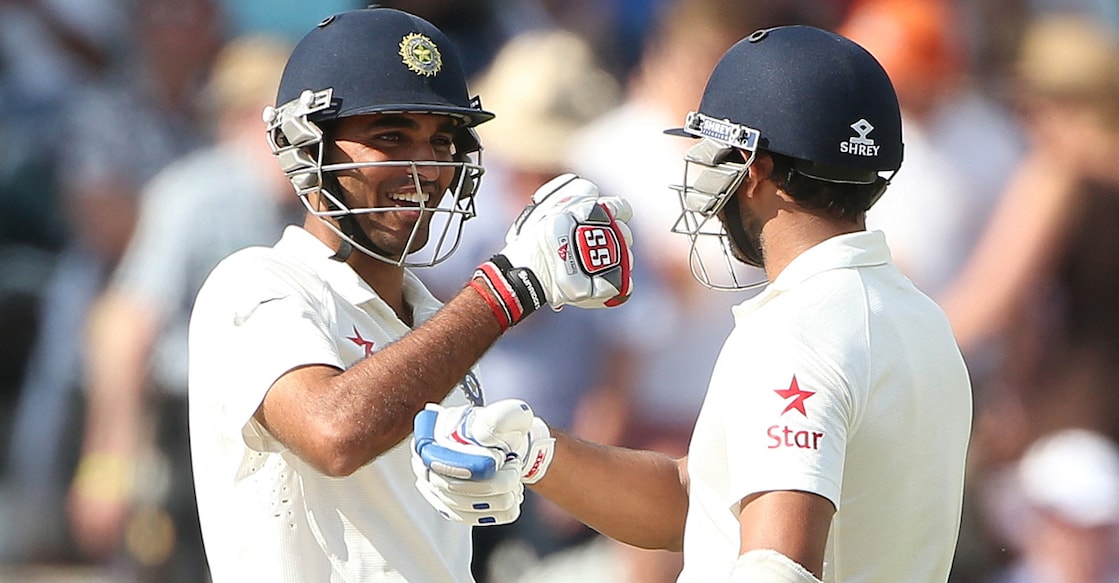
There have been numerous last-wicket partnerships exceeding 100 runs in the history of Test cricket, with the biggest one scored by England against India at Nottingham in 2014, when Joe Root and James Anderson put on 198 runs. This allowed England to escape from a precarious position when they were 298 for 9 wickets, in response to India’s first innings score of 457 runs. Incidentally, India’s last-wicket pair of Bhuvneshwar Kumar and Mohammed Shami had put on 111 runs. Thus, this Test match stands out as one where the last wicket pair of both sides were involved in a partnership exceeding 100 runs.
There have been a few occasions when the final wicket settles down to a good partnership in the last innings of the match and takes their side to a victory. Each one of such instances, where a team won the Test by one wicket, produced edge-of-the-seat excitement for the spectators.
The highest partnership for the last wicket that won a Test match took place at Durban in 2019 when Sri Lanka humbled South Africa. Chasing a last innings target of 304 runs, Sri Lanka was on the brink of losing the match when their ninth wicket fell with the total at 226. But Kusal Perera had other ideas. He had top-scored for the visitors in the first innings with a pugnacious knock of 53 and was unbeaten on 86 when last man Vishwa Fernando joined him. Perera kept his cool and took on the South African bowlers singlehandedly as he scored 67 out of the 78 runs that were required to take his side past the winning post. Perera was in such good form with the bat that none of the members of the famed South African attack, comprising Dale Steyn, Vernon Philander, Kagiso Rabada and Keshav Maharaj, could make much of an impression on him. Stress levels went up by several notches on the ground as Sri Lanka inched towards the target, but the pair held their nerve and scripted a memorable win for their side.

Test matches played between England and Australia for the “Ashes” generate more excitement than others, and hence these games inspire players to attain cricketing immortality through superhuman performances. The 2019 Ashes series will go down in history as one of the most tightly contested ones ever. England was playing at home, fresh from a successful campaign that saw them win the International Cricket Council (ICC) World Cup for the first time. After Australia won the first Test of the series, England held the visitors to a draw in the next one. Thus, the series was evenly poised when the third Test started at Leeds on August 22.
England appeared to have gained the upper hand when they dismissed Australia for a paltry total of 179 runs after putting them into bat on winning the toss. But the visitors struck back quickly to skittle out the hosts for just 67 and thus regained the advantage. Australia consolidated their position by posting a score of 246 in their second knock, thus setting a final innings target of 360. England recovered after a poor start to reach 141 for 2 wickets, after which wickets fell at regular intervals, to leave them tottering at 286 for nine wickets when Jack Leach, placed at No. 11 in the order, joined Ben Stokes, who was batting on 61. From this point onwards, Stokes simply decimated the Aussies, as he went on the rampage, scoring 74 runs off 45 balls, which included seven sixers and four boundaries, while Leach managed to survive 17 balls, scoring just a single. Aussie bowlers wilted under this marauding display as England recorded a surprise win.
Australia was at the losing end in one more Test on account of the last wicket pair putting on a half-century stand in the final innings. This took place at Karachi in 1999, where the Pakistani last wicket pair of Inzamam-ul-Haq and Mushtaq Ahmed put on 57 runs to help their side reach the target of 314. This match gained notoriety later on as the one where the Pakistani skipper Saleem Malik approached Shane Warne, offering money for losing the match. Warne not only refused the offer but also bowled brilliantly on the last day, picking up 5 wickets as Pakistan was pushed to the brink of defeat, with the scoreboard reading 258 for 9. As Inzamam and Mushtaq steadily brought down the target, Warne adopted the strategy of leaving the midwicket region open to lure the batsman into trying to hit through this area. Inzamam finally took the bait and stepped out only to find the bat missing the ball by a mile. But, as luck would have it, the ball kept low and went past wicket keeper Ian Healy also and raced to the fence for four byes, thus bringing up victory for Pakistan!
There have also been instances where the last wicket stand brought a side very close to a win but could not seal it. West Indies set Australia a last innings target of 185 runs in the first Test of the series at Adelaide in 1993. They were 43 runs away when Tim May and Craig McDermott came together. They added 42 runs when McDermott, who had scored 20 runs, was dismissed caught by wicket keeper Junior Murray off the bowling of Courtney Walsh, thus leaving the visitors winners by a margin of one run.
Australia were at the losing end against England at Birmingham in 2005, when, despite a last wicket stand of 59 runs in the final innings, they were defeated by a margin of 2 runs. This was a close repeat of the proceedings when the two sides met at Melbourne in 1983. On that occasion, Australia were 220 for 9 wickets chasing a target of 292. Allan Border and Jeff Thomson added 68 runs for the last wicket but just when victory appeared on the horizon, Botham got Thomson to edge a delivery, which bounced off the hands of Chris Tavare but was held by Geoff Miller to seal a 3-run win for England.

It is indisputable that all these matches will go down in cricket history for the intensity of the contest and the excitement that lasted till the final delivery. The players who were part of these Tests would retain memories of those moments for the rest of their lives. The bowlers who toiled for the last wicket, the batsmen who held their nerve and the fielders who had to keep their focus despite the rising stress levels would all have their own story to tell. Thomson had gone on record that he behaved in an abominable manner following the defeat, which prompted an apology from him at a later date.
India, too, figures in the list of countries that have won Test matches by one wicket. This took place against Australia (who else?!) at Mohali in October 2010. Chasing a target of 216 in the last innings, India was reduced to 124 for 8 wickets before VVS Laxman and Ishant Sharma came together and added 81 runs for the ninth wicket. However, Ishant was dismissed for 24 with the total at 205 when Pragyan Ojha joined Laxman, who was waging a heroic struggle despite being bogged down by a back injury. The pair survived some tense moments including a close call for run out before the winning runs were scored. The tension on the ground was so great that even the normally unflappable Laxman lost his cool and let out a curse when Ojha came close to being run out! But in the end, the pair held firm and saw the side home.
The world record for the biggest last wicket stand in first-class cricket is held by the Indian pair of Chandu Sarwate and Shute Banerjee, who put on 249 runs against Surrey in 1946. Sarwate, batting at No. 10 remained unbeaten with 124, while Banerjee scored 121. This is also the only instance of both No.10 and 11 batsmen scoring centuries in first-class cricket. Incidentally, the Surrey attack was no pass over, as they had in their ranks such eminent bowlers as Alec and Eric Bedser and Alf Gover. India went on to win this match by 9 wickets, which remains one of the few bright spots on this otherwise disappointing tour.
The week that went by saw the 80th anniversary of the world record set by Sarwate and Banerjee at Kensington Oval in 1946. It is a rare phenomenon for records to remain intact for eight decades in any sport in the international arena. Hence, one can take pride in the efforts of these two veterans of the past, which retain their place in the record books to date.
 Add as a preferred source on Google