

Malarikkal: All you need to know about Kerala's water lily village
Mail This Article


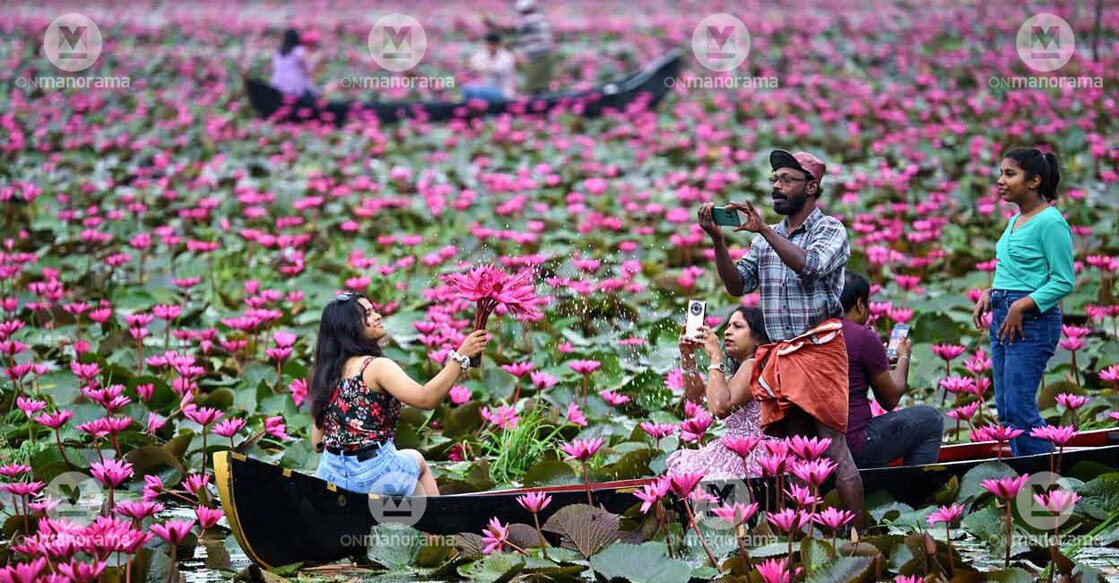
The beautiful village of Tiruvarppu in Kottayam district wakes up to the mantras and chanting from the famous Sree Krishna Temple, which opens its doors at 2 am. This temple is indeed the first to open in India every day. Now, the scintillating water lilies at Malarikkal in Thiruvarppu panchayat also lure visitors to the village early in the morning. They begin to swarm Malarikkal from 5.30 am onwards to witness the enchanting beauty of the water lilies against the golden rays of the morning sun. The quaint village comes alive with boatmen, flower vendors, and tea stalls ready to welcome the visitors.
The season
The water lily season that begins in August has now arrived early, bringing joy to the hamlet. Water lily rhizomes were sown at the Tiruvaykkari paddy fields after the reaping season ended quickly. People have already started coming to Thiruvaykkari to enjoy the mesmerising beauty of the water lilies.
Currently, there are 100 boats at Malarikkal to take the visitors into the blooming fields. Meanwhile, women are seen selling bundles of water lilies on the wayside. They collect water lilies the previous evening to sell them fresh in the morning.
Water lilies of Malarikkal
Water lilies bloom mainly at J Block 9000, the largest paddy field in the district that sprawls over 1800 acres and at Tiruvaykkari, which sprawls over 850 acres. From Kanjiramkavala, the visitors could first reach J Block 9000; Tiruvaykkari is just a few kilometres from here.

Blooming stories
Pallikonam Rajeev, general secretary of the local history research samiti, says that the village got its name from the 'malari' phenomenon that is formed in waterbodies. Malari and chuzhi(whirlpool or vortex) are two phenomena that are seen on the surface of water during strong currents. A vortex happens when the water from the surface is pulled downward with extreme force. Meanwhile, malari forms when the water on the surface is pushed outward by the strong currents under water. Malari is spotted when the water from the river flows into the backwater with a strong force. In the olden days, huge malari were formed during the monsoon where Meenachil River joins with Kodurar River. People who travelled in boats saw this phenomenon and called those spots Malarikkal.
Thiruvaykkari and Valiaveetil temple
Thiruvaykkari paddy fields were the farmland owned by the Poonjar royal family. The paddy fields likely got their name from being a patch of land at Vaymukham where the Meenachil River and Kodurar converge to form the backwater. However, some say that the paddy fields were called Tiruvaykkari as the grains for the royal kitchen were cultivated there. Pazhukkanila, which is part of the Vembanad Lake, is on the southern side of the Thiruvaykkari fields. The border of these fields is known as Irambam. In the centre of the fields, before you reach Irambam, there is a small patch of land with rows of palm trees as well as a Devi temple, popularly known as Valiveetilamma. Puja is offered at this temple only on the first day of the Malayalam months and on the day of Atham.
Malarikkal Fort
Vembanad Lake forms the border from Kainady to Kaipuzhamuttu on the western side of Thekkumkooru. Malarikkal Fort was an important strategic point at the border of this area that is full of lakes, rivers and paddy fields. The Tekkumkoor king likely built this fort to provide protection while moving cargo through the lakes and to monitor enemy movements.
The forts in the border areas were significant structures, as the neighbouring provinces of Kayamkulam, Chembakassery, Muttam, Vadakkumkoor, and Kochi also enjoyed transportation rights through the lakes. In September 1749, the Travancore Army led by Ramayyan Dalawa and Eustachius De Lannoy attacked the Thekkumkoor army at Pallam and Malarikkal. Ramayyan Dalawa and his troupe captured more than 35 vadakkanodi boats owned by the Thekkumkoor army. Both sides had suffered heavy losses in this war. Historians assume that the Malarikkal fort must have been destroyed in this war.
Mesmerising water lilies
Water lilies belonging to the Nymphaeaceae family are often considered one of the most beautiful and serene flowers in nature, floating gently on the surface. They bloom in a variety of colours, adding a vibrant contrast to the green leaves and dark water. The roots and stems of the water lily sprout from the rhizomes that are buried deep in the muddy water. Water lilies are considered an eternal plant, as their rhizomes are not easily destroyed or damaged. These mesmerising flowers play a pivotal role in protecting the ecosystem of a multitude of aquatic plants and organisms.
Water lilies can regulate the temperature of the water bodies during summer. They can block the harsh sun rays and prevent the proliferation of water moss to a certain extent. Besides, fish often lay eggs on the velvety leaves of the water lilies. Moreover, they are also part of the natural habitats of dragonflies and frogs.
Here’s how to reach Malarikkal
Kottayam – Malarikkal: 9 kilometres; Kottayam – Kanjiramkavala – Malarikkal
Kumarakam – Malarikkal: 10 kilometres; Kumarakam – Illickal – Kanjiramkavala – Malarikkal

Vaikom – Malarikkal: 28 kilometres; Vaikom – Kumarakam – Illickal – Kanjiramkavala – Malarikkal
Pala – Malarikkal: 35 kilometres; Pala – Kottayam – Illickal – Kanjiramkavala - Malarikkal
 Add as a preferred source on Google