

Rare forest fruit from Western Ghats grows in Kerala farmer's house, draws visitors
Mail This Article


Kerala's rare wild fruit, moottippazham, which many in yesteryear generations were familiar with, is making a comeback of sorts across the state. After social media reinvented it with its exotic 'jaboticaba-lookalike' factor, many have been travelling to various parts of Kerala where it grows in forests. Now, a farmer in Vazhakulam near Ernakulam has successfully cultivated it on his farm!
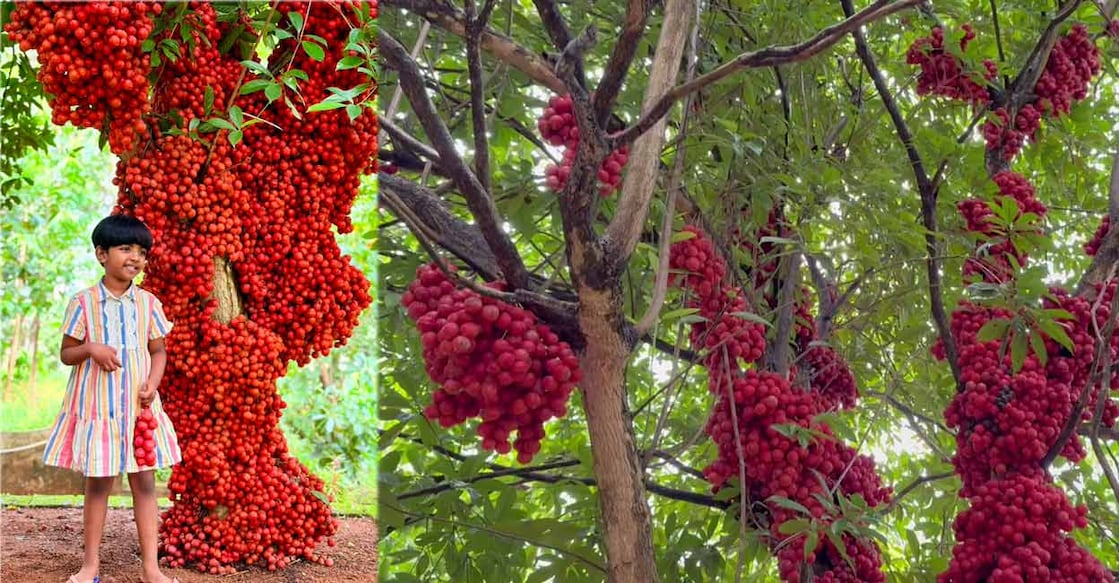
PJ Mathew, a resident of Avoly near Vazhakulam, has successfully cultivated moottippazham (scientifically known as Baccaurea courtallensis) on his homestead, turning it into a local attraction. Visitors are flocking to his property to witness the spectacular sight of two trees with trunks blanketed with vibrant clusters of crimson-red fruits.
Mathew's son Titto says, "The saplings of the tree were brought to our place around 15 years ago from Vannappuram, my mom's place. For the past few years, the tree has been bearing fruit without the aril. My dad felt it might be because moottippazham is dioecious (trees that require the male and female individual plants to bear fruit) and sourced a male tree as well." Once they planted it, the fruits began growing well. "The trees yielded their finest fruits this year," Titto explains. The tree generally bears fruits in the monsoon season.

A rare forest treasure on home soil
Moottippazham, sometimes called moottippuli, is traditionally found deep in the forest ecosystems of southwestern India. It is highly sought after for its unique flavour profile—a pleasant blend of sweet, sour, and mildly astringent notes. The fruit itself is about the size of an Indian gooseberry, boasting a brownish-red outer skin that encases a juicy, translucent pulp. Beyond its exotic appeal, the fruit is regarded as a powerhouse of Vitamin C and traditional health benefits, believed to help regulate body temperature, improve digestion, and purify the blood.

Culinary uses and wildlife appeal
While the sweet and sour pulp is typically eaten fresh, the versatile outer rind is also highly valued. It is commonly utilised to make tangy pickles, homemade wines, and refreshing juices. In the wild, the fruit is a crucial food source for forest wildlife, particularly monkeys, deer, and bears, who feast on them during the season. Cultivating this tree requires minimal intervention, as it naturally thrives with very little maintenance once established.
A visual spectacle and lucrative market
The peak season for moottippazham runs from June to September. The fruiting process begins with coffee-coloured flowers blooming directly on the main trunk and lower branches. As they ripen, they transform into dense, glowing red clusters that look almost like decorative fairy lights draped around the tree trunk. With exotic fruits gaining massive popularity among health enthusiasts, moottipazham currently commands a premium price in the market, fetching up to ₹650 per kg.
How to reach
To reach Mathew's homestead, take this route:
Muvattupuzha - Thodupuzha - Old Avoly Road. Their house is located on a slope near the Panchayat Office here. The trees are in their home compound, and therefore, visit responsibly between 9 am and 5 pm.
Phone: 9388448211 (PJ Mathew)
 Add as a preferred source on Google