

'Onattukara Kalakettu' on September 23: Why not miss the festival of bull effigies
Mail This Article


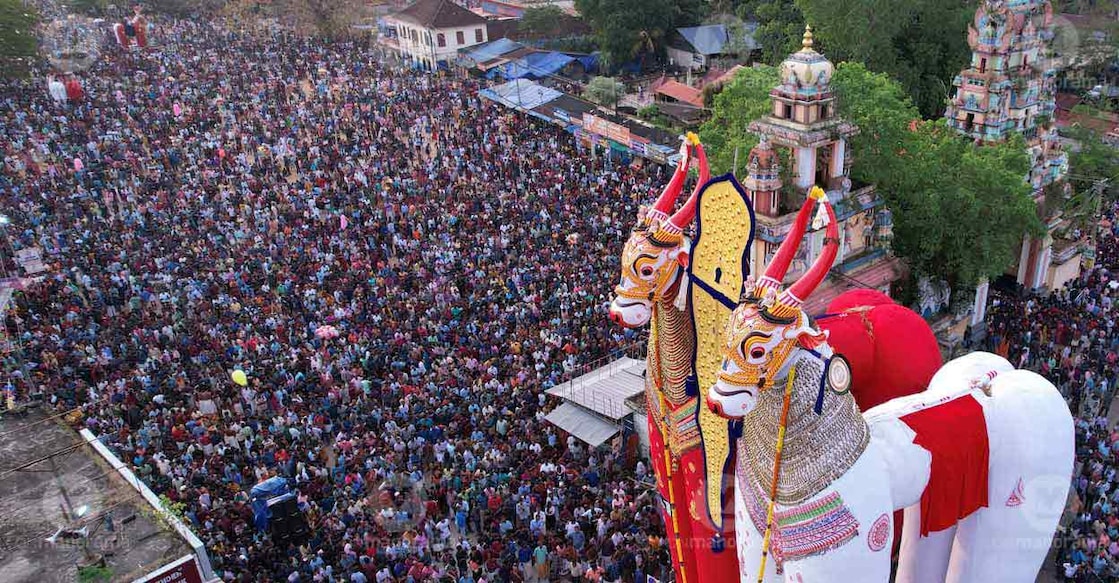
Featuring tiny kettukalas (bull effigies) small enough to sit on a grain of rice or a palm, to towering structures rising 80 feet, preparations for the Kalakettu festival, held at the Ochira Parabrahma Temple of Kollam, are in full swing. Devotees across 52 villages aka karas of the Onattukara region (border of Alappuzha and Kollam), are putting together the decorated bulls that will adorn the festival this year. Are you keen to attend it this time? Here's what you should know:
What is the kalakettu festival?
The Parabrahma Temple in Ochira follows a non-idol worship pattern. Its popular festival is the 'Ochira Kalakettu,' during which effigies of Lord Shiva's vehicle - Nandi (the bull), are showcased in pairs. This is why the effigies are called 'kettu kaalakal.' The pageantry of bulls in colourful temple cars, in red and white colours, along with drum music, creates a unique atmosphere at the temple. The festival will feature around 250 bull effigies from the 52 karas. Lakhs of people are expected to gather at Ochira for the event.
What is special about the Onattukara region?
Spread across the Karunagappally, Karthikappally and Mavelikkara taluks, Onattukara was traditionally an agrarian region, with farming at the heart of its life. The region is believed to have derived its name from 'Onam oottum kara', meaning the land that serves the Onam feast, which later came to be known as Onattukara.

When is the kalakettu festival held?
The festival will be held on Wednesday, September 23 this year. As of now, the bodies of most bull effigies are ready at their workshops, with workers now completing the heads, caparisons and other decorative elements. Workers expect to fit the heads by September 20, completing the structures. Once the final touches are done, the bull effigies will leave the workshops and take to the roads of Onattukara, beginning their journey to Ochira for the September 23 procession.
The festival season begins with the 28th day of Onam in the Malayalam month of Kanni and concludes with Ochirakkali in Mithunam. For the people of Onattukara, the agricultural calendar is marked by three Onam celebrations and a Makam festival. Pilleronam in Karkidakam, Thiruvonam in Chingam and the 28th Onam in Kanni are the three Onam celebrations.
The 'agriculture' connection
The 28th Onam is traditionally associated with cattle, which played a vital role in agricultural activities. Kettukazhcha is believed to have evolved from this agrarian tradition. The festival also reflects the traditional belief that the animals that helped farmers cultivate their land should be protected and honoured. Farmers would visit the Parabrahma temple before cultivation and after the harvest to offer kanikka (contributions) at the shrine.
After the harvest, farmers would bathe their cattle, adorn them with koovalam garlands, apply vermilion and sandalwood paste and feed them sweets before taking them in procession around the temple. Later in the evening, bull effigies made of wood and hay, draped in red and white silk, would be carried to the temple to the accompaniment of traditional percussion. Over time, the ritual evolved into the Kettukazhcha celebrated today.
Kalakettu workshops
The workshops for building these effigies, locally known as Kaalamoodu, are already alive with activities round the clock. Frames are being dressed, heads shaped, and decorative elements fixed as each kara puts the finishing touches to its creation. Every kettukala carries the identity of the village that builds it, with its design and scale reflecting local traditions and craftsmanship.
What to expect this year?
This year's line-up includes 13 newly built giant kettukalas, including Yuvamanthra of Changankulangara, Asuradhipathi Kalakeyan of Parayinathumukku, Shivaswaroopan of Muttathumannel, and Thrikannan of Govindamuttam.
Several familiar giants will also return to Ochira, including Kaala Bhairavan, Onattukathiravan, Raudrabrahma Rishabhan, Thirumukhavedan, Akhora Rudranethran, Prayar Vadakkekara Sivapriyan, Kinarumukku Komban, Brahmatejomukhan, Changankulangara Kara, Memana, Vayanakam and Puthuppally Thekku. Kettukalas built by as many as 25 women-led committees will also join the procession this time.
Villages gear up
Roads along the procession routes are being cleared of trees and other obstacles to make way for the giant structures. Power lines and other structures that could obstruct their movement are also being shifted. Community feasts, serving everything from kanji (porridge) to payasam, have begun at several locations. Some villages have also launched Sivapurana and Bhagavatha recitals, besides organising gatherings and discourses. Performances of traditional and folk arts are also adding to the activity at these locations.
How a kettukala takes shape
The head is the most distinctive feature of a kettukala, crafted from woods such as ezhilam pala (blackboard tree), uravu (large-flowered bay tree) and kummil (white teak). Traditionally, only five colours: white, black, red, yellow and green are used in its decoration.
The structure blends precise measurements with skilled craftsmanship. Anjili (wild jack) wood forms the frame and body, while straw is packed into the body to give it the desired form and volume. Other key components include the nettipattam (caparison), muthukudakal (decorative umbrellas), silk embellishments, kuttikol, Mittuvallazhi, Vallazhi Ulavuppadai, kaal, maruthukol, pallakol, naazhi, kazhathukol, pallamurith, ngapalaka and karnakkol.
Food, faith and togetherness
The festive season also reflects the spirit of communal harmony and collective participation across Onattukara. In each village, people cutting across caste and religion come together at the Kaalamoodu to build the bull effigies, turning the traditional preparations into a shared community celebration.
Food service begins on the day construction of the bull effigies starts and continues through the festival preparations. The fare largely consists of traditional dishes such as porridge, muthira (horse gram) puzhukku, pickle and padam, prepared with crops cultivated in the Onattukara region.
The practice of sharing food is rooted in the belief of Annam Brahmam, which regards food as sacred. In the evenings, several villages also organise puzhukku distribution, feasts with payasam and Uthradam feasts, bringing people together around the Kaalamoodu as the festival draws closer.
