

A mysterious Nagaland village that once fancied headhunting
Mail This Article


Who doesn’t fall for the bucolic settings of a village with a dash of mystery? The quaint hamlet of Sheanghah Chingnyu, tucked away in the India-Myanmar border district of Mon in Nagaland, is such a hidden gem. Riddled with history, intrigue and, of course, the pristine beauty of nature, this English-speaking village has enough mystery and stories to fascinate travellers. That said, travelling to the village is not an absolute breeze.
A muddy path will greet you as you reach 20km away from the border village of Longwa. A 60-minute travel through the path covered in sticky earth will take you to Sheanghah Chingnyu. If it’s raining, travellers will have to park their car at a suitable spot and hail a two-wheeler to ride through the unpaved road. They will have to be prepared to get off the two-wheeler and walk, as potholes can form large craters at certain stretches. The ride can never be comfortable, as the risk of the two-wheeler rider losing balance is high.
You would be surprised to see a bus stop with a roof made from coconut leaves. One may wonder why a bus shelter is on this stretch, since no buses ply on the route. But this modest structure is in place for some other reason. The wayside shelter has a large log of wood with a long, deep hole at its top, which serves as a gong. In the past, people used this gong to alert others that a hunting spree was over. A wooden mallet could also be found near the log of wood. Different tribes of the region depend on special songs to make the requisite declaration. The Konyak tribe has a great influence in Mon district.

Hunting spree
While traversing the muddy pathway, you may find people clad in casual dresses carrying something like logs of wood on their shoulders. As a matter of fact, you might be surprised to know that they are not carrying logs of wood but guns. But the gun-carrying passersby would be least interested in you, as their focus is on the nearby forests. They would break their stride and stand still if they heard the chirping of any birds, and stare in the direction from which the sound came. They would use guns only when needed.
A 'special' offering to the king
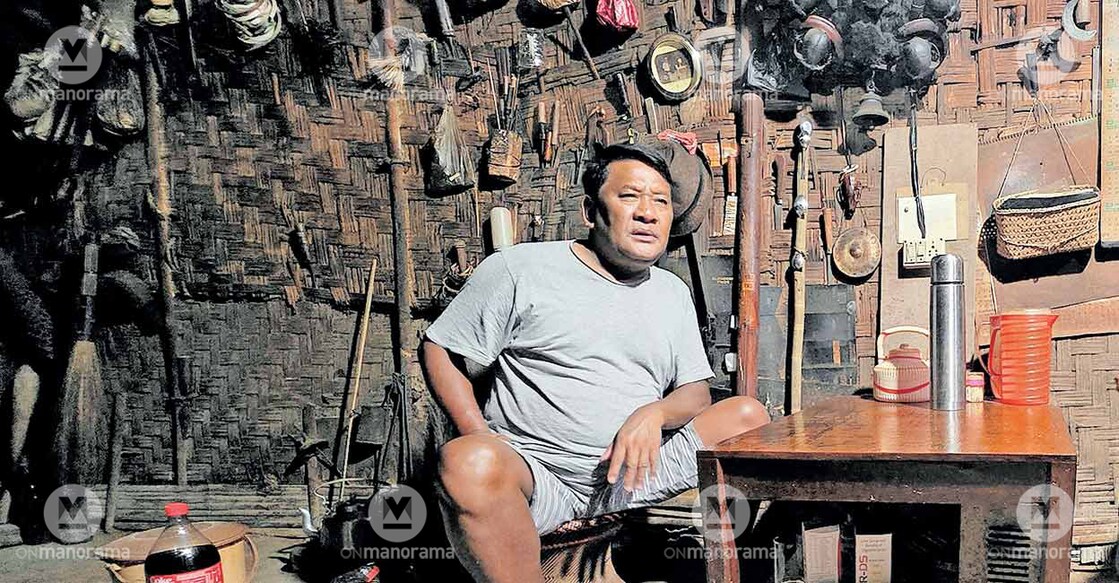
You could meet plenty of such hunters on the rugged road. After a rather adventurous ride on the muddy path, you will reach the front yard of a spacious house. Interestingly, the house's roof is thatched with paddy straw, and its walls are made of bamboo splints. Moreover, the walls are decorated with animal heads, mainly those of bison with long, elongated horns. Once you step into the house, a young man, who is the deputy king of the village, will greet you. There’s a ritual of sorts whereby an aqueous ‘offering’ is given to the king and deputy king. The ‘offering’ is nothing but liquor.
The story of Tonyei, the deputy king, is pretty fascinating. His father had five wives, and two of them were queens. The position of deputy king is hereditary and passed over generations, and a deputy king will never become a king. Tonyei’s son will be the next deputy king. As the first queen didn’t have any children, Tonyei’s mother was anointed as the queen. Tonyei studied at the village school till Class VII and later completed Class X at a school in Mon. After schooling, he returned to the village. In line with the current trend, the deputy king also has a YouTube channel, and the visitors’ experience is the main focus.
The Head and heads
The king’s residence is at a short distance from the thatched house, and you can find a museum on the way to the king’s house. The museum is nothing but a locked-up building, and through the broken window panes, you can see a pile of human skulls. The local people will proudly proclaim that there is nothing unusual in killing humans, and mainly, people belonging to opposite tribes are killed. When a person is killed, a pendant in the shape of a skull can be flashed in a necklace.
Earlier, the king’s palace exhibited human skulls alongside those of animals. But the practice was shelved following requests from the Christian missionaries and the government. Other villages reduced all the skulls to ashes, but Sheanghah Chingnyu village didn’t follow suit. A plaque listing the exploits of a former king could be found near the museum. The plaque says that the former king had 18 wives and 19 children. The next line is quite chilling as it says that he had severed 66 heads.
The King
The king’s palace is undoubtedly the largest structure in the village, and its walls are dotted with skulls and horns of bison. The walls of the palace can evoke fear and beauty in equal measure. The entry to the palace is through a small door. As you enter, you could find the king Aluh Ngowang relaxing, more often than not, in a room that is replete with skulls of various animals. The king has high hopes that a proper road will be paved and that the government will carry out the palace renovation. You would get a feeling that the only ‘development activity’ of the government is the revamping of the king’s house.
The king has great influence over the seven villages that come under his command. He decides who should be voted to power during the elections, and whenever an animal is hunted down, a portion is given to the king, who adores Hindi movies. As the king has more powers than a Member of Parliament or legislature, he doesn’t have any intention to test the electoral waters. The council hall is beyond the king’s room and is also replete with skulls of animals and birds. A stuffed wild cat could also be found in the room. The hats worn while hunting also adorn the room's walls.
Headhunting
A martial arts training and indigenous education center, traditionally known a ‘morung’, is located near the palace. The centre imparted training and equipped the members of the Konyak tribe to hunt. And hunting includes killing both humans and animals. Training is also given on how to attack a person without any weapons. ‘Morung’ is out of bounds for women, and they are not allowed to enter the facility. People used to stay at the ‘morung’ to undergo training, but there’s no such activity at the centre now. The centre is presently standing tall as the remnant of a bygone era.
How to reach Sheanghah Chingnyu?
Nearest airport: Dimapur Airport
Nearest railway station: Dimapur railway station
Documents: Apply for an Inner Line Permit (ILP) online via its website. You can also apply for the same at any entry point to the state for Rs 200. It should take about 10 minutes and let you travel throughout Nagaland.
For further details and for tour plans: +918730027353 (English-speaking guide, Nokoa)
 Add as a preferred source on Google