

Pulikali: What determines whether it is vulgarity or an art form?
Mail This Article


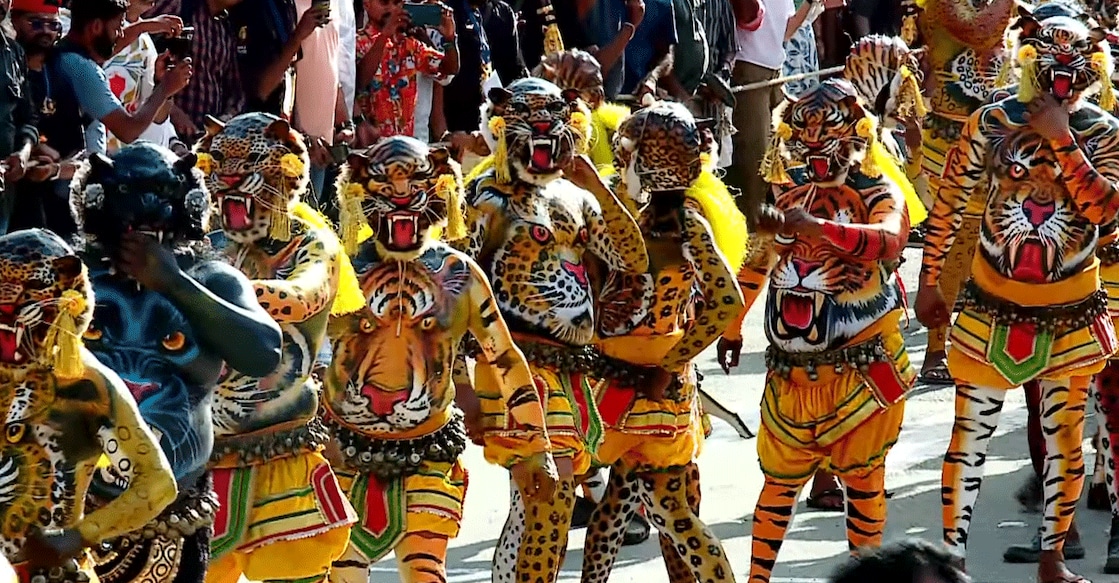
A few years ago, Facebook featured Kerala's 'pulikali' art form as part of its 'More Together' campaign, celebrating how it lifts spirits. The art form has also been widely included in various promotional initiatives, marketing drives and more, over the years. This year, as the pulikali fans gear up for the Onam-special performance in Thrissur on August 29, a controversy has erupted.
Referring to pulikali, Malayalam actor and writer VK Sreeraman wrote on Facebook - 'Stomach and breasts on men are not attractive. Showcasing them for art is not tasteful either. Nowhere else in the world would you see anything nauseating like this!' Comments supporting and opposing his views have been pouring in. However, what determines whether pulikali is an art form or vulgarity? We speak to pulikali artistes, historians, Thrissur's pulikali desams and doctors.
When did pot belly become the spotlight?
According to Kerala art historian MG Sasibhooshan, pulikali comes in different forms in Kerala, and the one in Thrissur is its own distinct version. He explains, "While it is 'puli' kali (leopard dance) in Thrissur, southern Kerala has 'kaduva' kali (tiger dance) and the Onattukara area in Alappuzha has 'karadi' kali (bear dance). Pulikali is less than 100 years old, and like its other versions, it has no standard version or rulebook of its own."
Was having a big belly always important for pulikali performers? "Not really. That is a more recent evolution of the art form. Interestingly, Thrissur had a famous competitive eater named Theetta Rappayi. Various competitions were even held to ascertain the champion eater, and their bellies often fascinated onlookers too. Over time, this aspect seems to have influenced pulikali too," he says.
Meanwhile, Krishna Prasad PN of Ayyanthole Desam, one of the nine primary pulikali troupes of Thrissur, says, "Pulikali was performed first by local soldiers for fun, and it has no religious or community basis. It is an art form popular within about 10 km of Thrissur city, though artistes also perform in other parts of the state and country. While artistes without big bellies commonly performed in the past, what gives it a better scope for body art is more surface area to paint on." Apparently, there are also 'pulis' with 6-pack bodies. "However, there isn't much a painter can do to augment the leopard on them."
Pulikali is an extremely physically demanding art form, as compared to many other performances, Krishna Prasad explains. "An artiste begins preparation around 4 am in the morning, and by the time they wash off the paint on their bodies, it can be midnight. Moreover, many of them wear 'aramanis' (bell belts) that weigh around 2.5 to 5 kg, while moving in a rhythmic fashion. This can't be done if a person doesn't love the pulikali performance," he says.

Performances across the year
While Onam is traditionally when pulikali is performed most, many pulikali artistes have programmes year-round. Inaugurations, VIP arrivals, Onam celebrations, IT park events and more demand pulis, that too those with big bellies, say artistes and organisers. Apparently, popular pulis can make between ₹5,000 and ₹10,000 for a single day's performance. Many performers also visit other states and countries from time to time for shows. "They view it as a commitment to an art form that they love, regardless of the body shaming or other forms of criticism that come their way. As with many art forms, this too has certain physical demands, that's all," Krishna Prasad says.
What professional puli artistes feel
Rahul KS, a professional pulikali artiste from Thrissur, has performed for around 17 years. "My dad too was a pulikali artiste, and people often used to refer to us as 'leopard and cub'," recalls Rahul, who has also performed in the UAE and Bahrain, and for PM Modi's programmes in Gujarat and other states of India. "I am into this performance because I love it. I always had a bigger body type, but have the fitness and passion to handle the demands of pulikali. Yes, at times people criticise various aspects of it, but it doesn't matter," he says. His co-performer Biju Velur agrees, adding, "Not every person with a paunch can perform pulikali. It is quite tough. How many art forms require your physical commitment from early morning to midnight for a performance, like in pulikali?"

The fitness side of pulikali
A smaller waistline is always advised for better health. From that angle, most people wonder how pulikali artistes can remain healthy, with their bigger bodies. Dr Baby Thomas, President of IMA, Thrissur, explains, "In my observation, a lot of people who are pulikali artistes are quite hardworking in their day-to-day lives. Many of them are labourers, who do physically demanding jobs, regardless of their appearance. As a performance that requires considerable stamina and endurance, just anyone with big tummies can't do pulikali."
Krishna Prasad says that while there is a demand for big tummies, performers are often urged to keep a close eye on their health parameters as well. "We regularly conduct free health checks too for the artistes. Earlier, we had regular yoga practice as well, which was discontinued only because the pulis are extremely busy giving shows, far and wide. Regardless, they are all quite active," he says.
What about the accusation that many performers use alcohol to survive the demanding hours of the art? An artiste, who didn't want to be identified, asks, "In every art form, there might be a few like that. How is it fair to say that every artiste does it? If our conduct isn't good and the performance isn't visually appealing, why are pulikali artistes in demand even outside the country? Critics should consider these aspects too."
