

Explained | What is the role of GST Council?

Mail This Article


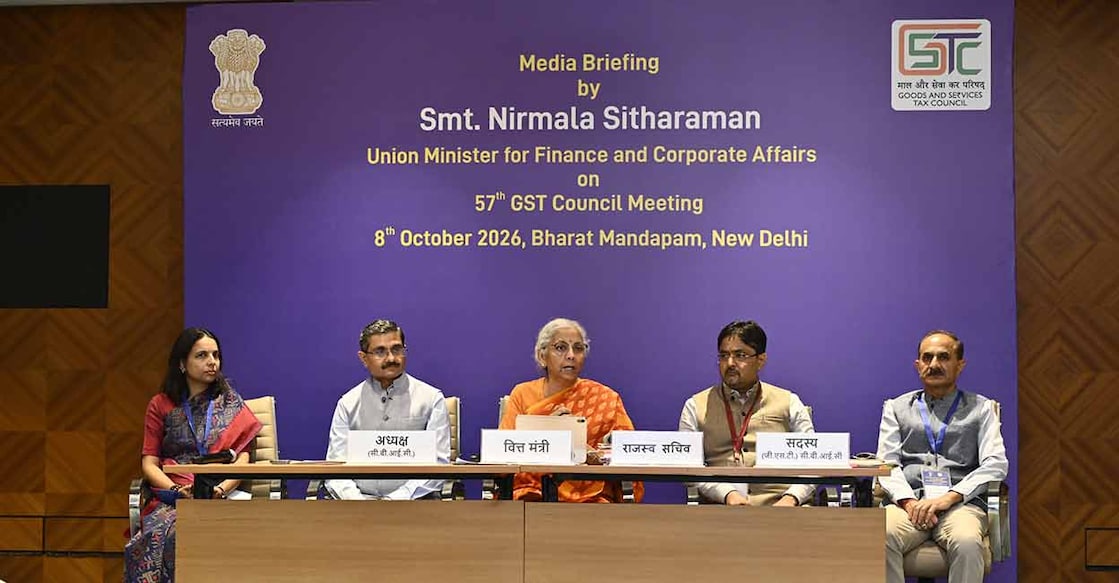
• The 57th meeting of the GST Council was held under the chairpersonship of the Union Finance & Corporate Affairs Minister Nirmala Sitharaman in New Delhi on October 9.
• Next-Gen reforms made as per recommendations of the GST Council in its 56th meeting in 2025 had focussed on rate rationalisation and reduction of rates.
• In the 57th meeting, the GST Council made recommendations relating to process reforms primarily covering registration, returns, refund and adjudication; clarifications regarding applicability of GST on supply of certain goods and services; and other measures for trade facilitation and streamlining compliances in GST.
• The meeting approved reforms to complete GST 2.0, including revoking arrest powers of tax officials.
Major recommendations made in the 57th GST Council meeting:
• The Council has recommended complete withdrawal of arrest powers under GST by omission of section 69 of CGST Act, 2017. The existing provision allows the Commissioner, subject to specified conditions, to authorise a central tax officer to arrest a person suspected of certain offences.
• The monetary threshold for prosecution will be raised from Rs 1 crore to Rs 5 crore.
• It recommended reducing the maximum general penalty under section 125 of the CGST Act, 2017 from Rs 25,000 to Rs 10,000.
• Amendments to provide for system-based processing and sanctioning of refund claims, pertaining to excess balance in electronic cash ledger, zero-rated supplies, and inverted duty structure.
• Time limit for issuance of acknowledgement or deficiency memo to be reduced from 15 days to 10 days.
• For refund claims on account of zero-rated supplies and inverted duty structure, 90 per cent of the amount claimed will be sanctioned on a provisional basis automatically by the system, without officer intervention, on the basis of identification and evaluation of risk by the system.
• Most refunds to be sanctioned within three working days based on risk assessment.
• Minimum threshold of Rs 10,000 for issuance of show cause notices. No notices will be issued if the tax amount involved is less than Rs 10,000.
• A conveyance carrying goods can be intercepted only on specific intelligence and with the authorisation of an officer not below the rank of Joint Commissioner.
• Only the state the goods started from (source state) and the destination state may inspect the goods moving in a conveyance. States along the route will not be able to stop the conveyance.
• A simple mechanism for registration for small suppliers making supplies of goods through e-commerce platforms.
• GST rate changes to be taken up once a year.
• Changes under GST policy reforms to be effective from April 1, 2027.
What is the role of GST Council?
• Goods and Services Tax Council is a constitutional body for making recommendations to the Union and state government on issues related to GST.
Composition:
• The chairperson of the GST Council is the Union Finance Minister.
• A member of the GST Council includes the Union Minister of State in charge of revenue or finance.
• Each state government nominates a minister responsible for finance or taxation, or another designated minister, as a member of the GST Council.
• The role of vice-chairperson rotates among the state representatives.
• The chairperson of the Central Board of Excise and Customs (CBEC) attends as a permanent invitee to the GST Council but without voting rights.
• The secretary of the revenue department serves as the ex-officio secretary to the GST Council.
Powers of GST Council:
• A GST Council meeting requires at least 50 per cent of its total members to be present for decisions to be valid.
• Decisions of the GST Council are based on a majority of not less than three-fourths of the weighted votes of members present and voting.
• The central government holds one-third of the total votes, while states collectively have two-thirds weightage in voting.
Functions of GST Council:
• The GST Council determines which taxes, cesses, and surcharges are to be subsumed under GST.
• It decides on the goods and services to be taxed under GST and those exempted from GST.
• The council formulates GST laws and principles for levying and distributing GST on interstate trade.
• During natural disasters, the council may levy special rates or additional resources through GST for relief efforts.
• The council sets turnover thresholds below which businesses are exempted from GST.
• It decides on GST rates, including setting a floor rate and establishing rate bands.
• The council considers and implements special GST provisions for states like Arunachal Pradesh, Assam, Jammu & Kashmir, Manipur, Meghalaya, Mizoram, Nagaland, Sikkim, Tripura, Himachal Pradesh, and Uttarakhand.
Significance of GST Council:
• Decisions made by the GST Council are based on consensus among all participating states and the central government.
• It reinforces federal principles by involving states in decision-making on tax matters.
• The council addresses emerging challenges and issues related to GST implementation.
• It oversees IT readiness, conducts consultations, workshops, and training for stakeholders involved in GST implementation.
