

Postcard puzzle is Kochi conservation architect's ode to heritage
Mail This Article


In an age where most travel memories disappear into phone galleries and cloud storage, Kochi-based conservation architect Aishwarya Das is trying to bring back something slower, more tactile and deeply personal. Through her venture, The d.a.k studio, she has found a way to combine two things she cares deeply about: heritage and puzzles.
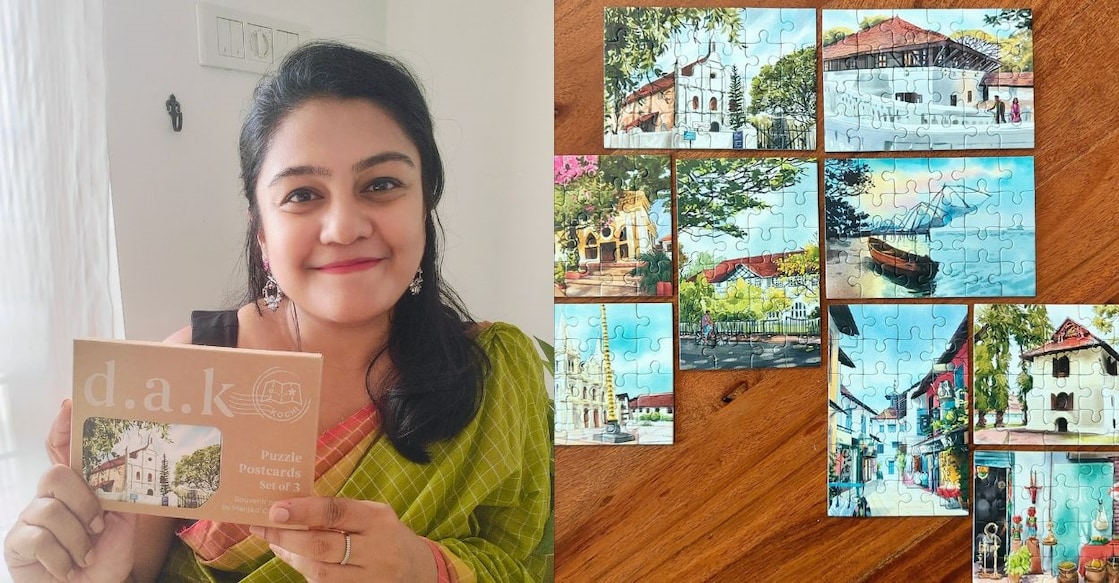
The idea is simple at first glance. Tiny postcard-sized puzzles inspired by heritage locations. But spend a little more time with them, and the intention behind the product begins to unfold. Each box is designed not merely as a souvenir, but as a way of helping people pause, observe and reconnect with places that often become part of the background in everyday life.
Aishwarya, who runs the heritage documentation initiative Manjadi alongside d.a.k studio, says her work has always centred around bringing people closer to history and architecture. “My focus has always been to make people more curious about heritage,” she says. “I wanted to create something engaging, and because I’m based in Kochi, it felt natural to begin with heritage locations here.”
The name itself carries layers. 'Dak' means post or mail in Hindi, but Aishwarya has also reimagined it as 'do and keep', reflecting the hands-on nature of the product. Each puzzle box contains three miniature postcard puzzles along with envelopes, postcards and a small heritage map. Once assembled, the puzzle can be stuck together and sent to someone like a postcard. A QR code inside the box opens up a larger digital map with walking routes through neighbourhoods known for their historic architecture.

The idea stemmed from something Aishwarya kept thinking about during her conservation work. In a fast-moving world, memories are often consumed quickly and forgotten just as fast. She wanted people to experience heritage differently, not as something glanced at and moved on from, but as something they could slowly piece together with their hands.
“If you have something physical to take back with you, you begin noticing details you normally wouldn’t remember,” she explains. “While putting the puzzle together, you start observing architectural elements, colours and little features that may not have stayed with you otherwise. It’s also something children and adults can do together.”
That sense of intimacy is reflected in the artwork as well. The visuals used in the puzzles are watercolour illustrations created by a local artist, giving the pieces a softer, more personal quality than conventional printed souvenirs.
The products first found visibility during the Kochi Biennale, and today they are available through select stores in Fort Kochi as well as the d.a.k studio website. While the original launch featured three boxed sets containing three puzzles each, growing demand has also led to single-piece versions being sold separately. A full set is priced at ₹900, while individual puzzles cost ₹350.
What has surprised Aishwarya most is the emotional response people have had to them. Many buyers, especially those from Kochi now living outside Kerala, see the puzzles as more than decorative keepsakes. “People tell me they want to frame them,” she says. “A lot of people from outside Kerala but originally from Kochi buy them because they feel connected to the place through the art and the process of making the puzzle.”
The project also naturally ties back to Manjadi, Aishwarya’s larger conservation practice, which focuses on documenting family histories and private heritage. Having studied abroad before returning to Kerala, she says she always knew she wanted to build something rooted here.
“In India, conservation is still largely associated with public buildings and monuments. But private histories also deserve to be documented,” she says. Through Manjadi, families approach her to record their lineage, stories and personal archives through books and digital platforms. One of her recent projects involved documenting a family connected to Kochi’s role in the freedom struggle.
In many ways, d.a.k studio grows from the same idea. Through postcard puzzles inspired by heritage spaces, Aishwarya is trying to preserve memory in a form that feels interactive, personal and rooted in place.
