

On the sets of ‘Padayatra’: How Adoor and Mammootty craft cinema with monk-like precision
Mail This Article


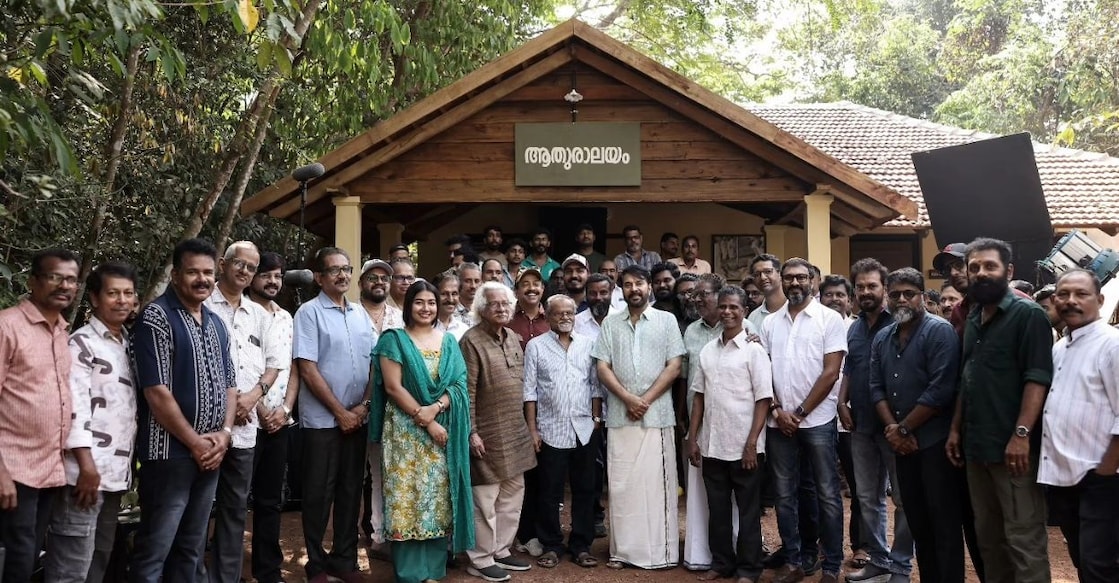
He moves on the set like a breeze. Adoor Gopalakrishnan’s call for “action” and “cut” while making Padayatra feels more like a teacher announcing the start and end of an examination. The 86-year-old works with a film crew half his age, all in awe of him and eager to learn his art of making classics.
So is Mammootty, known for his one-liner quips on set. Fresh from receiving the Padma Bhushan, he moves around the set — a hospital for tribal people specially created for the film in the green belt of the FACT fertilizer plant on the outskirts of Ernakulam — with a quiet smile, observing everyone and everything. He is not only the lead actor but also the producer. Padayatra is his fourth film with Adoor after a gap of 32 years.
At 86, can Adoor pull off yet another classic for the world of cinema to celebrate? Is he physically okay? These are common questions. No one doubts his creative spirit or sharp mind, which often sparks debate. About his health, Adoor says that once shooting begins, creative energy flows through his veins and even a common cold waits until the schedule ends. Still, his family has ensured that his personal assistant Pushparaj shadows him throughout the shoot. Rajan, as he is fondly called, accompanies him even when he walks a few steps from his chair to brief actors. His longtime associate Meera Sahib is also always around, helping translate Adoor’s vision to the crew. They have worked together since Kodiyettam, Adoor’s second film.
From early indications, Padayatra appears to be a Gandhian take on the complex socio-political realities of contemporary India. Set in the mid-2000s, it follows a doctor who leaves a successful urban practice to dedicate his life to social service in a tribal area. In many ways, it is a march back to the roots — Adoor’s response to the socio-political issues around us. Though there is a Maoist presence in the tribal areas of Wayanad where the film is set (late 2008–10), Adoor describes it as a non-political film.

A new entrant to Adoor’s core team is novelist K V Mohan Kumar, who co-wrote the script. He is amazed by how Adoor reshaped characters and the storyline to make the film more humane and visually rich. Dialogues are perfected in accent and delivery exactly as Adoor visualises. Often, he goes for a take after just a few rehearsals. Like his first film, Adoor has opted for sync sound, though some ambience and dialogue dubs will be added later.
Mammootty, a master performer, delivers a different variation each time a shot is repeated. Cinematographer Shamnad Jalan, who worked with him in Bramayugam, says Mammootty’s best performance is usually his first take, though he delivers equally strong follow-ups when needed. Many times, Adoor approves the first take but repeats it as a safe option for editing.
A typical Adoor shooting day starts at 8 am and ends between 6 and 9 pm, with breaks for breakfast and lunch. After spending a few days on set, one realises that once Adoor enters a creative zone, he becomes like a yogi in meditation — constantly thinking about shots, angles, costumes, movements and ambience. “We generally shoot till the light fades, unless we need night shots,” he says. Meera Sahib adds that filmmaking demands a mind free of distractions to recreate life situations.
Being his 13th film, Adoor is particular about every detail. The first shot features Mammootty as Dr Devadas lifting a painting of Gandhiji while tending to a sick old man — a powerful introduction to an urban doctor who leaves his career to serve in a tribal area. Soon, Indrans appears as his assistant with a plaque and a donation box. The plaque reads: treatment is free, but you may contribute what you can. This neatly sums up the theme — a socially committed doctor gradually entangled in issues involving landlords, politicians, the administration, police, Maoists and the tribal community he serves.
Actors are given only brief one-line instructions. Senior actor Sreekumar, who plays the landlord, recalls his brief: “Kayiliruppu shari alla” (bad intentions). Adoor usually does not share the full script, as he believes actors might form fixed ideas about their characters. Instead, he wants them to perform the character he has imagined. Grace Antony, who plays the nurse assisting Dr Devadas, easily fits into her role with Adoor’s detailed shot-wise guidance. She is reportedly on a vegetarian diet during the shoot to maintain her look.
Even the smallest roles are carefully etched. Theatre artist Gopalakrishnan plays the landlord’s assistant, Ajit Kumar plays the MLA’s aide, and Prof Aliyar plays a teacher from the Adivasi community who supports the doctor’s Gandhian outreach. Njavarakkal Rajan was asked not to cut his long curly hair so he could convincingly appear as a Maoist from the Wayanad forests. A trained Belgian Malinois dog named Naz plays the landlord’s pet and even performs a dramatic “death” scene during a Maoist raid.
What stands out most on the Padayatra set is the crew. Most are in their 40s — half Adoor’s age — yet eager to learn from the maestro. A young editor noted that Adoor uses only one camera and takes limited shots, unlike many contemporary filmmakers who use multiple cameras and decide later in the edit. Adoor’s response is simple: he takes only what he needs, nothing more, nothing less.
Cinematographer Shamnad Jalan consults him on every detail, from camera placement and angles to lens choice. Art director Shaji is equally meticulous, ensuring even trampled leaves do not appear unnaturally in frame. The set of Dr Devadas’s hospital-cum-residence was built in the green belt at Ambalamugal in the FACT township, where most of the action unfolds. Adoor leaves nothing to chance and ensures each frame matches his vision. On this set, it truly feels like a masterclass in filmmaking, with the crew as attentive students.
Only three people know the day’s schedule, and actors are called accordingly. Santhosh, working closely with Meera Sahib, handles scheduling and coordination. Mammootty Kampani has deployed a large team across departments — makeup, art, costumes, catering, transport and coordination — all functioning with clockwork precision so that Adoor can focus entirely on his creative work. Every detail is prepared and presented to the director each morning.
Adoor describes himself as responsible for “rachana-sakshathkaram” — writing and realisation — rather than just direction. Shot by shot, he builds the film through visuals, ambience, performances, props, accents and camera angles. The point of view of the characters guides his shot choices, shaping the narrative into a rich visual experience. Watching Adoor at work, one feels he is indeed recreating life to express his own cinematic vision.
(The writer spent the first week of the shoot on the set of Padayatra, observing Adoor Gopalakrishnan and his crew at work.)
