

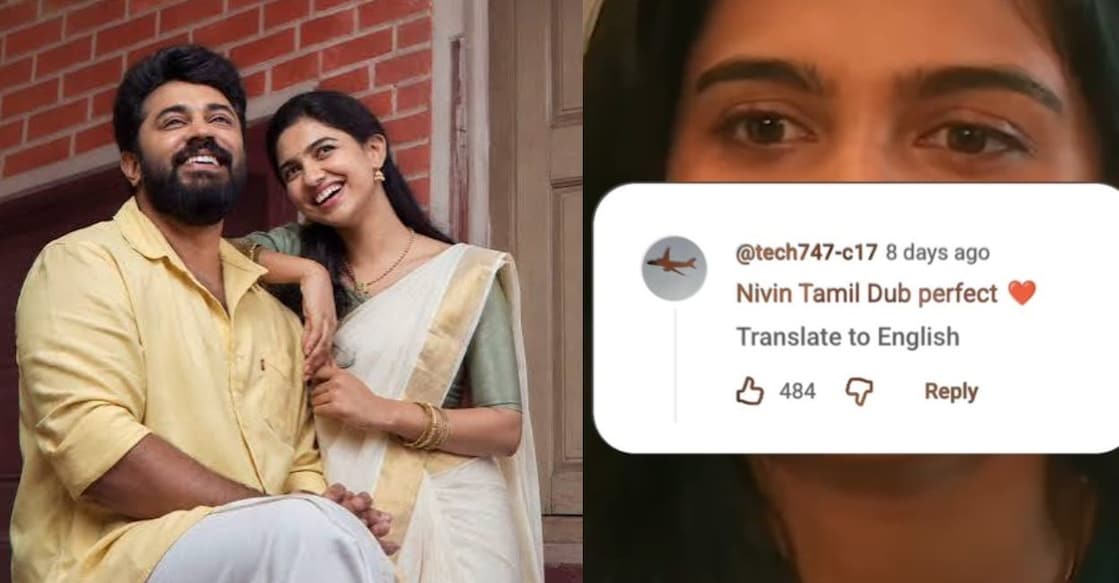
Nivin Pauly didn't dub ‘Bethlehem Kudumba Unit’ in Tamil, but how Justin sounded exactly like him

Mail This Article


For actors, their voice can be as recognisable as their face. Nivin Pauly’s is no exception. When Girish AD’s ‘Bethlehem Kudumba Unit’ reached Tamil audiences, the voice delivering his lines sounded unmistakably like his own. The resemblance was so convincing that even a mimicry artist would have struggled to reproduce Nivin’s voice with the same precision.
But there was a catch. Nivin had not dubbed his portions for the Tamil version.
So how did the film retain his distinctive voice without him recording a single line in Tamil? The answer lies in an AI experiment by Vaani, a localisation platform founded by filmmaker-turned-entrepreneur Abhinav Mohan. Using AI to recreate Nivin’s voice over an existing Tamil dub, the team completed the process in roughly two hours.
Two performers, one voice
The project came about because there was not enough time for Nivin to dub the Tamil version before its release. Hiring a dubbing artist would have solved the language problem, but audiences would have heard a different voice, whereas Tamil audiences are already familiar with Nivin’s voice.
Bhavana Studios approached Vaani through Sanath Sivaraj, the editor of the Malayalam film ‘Pluto’, who also worked on ‘Bethlehem Kudumba Unit’.
Abhinav says the arrangement was limited to the project, with no long-term retention of Nivin’s voice. “We entered into an agreement directly with Bhavana Studios for this project. We work on a film-by-film basis, and Nivin’s voice data is not retained after the project is completed.”
A Tamil dubbing artist had already dubbed Nivin’s portions in the film. Vaani then trained an AI clone of Nivin’s voice on its platform and applied it to the existing Tamil dub, retaining the original performance while replacing the dubbing artist’s voice with Nivin’s.
“We trained a clone of Nivin’s voice on our own platform, Vaani, and converted the Tamil dub into his voice,” Abhinav says.
The Tamil dubbing artist delivered the performance, including its timing, pauses and emotional nuances. Vaani’s AI then converted the voice to sound like Nivin while preserving the original delivery.
According to Abhinav, the process took about two hours. Having Nivin dub the film himself would have taken several days, making the technology a practical solution to the team’s tight release schedule. He says the decision was driven primarily by time constraints, rather than cost savings.

A problem first solved on set
Vaani’s first film project was ‘Pluto’. After filming a scene, the team realised that an actor’s dialogue needed to be changed. Reshooting the scene would have meant bringing the actor back to set, with the process potentially costing ₹3 lakh to ₹5 lakh and taking an entire day.
Instead, Vaani used its lip-sync technology to modify the actor’s mouth movements to match the revised dialogue, making the correction without having to shoot the scene again.
Abhinav’s experience in filmmaking and advertising helped shape the idea for Vaani. Adapting content for different languages can involve separate tools and teams for translation, dubbing and lip synchronisation, adding time and complexity to production.
“I put my film career on hold to build Vaani with my co-founders, Jayaneeth and Indrajith,” Abhinav says. Launched in June 2026, Vaani ranked third among more than 800 products featured on Product Hunt, a platform where new technology products and startups are launched and discovered by users.
Vaani combines translation, voice cloning and lip synchronisation in one workflow. It supports more than 40 languages, with a focus on Indian languages, and targets film production houses, advertising studios, microdrama platforms and OTT companies. The system is also designed to preserve a film’s original music and background score during localisation.
Abhinav says the social media attention following the news of AI being used to recreate Nivin’s voice has led to enquiries from ad studios, film production banners, microdrama platforms and OTT companies. Some are exploring Vaani for localisation, a process that can involve multiple teams and tools. He says a few companies are now trialling and onboarding the platform.
