

‘Kaantha’ review: Dulquer leads strong performances in a visually striking but emotionally distant period drama

Mail This Article


There is an undeniable charm to old cinema. Not just the films, but the mood of the era itself. Everything feels bigger, louder, more expressive. Even the silences seem to echo. 'Kaantha', Dulquer Salmaan’s latest release, directed by Selvamani Selvaraj, taps into that lost world with surprising confidence. Within minutes, the film pulls you into a time most of us have only seen in grainy photographs and studio portraits: the 1950s, when Tamil cinema was still finding its voice, and when egos were just as colossal as the sets.
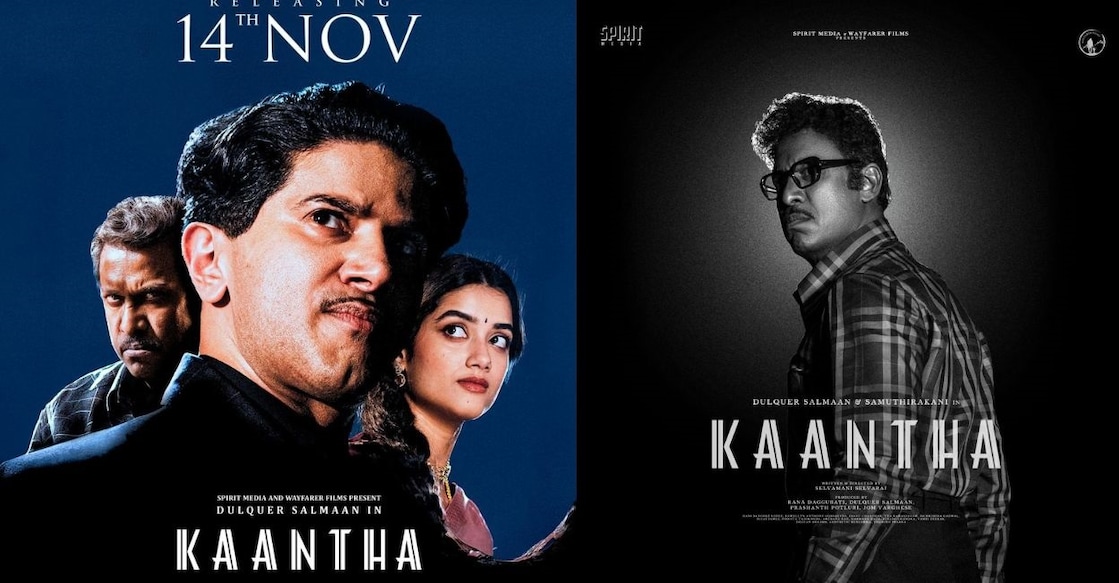
At the centre of 'Kaantha' lies a simmering rivalry between superstar TK Mahadevan (played by Dulquer) and filmmaker Ayya (Samuthirakani). Their relationship is built on admiration, bruised pride, and a mutual refusal to step aside for the other. The tension isn’t explosive; it lingers like an unfinished argument. This is where the film faintly echoes something like 'Iruvar', not thematically in a direct sense, but in the way it looks at two men caught between cinema and politics of the heart.
Stuck between these towering personalities is Kumari, played by Bhagyashri Borse. She’s the heroine of the film-within-the-film 'Saantha', which eventually becomes 'Kaantha' for reasons better discovered on screen. Kumari is no mere prop; she is the thread that unknowingly ties the two men together and the first casualty of the creative power struggle playing out behind the camera. Her presence grounds the film, especially in moments where the narrative threatens to slip into pure male ego.
The plot begins as a straightforward clash between a star and a director but slowly expands into something darker. As the conflict grows, so do the consequences. What seems at first like a period drama tilts into a mystery, eventually revealing itself as a full-fledged murder investigation. It’s a risky tonal shift, but one that Selvamani handles with patience. He allows the audience to settle into each phase of the story, to feel the unease, to guess, to second-guess, and finally to arrive at the truth just moments before the characters do.
Performance-wise, the film rarely falters. Dulquer is easily the standout. He slips into the 1950s with such ease that nothing about his performance feels recreated. The little gestures – a slight twitch of the lips, the self-assured tilt of his head, the exaggerated surprise in his eyes – feel like notes borrowed from real stars of the era. He plays Mahadevan as someone who is aware of his screen power yet vulnerable beneath the layers of fame. There are shades of his work in 'Mahanati' here, but this feels more lived-in.
Samuthirakani, as Ayya, brings his own depth. He doesn’t play Ayya as a one-note antagonist. His dislike for Mahadevan is rooted in artistic frustration, in watching a star overshadow the very craft he worships. His scenes carry a quiet fire that balances Dulquer’s flamboyance perfectly. Bhagyashri Borse is a wonderful addition, expressive without being loud, and her chemistry with Dulquer feels organic.
Technically, 'Kaantha' is a treat. Dani Sanchez-Lopez’s cinematography is consistently arresting. His black-and-white frames, especially, feel like postcards from a time machine. They’re not merely aesthetic; they’re functional, helping us navigate shifts in mood and memory. Jakes Bejoy’s music embraces the heightened drama of the era without drowning the scenes.
The film does test your patience at times. Some portions feel repetitive, and certain beats are predictable. The slow burn occasionally becomes a little too slow. But the story does regain its grip when it switches gears into the whodunnit mode. Rana Daggubati’s role, small but striking, brings an eccentric energy that helps reset the tone.
The climax is thoughtful. It brings back the film’s most important idea: in the world of cinema, reality and performance often merge until you no longer know where one ends and the other begins. 'Kaantha' pays tribute to the stars and storytellers who lived through that blur.
If there’s one shortcoming, it is the emotional distance. We admire these characters, but we don’t always feel for them. Yet, as a love letter to yesteryear cinema and the people who shaped it, 'Kaantha' is evocative and sincere. It captures a time when drama wasn’t just on screen – it was life itself.
 Add as a preferred source on Google