

The ‘Kerala Story 2 Goes Beyond’ review: Ideology over inquiry

Mail This Article


The memory of ‘Shalini Unnikrishnan from Diruandhapuram,’ the much-debated figure from the first film, lingers over ‘The Kerala Story 2 Goes Beyond.’ This time, the narrative introduces Surekha Nair from Kochi.
Yet, the attempt to root the story in Kerala feels tenuous from the outset: sweeping shots of paddy fields render Kochi’s distinct urban character indistinguishable from backwater landscapes elsewhere. It is an early signal that geographical and cultural specificity are secondary to the film’s larger preoccupations.
If the first film sought to frame its argument within a college campus and the contested idea of ‘love jihad,’ the sequel dispenses with even that scaffolding. It proceeds on the assumption that its ideological premise requires no fresh contextualisation.
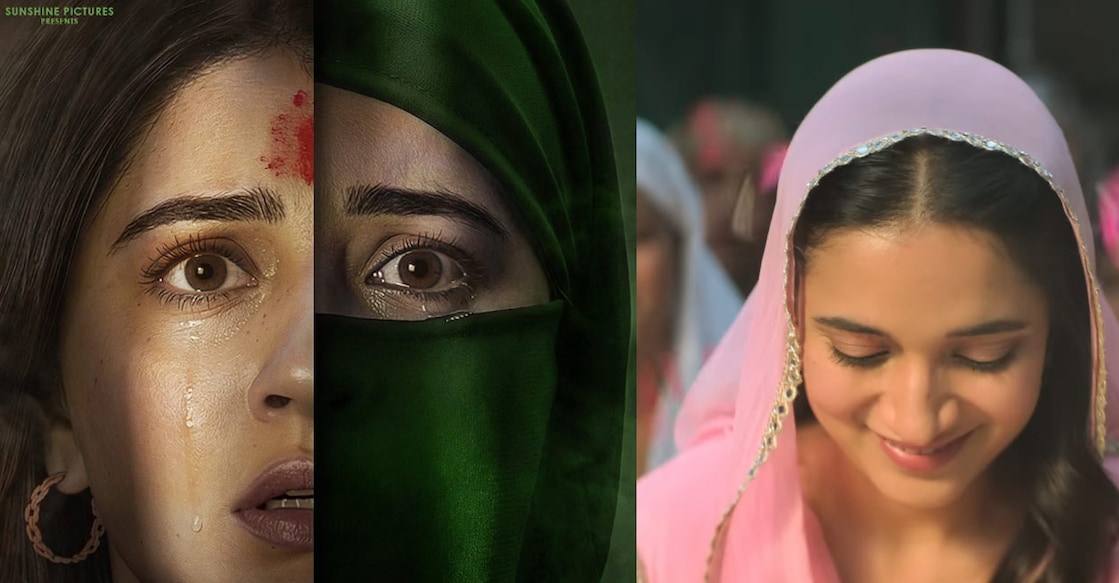
Three young women (from Kochi, Gwalior, and Jodhpur) form the emotional spine of the story. Their trajectories are mapped less as individual lives than as cautionary templates. The suspense lies in not what happens but in how it unfolds.
Directed by Kamakhya Narayan Singh, the film ventures into grim territory. There is coercion, exploitation, and violence under the guise of marriage. Such themes have cinematic precedent, and confronting them is not, in itself, objectionable.
The discomfort arises when these crimes are framed as the defining attribute of a single community. In doing so, the film narrows its moral universe to the point that it leaves little room for complexity or dissenting realities.
Characterisation suffers accordingly. Muslim figures are sketched in broad, antagonistic strokes, with little nuance. The emotional authenticity the film achieves surfaces largely in the scenes between the young women and their parents.
These are scenes that momentarily transcend the polemical thrust. A passing reference to secular and widely admired Muslim public figures gestures towards balance. However, it feels fleeting within the film’s dominant tone.
Performances show improvement over the previous instalment. Ulka Gupta as Surekha Nair brings conviction, even if her Malayalam dialogue is minimal. Aditya Bhatia’s Divja, a dance-loving teenager shaped by social media aspirations and Aishwarya Ojha’s Neha, a promising athlete, lend some individuality to roles that might otherwise have been schematic.
The background score, particularly in the climactic stretches, leans towards excess, underlining scenes that might have benefited from restraint. In the end, ‘The Kerala Story 2 Goes Beyond’ appears less invested in probing a social issue than in reiterating a fixed viewpoint. Cinema, at its most compelling, invites conversation. Here, the insistence on a singular lens limits that possibility.
