

Kochi band makes music with unique instruments & people find it perfect for meditation
Mail This Article


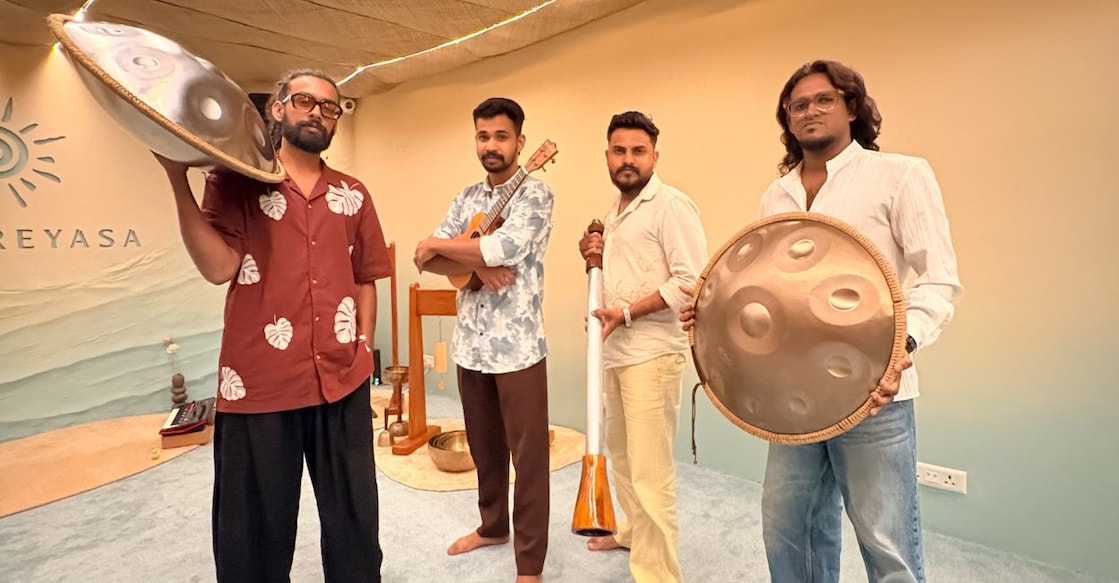
It looks a little like a UFO. To an unsuspecting Malayali, it could even pass for a traditional chatti. But when fingers tap its steel surface, the handpan produces soft, resonant notes that linger in the air. In Kochi, four young musicians have made this unfamiliar instrument the centre of a band that creates ambient, meditative sound experiences using handpans, a didgeridoo, morchang, djembe and instruments that recreate the sounds of rain and water. While the handpan is a relatively modern instrument, some of the others they use have histories stretching back centuries.
‘The Handpan Ensemble’, made up of Safran Peter, Jagath Pavan, Rahul and Sidharth, is less interested in playing conventional songs than in creating an atmosphere where people can slow down, close their eyes, dance or simply lie back and listen. What began with friends experimenting with unfamiliar instruments at a drum club in Fort Kochi has grown into a musical project built around that idea.
The group began taking shape only in early 2026. None of them started out with a grand plan to create a sound-healing collective. In fact, they were still figuring out the instruments themselves.
It began with unfamiliar sound
The Fort Kochi music scene played an important part in bringing them together. Safran and his friends were regulars at a local drum club, where they met travellers and musicians who introduced them to instruments they had rarely encountered before.
The handpan was one of them. A modern steel percussion instrument that emerged in Switzerland in the early 2000s, it is played entirely with the hands and fingers. Its different tuned sections produce soft, melodic notes, giving it a sound quite unlike the percussion instruments commonly heard in Kerala.

The group began with the handpan and gradually brought in other instruments. The didgeridoo came through Jagath, who had been interested in instruments since childhood. He first saw a Spanish musician playing one in Fort Kochi and was immediately drawn to its deep, continuous sound. He also plays the morchang, among other instruments that add organic textures to the group's sound.
For Jagath, the didgeridoo is more than just another instrument in the ensemble. “It can be played solo as well, and we use it to help create a relaxing environment,” he explains.
The ensemble's sound also includes the morchang, a traditional Indian jaw harp known for its distinctive twang, and the djembe, a West African hand drum that adds rhythm. Then there are the ocean drum and rain sticks, which recreate the sounds of water and rain.
Rahul plays the ukulele and electric guitar, adding rhythm and texture to the performances. He says getting into the handpan scene was not easy, especially when they were still discovering the instrument and the possibilities it offered.
Depending on the performance, the group can use as many as 12 instruments.
They are not full-time musicians, and most of their practice happens during weekend jam sessions at Jagath's studio in Fort Kochi. Over time, they have learnt to recognise each other's rhythms and anticipate where another instrument might enter.
Not quite a concert
The ensemble describes what it does as a sound journey rather than a conventional musical performance.
“We started this as a sound journey, to help people calm down or maybe just slow down,” says Sidharth. They now work with two formats: ecstatic dance and sound journeys. Explaining the difference, Sidharth says a sound journey is designed to make people feel completely comfortable. “Sometimes, they are even lying down and simply taking in the experience. It is difficult to define it as music all the time because there are moments when it is just sounds. Our whole focus is to help people get into a flow.”
Ecstatic dance takes the music in a different direction. “That is done at a much higher BPM, or beats per minute. Our intention there is to get people moving and dancing.” It was while performing for friends at house parties that the group first noticed how differently people responded to their music.
Some said the experience had been deeply relaxing. Others described it as life-changing. There were even occasions when people cried.
Safran says the group did not initially set out with an understanding of the healing aspect of what they were doing. “During performances, we saw the kind of changes happening to us and the people listening. That's when we decided to explore this further.”
For Safran, what they create cannot really be reduced to a conventional song or track. “It is an experience. When we play, the music guides us, and the people listening are also taken into a meditative space.”
Finding their own rhythm
The ensemble's interest in the handpan has also taken them beyond Kochi. A handpan festival they attended in January introduced them to musicians experimenting with the instrument in ways they had not previously considered.
For an instrument that remains relatively unfamiliar to most people in India, Safran believes there is still plenty left to explore. “The handpan has a big community around the world, but what all it can be used for is still being explored,” he says. That sense of discovery is what holds ‘The Handpan Ensemble’ together. They are still learning, experimenting with different combinations and discovering what happens when an unfamiliar sound fills a room.
