

Sadya 101: How to place the banana leaf, eat an Onasadya and fold it after the feast
Mail This Article


Onam is here, and for Keralites everywhere, that means one thing: a banana leaf loaded with the colours, textures and flavours of an Onasadya.
An Onasadya is more than a feast. There is an order to the way the leaf is placed, the dishes are arranged and served, and even how the meal is finished. While customs vary slightly between regions, families and communities, these are some of the traditions commonly associated with a Kerala Sadya.
First, get the banana leaf right
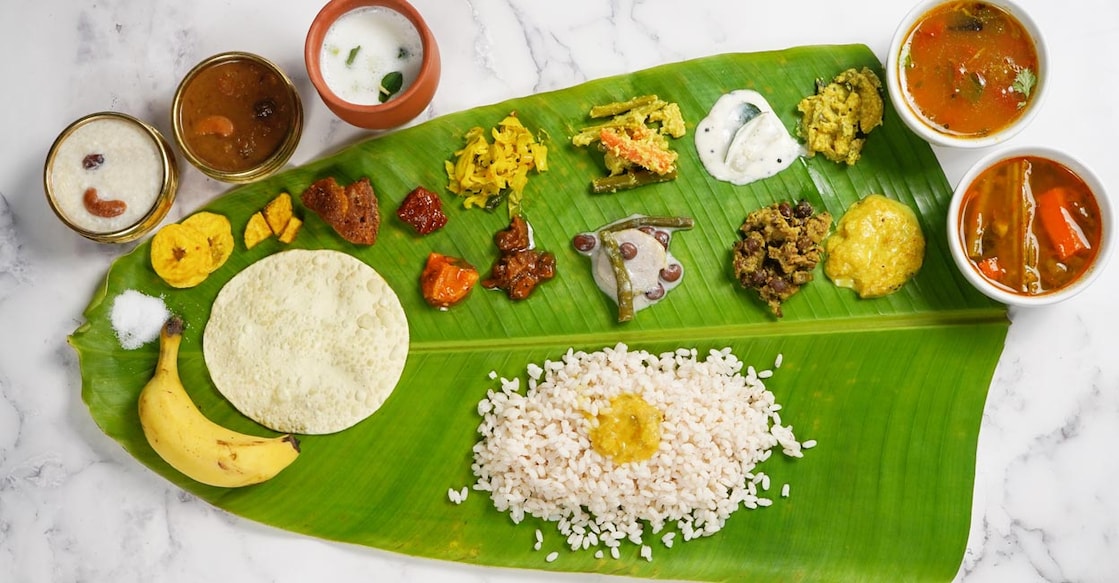
A traditional Sadya is served on a thooshanila, the portion of a fresh banana leaf that includes its tip.
Place the leaf in front of you with the tip pointing to your left and the broader end towards your right.
The leaf is traditionally placed with its upper half facing the diner relatively open for rice and mixing the curries.
The fresh leaf also adds its own aroma to the meal, especially when hot rice and curries are served on it.

Where do the dishes go?
There can be differences in the exact arrangement, but the classic Sadya layout follows a broad pattern.
At the far left near the tip of the leaf, you will usually find the small accompaniments:
- Banana (Njalipoovan or Palayankodan)
- Salt
- Banana chips or upperi
- Sharkara varatti
- Pappadam
Moving across the upper half of the leaf, the servers add the vegetable preparations and accompaniments. These may include:
- Pickles such as mango and lime
- Inji curry
- Kichadi
- Pachadi
- Olan
- Erissery
- Madhura curry
- Koottu cury or other regional Sadya preparations
- Thoran
- Avial
The exact order is not universal. Different Sadyas may add or omit dishes, and the arrangement can change depending on the tradition being followed.
- The lower half of the leaf is kept open for rice.
A curious Sadya rule: Served first, eaten later
One of the interesting things about a Sadya is that the order in which dishes are served does not always match the order in which they are eaten.
For instance, inji curry may be placed on the leaf at the beginning of the meal, but it is traditionally enjoyed towards the end.
The dishes are also often served across the leaf from one side to the other, while the diner moves through the flavours in the reverse direction.
So don't feel compelled to eat everything the moment it lands on your leaf.
Now comes the rice
Once everyone is seated, hot rice is served in the open space in the centre or lower half of the leaf.
The first rice course is traditionally parippu with ghee.
Take a small portion of rice, add parippu and a little ghee, and mix it with your fingers. Sadya is traditionally eaten with the right hand, using the fingertips to mix the rice and curry and form small portions.
There is no need to mix the entire mound of rice with every curry at once. A little rice at a time allows you to experience the different combinations.
What comes next?
The sequence can vary, but a traditional Sadya broadly moves through these courses:
1. Parippu and ghee
The first rice course is parippu, generally a moong dal preparation, topped with ghee.
The creamy dal and ghee provide a gentle beginning to the rice courses.
2. Sambar
Next comes sambar, usually eaten with rice and the vegetable preparations on the leaf.
This is one of the more substantial and spiced rice courses.
3. Kaalan, pulissery and other yoghurt-based curries
Depending on the Sadya, kaalan or pulissery may follow. Kaalan is traditionally made with yoghurt, coconut and vegetables such as yam or raw banana.
Pachadi and kichadi, which also have yoghurt-based preparations, can be eaten alongside the rice courses.
4. Payasam
Then comes the sweet course everyone waits for: payasam.
There may be one payasam or several, depending on the Sadya.
A traditional way of enjoying payasam is to mash some ripe banana into it. Some people also add a little pappadam.
And there is another small Sadya trick: pickle may be served again after the payasam. The sharp sourness of mango or lime pickle provides a contrast to the sweetness of the dessert.
5. Rasam and moru
The meal can then move towards its lighter final courses with rasam and buttermilk, or moru/sambaram.
Some people drink the rasam directly, while others have it with a little rice.
Buttermilk is often considered the final cooling note of the meal.
And if your Sadya includes chukku vellam, the warm spiced water made with dry ginger and often cumin, it may be served alongside or towards the end.
What about all those dishes on the upper half?
You don't have to eat them in a strict sequence.
The idea is to enjoy the combinations. A little thoran with rice, some avial with sambar, erissery with a touch of sweetness, or a sharp pickle between mouthfuls can completely change the experience.
Some dishes have traditionally been associated with particular roles in the meal too.
Inji curry, for instance, is served early but may be eaten towards the end. Ginger has long been valued in traditional food practices for its digestive properties.
Olan is mild and subtle, with ash gourd or other vegetables, coconut milk and coconut oil.
Avial brings together mixed vegetables with coconut and yoghurt.
Erissery balances the sweetness of pumpkin with coconut.
Thoran adds vegetables, coconut and texture.
Rasam provides a peppery, tangy finish before the cooling buttermilk.
The beauty of a Sadya is that there is no single flavour dominating the entire meal. Sweet, sour, salty, bitter, spicy and savoury notes appear across the leaf.

How much should you eat?
This is where modern common sense can happily join tradition.
Take small portions first. You can always ask for another serving.
Rice forms the bulk of the meal, while dishes such as parippu, sambar, avial, thoran and other vegetable preparations add fibre and nutrients. Pappadam, chips, sharkara varatti and multiple servings of payasam, meanwhile, can quickly increase the amount of fat, salt and sugar you consume.
So if you want to enjoy a long Sadya without feeling completely stuffed afterwards, load up on the vegetable preparations, take rice in moderate portions and treat the fried snacks and sweets as accompaniments rather than the main event.
There is no fixed calorie count for an Onasadya. The total depends heavily on the number of dishes and, more importantly, how much you serve yourself. A moderate Sadya may be around 1,000–1,200 kcal, but a generous feast with several payasams and large portions can easily exceed that.
And finally, how should you fold the leaf?
This may be the most debated part of Sadya etiquette.
There are several traditions and interpretations.
A commonly heard Kerala custom is that after a happy occasion such as Onam or a wedding, the leaf is folded towards you. It is sometimes explained as a gesture of satisfaction and a wish that such a sumptuous meal will come again.
Some people say:
- Fold towards you if you enjoyed the meal.
- Fold away from you if you did not.
There are also traditions that associate the direction with the nature of the occasion, with one direction used for happy occasions and the other for funerals.
But these conventions are not uniform across Kerala. Some families follow the opposite practice, and traditions can also differ between Kerala and Tamil Nadu.
There is a much simpler practical explanation too.
If there is curry, payasam or other liquid left on the leaf, folding it away from you can help prevent the leftovers from spilling onto your clothes. At weddings and other large gatherings, folding the leaf away can also make it easier for the cleaning staff to collect and dispose of the used leaves.
If you are clearing your own leaf, or if the local custom calls for it, folding towards yourself may be perfectly appropriate.
So the safest Sadya rule is:
At a traditional ceremony, follow the custom of the household or venue.
If there is no particular custom, choose the practical option and fold the leaf away from you to contain any leftover liquid.
And if you are the sort of person who wipes the leaf completely clean, like a truly committed Sadya lover, there may not be much left to spill anyway.
The Sadya cheat sheet
- Leaf: Tip to your left.
- Upper half: Banana, chips, sharkara varatti, pappadam, salt, pickles and the various vegetable and yoghurt-based accompaniments.
- Lower half: Keep it open for rice.
- First rice course: Parippu + ghee.
- Next: Sambar and vegetable combinations.
- Then: Kaalan/pulissery and other yoghurt-based preparations, depending on the Sadya.
- Sweet course: Payasam, often enjoyed with ripe banana and sometimes pappadam.
- After payasam: Pickle can return to cut through the sweetness.
- Final courses: Rasam, followed by moru/sambaram or buttermilk.
- How to eat: With the right hand, mixing small portions of rice and curry as you go.
- How to finish: Follow the local custom for folding the leaf. If there is no custom to follow, folding away from you is the practical choice.
And perhaps the most important rule of all: don't rush a Sadya. Take your time, taste the combinations, ask for more of your favourites and enjoy the feast the way it was meant to be enjoyed.
