

Egg shells, watermelon rinds, flower pots... Health workers explain how backyard items invite diseases
Mail This Article


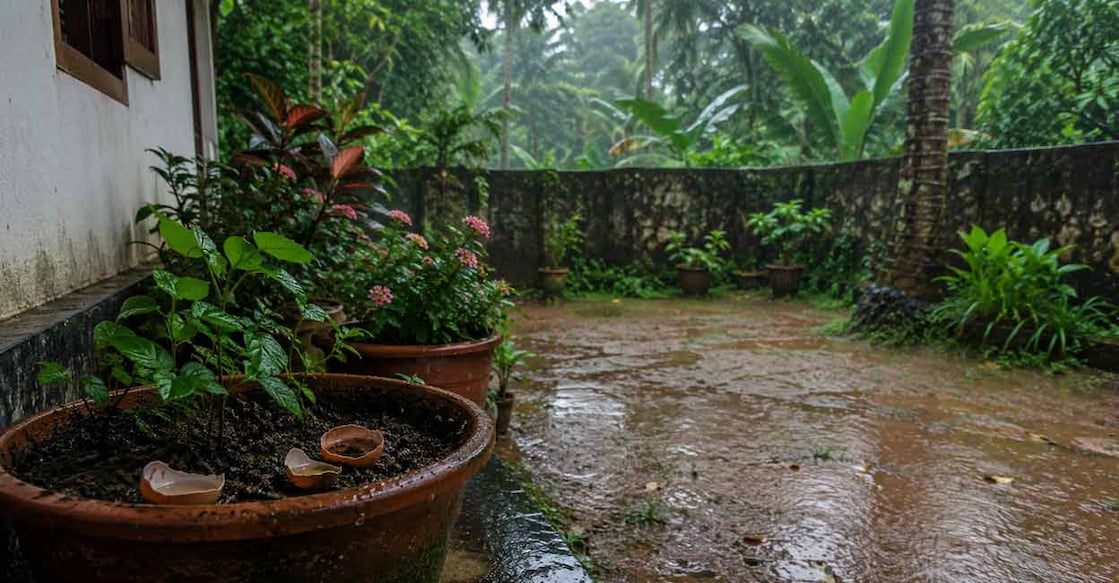
A little carelessness can have life-threatening consequences during the Kerala monsoon season. From playing in contaminated water to leaving stagnant water in discarded containers, seemingly harmless acts can create breeding grounds for disease-causing mosquitoes. Even a discarded eggshell in the garden, if left uncrushed, can provide a space for mosquito larvae to multiply, says health workers.
Recently, health workers in Kollam district said they found mosquito larvae even in the gaps between loose tiles in house courtyards. Experts point out that alternating spells of rain and sunshine create ideal conditions for the spread of diseases. Continuous rainfall or prolonged dry weather, on the other hand, does not provide favourable conditions for mosquitoes that transmit dengue to multiply. Health workers engaged in dengue prevention efforts warn that awareness alone cannot win the battle against infectious diseases. It demands a collective effort to identify and eliminate the hidden breeding sites that allow mosquitoes to thrive.
Unusual breeding grounds spotted
Flower pots: Decorative flower pots kept around homes can unknowingly become dangerous breeding grounds for mosquitoes. Pots with hardened soil can collect stagnant water and provide a perfect environment for mosquitoes to lay eggs and multiply. Many people fail to notice this hidden risk. Even discarded bottle caps can serve as breeding sites, as disease-carrying mosquitoes can breed in surprisingly small amounts of stagnant water.

Courtyard tiles: When health workers inspected interlocking tiles laid in house courtyards, they found mosquito larvae breeding in stagnant water collected beneath tiles that had sunk slightly below the level of the others.
Negligence inside homes: A plastic bowl used by a pet cat to drink water was found filled with mosquito larvae. Similarly, the water kept in bottles containing money plants used for home decoration can become a breeding ground for mosquitoes if it is not changed at least once every 72 hours.
Eggshells and watermelon rinds: In some areas, eggshells and discarded watermelon rinds have emerged as unexpected breeding sources for mosquitoes. Watermelon rinds thrown away during summer can remain partially decomposed in open spaces, collect rainwater, and become breeding grounds. Similarly, uncrushed eggshells placed under plants can collect water and become breeding sites for mosquito larvae.
Parcel food containers: Health problems can also arise when containers used for parcelled food are not properly disposed of and left for days with leftover food. The resulting organic waste can become a source of waterborne diseases as well as mosquito-borne illnesses such as dengue.
Septic tanks: In areas where houses have been built on reclaimed paddy fields, groundwater seepage during the rainy season can cause septic tanks to overflow, allowing contaminated water to enter nearby streams. This can also lead to the pollution of nearby wells. Such incidents have been reported in areas where waterborne diseases, including cholera and typhoid, have been detected. The practice of releasing untreated toilet wastewater into roadside drains further contributes to health concerns.
Waste dumping: The practice of dumping waste along roadsides and in abandoned, overgrown plots is widespread. Even soiled waste, including children's used diapers, is often discarded in such places. Such waste can contaminate nearby wells and streams.
Bathing in contaminated water: In some areas, children have been found playing and bathing in nearby streams and ponds. Parents need to be made aware that bathing in polluted water bodies and allowing contaminated water to enter the nose can increase the risk of amoebic meningitis.

Abandoned plots: Overgrown private plots left uncultivated can become ideal breeding grounds for mosquitoes. Even small pools of water collected on leaves can provide enough space for mosquitoes to lay eggs and multiply. Plastic covers and bags carelessly dumped in these areas often collect rainwater, creating breeding sites for mosquitoes.
Burning plastic waste: The practice of secretly burning plastic waste continues in some areas. The toxic smoke released by burning plastic can contribute to respiratory problems and pose serious health hazards.
Organic waste: There is a growing tendency to store kitchen organic waste in cans or barrels for weeks without proper disposal, and later allow it to flow out with rainwater. When rainwater flow slows, these waste materials often accumulate and rot in roadside drains, creating unhygienic conditions and posing health risks.
Malaria confirmed in Thrikkadavoor
Intermittent rainfall has led to a surge in mosquito-borne diseases across the district. A case of malaria was confirmed in the Thrikkadavoor region on Monday. Within just two days, 37 dengue cases were reported, along with five cases of leptospirosis and two cases of hepatitis A. Around 700 people sought hospital care for viral fever during the same period.
Over the past few days, cases of diseases such as shigellosis have also been reported from various parts of the district. Following the recent death of a woman in the Kulathupuzha region due to amoebic meningitis, health authorities have stepped up preventive measures in the area. Similar control measures have also been launched in regions where malaria cases have been detected.
 Add as a preferred source on Google