

From classroom to coop: How Sheeja Teacher from TVM made eggs her empire
Mail This Article
For Sheeja, a teacher from Chullimanoor in Thiruvananthapuram and a passionate poultry entrepreneur, students who “don’t lay eggs” in exams and hens that lay daily make for a favourite comparison. And it’s more than a light-hearted remark as she works tirelessly to turn her passion into reality.
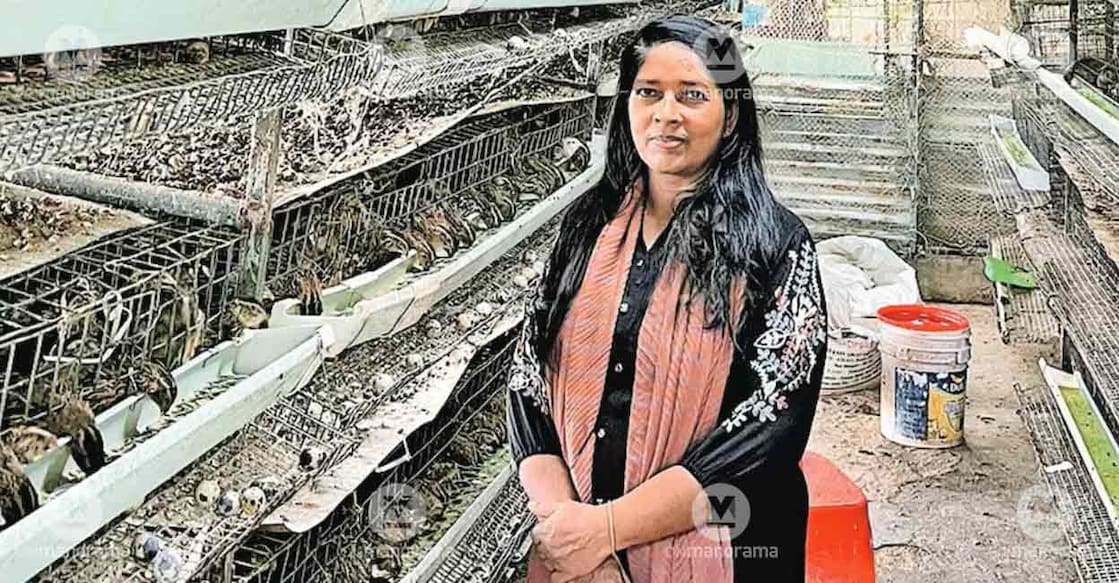
After returning home from school, Sheeja Teacher, as everyone fondly calls her, spends all her time among her poultry stock of hens and quails. She says her income from egg production and her small egg nursery often matches or even exceeds her salary as a teacher. With over 15 years of experience in poultry farming and allied activities, she also has plenty of insights to share with aspiring entrepreneurs entering the field.
Sheeja’s love for flowers and birds began at a very young age, which makes her involvement in this business all the more exciting for her. She also grows fish, keeps honeybees, and cultivates vegetables to meet her family’s needs.
From eggs to income
It all started with her egg-loving children. Wanting to meet their preferences, Sheeja began rearing hens and later added 50 quails to her small farm. When she realised that eggs, once bought from the market, were now being produced home, she sensed the business potential in poultry farming. Convinced that it could generate a decent profit, she decided to step into the field.
Her first attempt was a broiler farm, but it failed as the price of poultry meat fluctuates heavily, increasing the risk of loss. It was after this setback that Sheeja shifted to egg production, a segment that enjoys steady demand in Kerala all year round.
On her poultry farm, Sheeja tends to a flock of 2,000 BV 380 hens and 7,000 egg-laying quails. The BV 380 hens are highly productive, laying about 80% of their eggs in the first 18 months, with peak production reaching up to 95%. After around 15 months, egg production gradually declines, and when it drops to about 65%, the hens are sold for meat. The wholesale price of each egg is ₹7.
Her quails too follow a similar pattern. In the first year, they lay 75–80% of their potential eggs, with production peaking at 95% during the first five months. Quail eggs sell for ₹2.50 each.
Feed is the largest expense in egg production. Depending on their growth stage, hens and quails receive different types of feed such as layer mash, layer pellets, layer crumble, and grower feed. Each egg-laying BV 380 hen consumes 100–120 grams of feed daily, costing ₹3 to ₹3.50, while a quail requires about 30 grams of feed, costing around ₹1.50 per day.
While feed costs can be partially offset by using vegetable waste and grass, collecting these materials is time-consuming. Sheeja therefore relies on commercially prepared feed, ensuring consistent quality and maintaining high production levels.
Sheeja ensures that all her birds are vaccinated against diseases on a regular schedule. In the event of illness, she consults a veterinary doctor, although she notes that access to professional veterinary services for poultry farms is often limited.
The actual cost of egg production can only be calculated by accounting for feed, investment in cages, expenses on medicines and nutrients, the price of chicks, and transportation costs. As a result, production costs may vary for each entrepreneur.
BV 380 hens are sold for meat once their egg-laying declines. These hens, weighing on average 1.5 to 2 kg, are sold at ₹130 per kilogram. Quails that have completed their egg-laying cycle are sold at ₹35 per bird. The proceeds from the sale of birds are then used to purchase the next batch of chicks.
According to Sheeja, selling eggs and birds has never been difficult for her, thanks to her one-and-a-half decades of experience in poultry farming. She estimates that an average monthly income of ₹50,000 can be earned by rearing 600 to 700 BV 380 hens, though this can vary slightly depending on local market conditions. She also points out that those who can deliver eggs directly to homes, apartments, or restaurants can maintain better control over retail prices and earn higher net profits.
Egger nursery
In her egg nursery for BV 380 hens, Sheeja introduces new batches of one-day-old chicks every 15 days. These chicks are sourced from the Namakkal centre of Venkateshwara Hatchery, with each batch comprising 4,000 to 5,000 chicks depending on demand. Once grown for two months, each chick can be sold for ₹170, with an additional ₹18 added to the price of bird for every extra week of growth.
Quail chicks are handled more selectively. Sheeja receives quail chicks in limited quantities because roughly half of each batch are males, which have little demand. In contrast, BV 380 chicks are selected by gender, so this is not an issue. Female quails at four weeks of age are sold for ₹45, while males fetch ₹35.
Tips for aspiring poultry entrepreneurs
Although Sheeja runs both an egg nursery and an egg production unit simultaneously, she recommends that beginners focus on egg production. The risk of loss in egg production is much lower, making it a safer venture for newcomers.
Egg nurseries can be challenging and carry higher risks, especially if preventive vaccinations and proper flock care are not followed. In contrast, birds grown for egg production have already completed their vaccination schedule and nursery phase. These birds require only timely water, feed, and calcium supplements.
In addition, the excreta from both hens and quails can be sold as manure, providing extra income. Chicken manure can fetch ₹50 to ₹100 per bag. However, demand is lower in rural areas, and any leftover high-quality manure, after personal use, is often given away for free.
The cost of cages for quails and hens varies depending on the construction method and other factors. While the initial investment in high-tech cages is higher, they are more durable and last longer. The ideal location for setting up these cages should have ample airflow and sunlight. Avoid densely populated areas, and ensure that all necessary permits and approvals are obtained at the very beginning. Poultry sheds should comply with the existing legal framework.
Beginners are advised to enter the field only after gaining a clear understanding of poultry rearing. This can be achieved through market studies, attending training programs, visiting other farms, and interacting with experienced poultry farmers.
It is best to start on a small scale and expand gradually. Once the purpose of the poultry business is decided, suitable chicks should be purchased from standard and trustworthy hatcheries. Ensure that the chicks have received all preventive vaccinations.
Sheeja Teacher also recommends that BV 380 as the best choice for commercial egg-laying poultry. She can be contacted at 8589957371 for guidance and support.
 Add as a preferred source on Google