

Kerala church unveils multi-level cemetery to address land, environmental concerns

Mail This Article


Thrissur: Breaking away from the traditional image of cemeteries as sombre, space-consuming burial grounds, a church in Kerala's Thrissur has introduced a modern, environmentally conscious alternative.
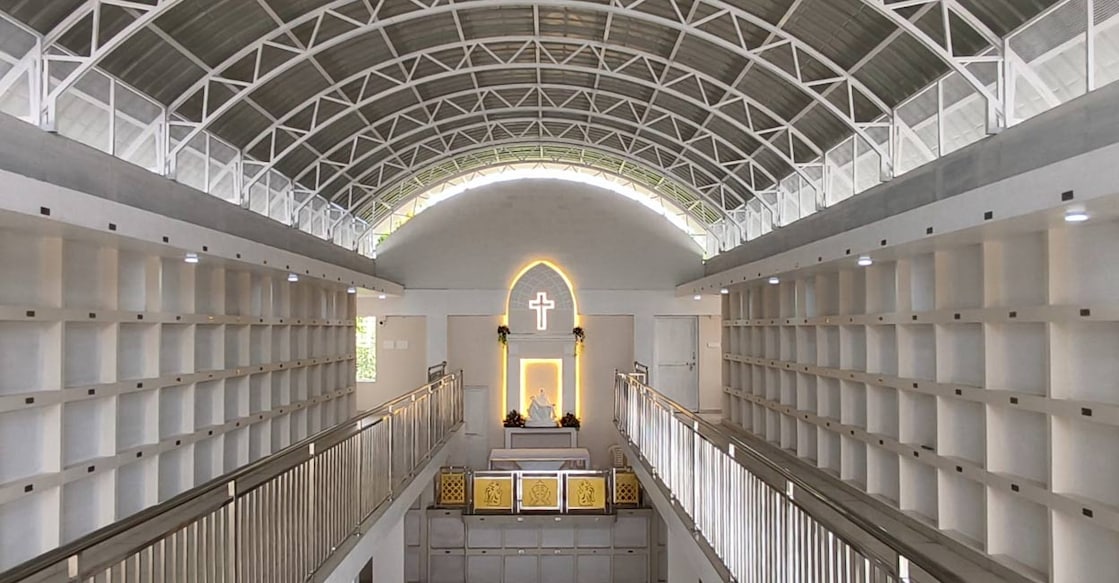
The St Alphonsa Church at Vallakkunnu, under the Irinjalakuda Diocese, has established a unique cell-based cemetery inside a two-storey building, offering a sustainable solution to growing land scarcity and environmental concerns.
From the outside, the structure resembles a parish hall or even a shopping complex. However, stepping inside reveals a thoughtfully designed cemetery spread across 6,000 square feet over two floors, housing 388 burial cells. The project was completed at a cost of ₹3 crore, funded entirely through contributions from parish members.
According to parish priest Fr Tinto Kodiyan, the facility has been designed to ensure that funeral services can be conducted comfortably regardless of weather conditions. Family members and mourners can participate in ceremonies from both levels of the building, protected from rain and extreme heat.
While a few churches across Kerala have introduced limited cell-based burial systems, Vallakkunnu's project is believed to be the first of its kind in the state to accommodate cemetery cells within a dedicated multi-storey building.
Parish member Sunny, who played an active role in the project, said the new model also helps eliminate environmental issues often faced by residents living near conventional open cemeteries.

For decades, Vallakkunnu parish lacked its own cemetery, forcing families to bury their loved ones at a neighbouring church. The idea of constructing a cell cemetery was first discussed among parish members in 2018. However, actual construction began only about one and a half years ago. Following the inauguration of the facility, the mortal remains of around 30 recently deceased parishioners have already been transferred and interred in the newly created cells.
The cemetery has been designed with a long-term sustainability mechanism. As the remains naturally decompose over time, they are transferred to an ossuary chamber located behind the cells, allowing the same burial spaces to be reused for future generations.
Church authorities believe the innovative project could serve as a model for other parishes facing land shortages and environmental concerns, marking a significant step towards modernising burial practices in Kerala.
 Add as a preferred source on Google