

Gujarati dandiya in Kovalam triggers unusual questions in Kerala; cause for concern?

Mail This Article


A dandiya and garba night in the heart of Thiruvananthapuram has sparked a debate over a question that may seem simple but touches on cultural identity: why is Kerala Tourism promoting a festival rooted in Gujarat? While the event is envisioned as a celebration of cultural diversity, concerns over the promotion of another state's traditions in Kerala have surfaced on social media.
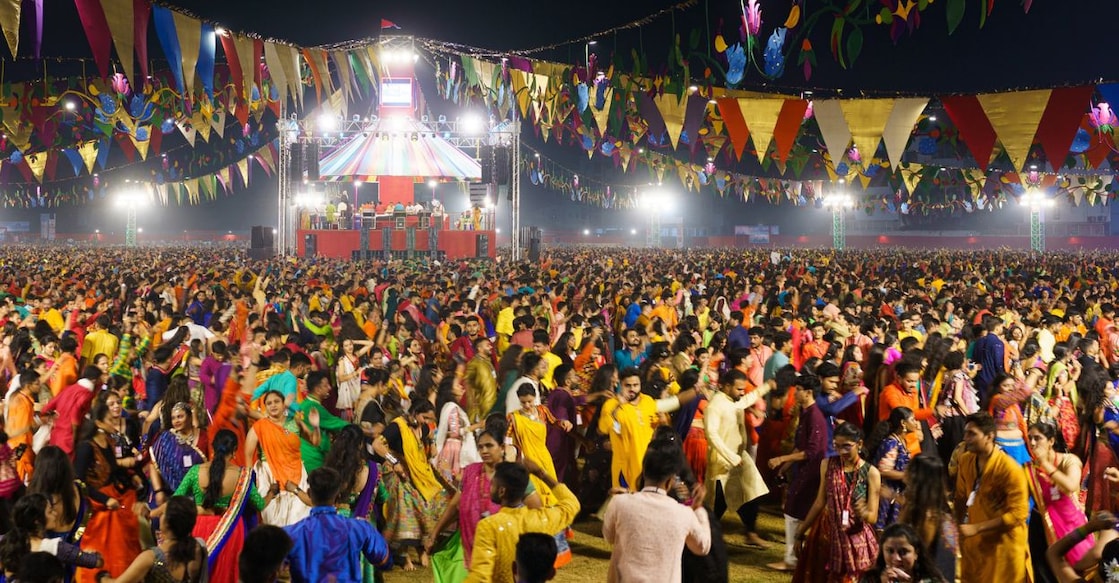
As the entire country celebrates Navaratri, a group of youngsters, in association with the Kerala Arts and Crafts Village, is gearing up to bring the vibrant dance traditions of western India to the capital. Titled Navranga, the five-hour event, organised by LiveByOruNewCulture (LiveByONC), will be held on October 17 at the Kerala Arts and Crafts Village in Kovalam, in association with Kerala Tourism.
The event promises an evening of dandiya and garba, two dance forms closely associated with Gujarat's Navaratri celebrations. Participants typically dance in groups or pairs to traditional music, with dandiya featuring rhythmic movements using sticks.
But even before the celebrations could begin, the event prompted questions about the rationale behind Kerala Tourism's support for a festival rooted in another state's cultural traditions. A social media post addressed to Tourism Minister PC Vishnunath criticised Kerala Tourism for supporting the event, questioning why Gujarati culture was being promoted in Kerala. The post went further, calling for a boycott of Gujarati culture, businesses and anything associated with the state, while linking the celebrations to wider political and economic grievances.

A few others questioned whether Gujarat would similarly welcome the promotion of Kerala's cultural traditions, such as Thiruvathira, on its soil. For the organisers, the reaction has been a bit disappointing, particularly when their stated intention was to offer people an opportunity to experience a culture they may not have encountered before.
“We came up with the idea of hosting a dandiya event because we found it unique. We wanted to bring a different culture to the city and give people a new experience. What we did not anticipate was the hate directed at us. Some accused us of trying to promote Gujarati culture, while others gave the event a political colour. A few even questioned whether the Gujarati community would allow a Kerala cultural event such as Thiruvathira to be held in the North,” Adhwaith, a representative of LiveByONC said. Despite these concerns, the registrations have given the team reason to remain optimistic. More than 700 people have registered for the event so far.
‘Why bring religion or politics into it?’
Sree Prasad, COO of the Kerala Arts and Crafts Village, which functions under the Kerala Tourism Department, said the event was also conceived as an opportunity to place women at the centre of a public cultural celebration.
“Across India, there are very few festivals where women are given such prominence. At many musical festivals, men tend to dominate. Can you think of another event where women become the main attraction as dancers? We have different cultural traditions across the country, and an event like this gives women the opportunity to come out, dance and enjoy themselves. That is what we wanted to achieve,” he said.
He also questioned the need to attach political or religious interpretations to the event. “There is no need to bring politics or religion into this. People who have not seen or experienced such festivals before should be able to come and enjoy them. We see the objections as a non-issue. Kerala should be known as a state that welcomes different cultures and religions. If people try to bring politics or religion into it, we should simply set those arguments aside,” he said.
A tradition that remains largely within the community
In Kochi, the Gujarati community has maintained its Navaratri traditions for generations. However, celebrations have largely remained within the community, with events often held in temple premises.
Manish, whose family has lived in Mattancherry for generations, said the celebrations in Kochi are largely attended by members of the Gujarati community, although some neighbouring Hindu families also participate.
“Everyone is welcome, but most of those who attend belong to our community. Some nearby Hindu families also join us, but otherwise, the celebrations have remained largely within the community,” he said.
‘Those who oppose it are resistant to change’
K J Sohan, former Mayor of Kochi, said Kerala has historically been home to different communities and traditions, with people living alongside one another in relative harmony. “Kerala has always been inclusive of different cultures. There is a great deal of harmony among people from different backgrounds. Those who oppose an event like dandiya in Kerala are likely to be people who are resistant to change,” he said.
With Navaratri celebrations underway, several events are being planned across the state. Thiruvananthapuram alone is expected to host around 15 to 20 celebrations, ranging from smaller gatherings to larger public events. In Kochi, the Gujarati community is also preparing for its traditional festivities. Against this backdrop, the Dandiya debate raises a larger question about cultural exchange in a state that takes pride in welcoming diverse traditions.
