

Power struggle: Pinarayi finds Satheesan's role in power purchases 'mysterious', CM hits back
Mail This Article


The LDF is in no mood to let the controversy surrounding the purchase of power from the 'over-the-counter' power platform, General Network Access (GNA), die down.
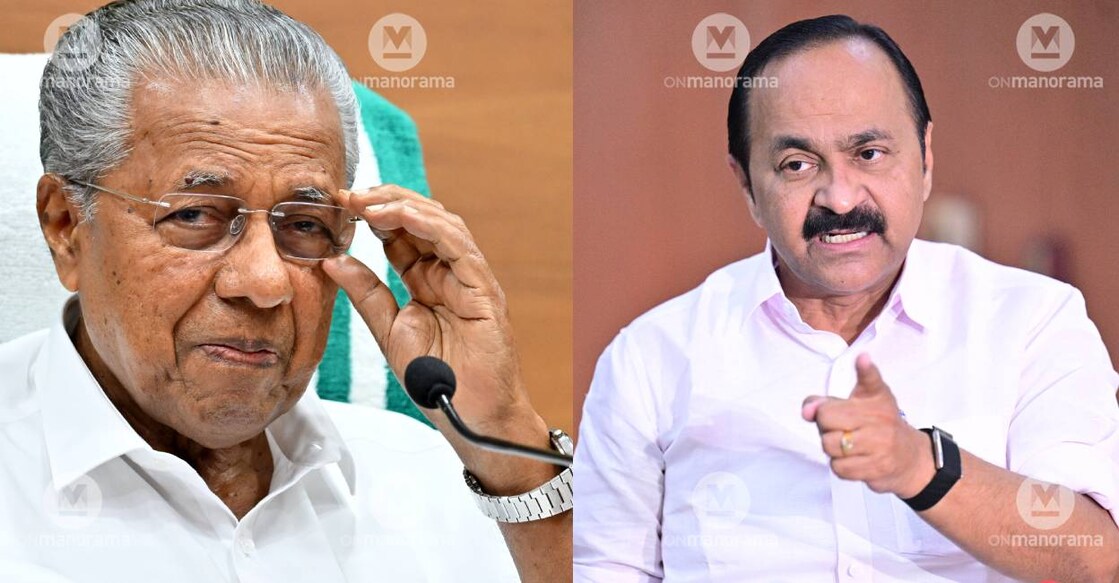
Opposition Leader Pinarayi Vijayan called a press conference on Friday and said the agreement with GNA was an attempt to serve the interests of private companies that dominate power generation in the country. "GNA is not a power-producing company; it is only an over-the-counter platform. Why would the Chief Minister intervene directly on behalf of a company that does not produce electricity," Pinarayi said.
The Opposition Leader wanted the government to name the private company whose power would be purchased through GNA. "It is highly mysterious that the name of the company is kept under wraps," he said. Pinarayi then urged Chief Minister V D Satheesan to publish all the files and documents related to the power purchase agreement with GNA.
Soon after, the Chief Minister sought to rebut most of Pinarayi's charges in a Facebook post. He termed as "baseless" Pinarayi's remark that the "Chief Minister's interest in securing the deal for GNA is shrouded in mystery".
Pinarayi: It is misleading for the CM to state that the power from Himachal Pradesh State Electricity Board was priced at ₹14.50 per unit. Not only did the HPSEB revise the cost to ₹12.50 per unit but also rescheduled the supply during peak hours.
Chief Minister: This is incorrect. In the file that came to me, here is what the very officer you had called "efficient" (former KSEB chairman M D Rajamanickam) had said about Himachal power on October 29, 2026: "12.50/kWh shall not be treated as confirmed unless expressly accepted in writing by the competent HP (Himachal Pradesh) authority".
It is clear from this that the Himachal authorities had not given KSEB an assurance that the cost would be reduced to ₹12.50 per unit. How did the Opposition Leader receive a proposal (of the lowering of cost) that even KSEB had not received?
According to documents collected from KSEB and the Rajasthan Regulatory Commission, the Rajasthan board had approved an agreement to purchase electricity from Himachal on October 17, 2026, at Himachal's urgent request, and issued a letter on October 18. How can Himachal agree to supply electricity to Rajasthan at ₹15.50 per unit and offer it to KSEB at ₹12.50?
Pinarayi: GNA's rate of ₹8.63 per unit will apply during the whole day, even during non-peak hours when Kerala does not require power. As a result, there will be an additional loss of ₹722 crore. The Chief Minister is masking this. He is trying to justify GNA offer by comparing it with the old rates of Himachal.
CM: So, you have acknowledged that GNA is the better option when compared with Himachal's old tariff. Fact is, Himachal has offered KSEB only one rate.
There is no distinction between an old rate and a new rate. Pinarayi Vijayan, who is now saying that GNA is not a power generation company, had purchased electricity several times through the same organisation when he was Chief Minister. Did those who prepared the note for the Leader of the Opposition deliberately forget this? If so, they are trying to embarrass you. We are ready to provide the details of the electricity purchased by the previous government through GNA if the Leader of the Opposition asks for them.
Pinarayi: Why is there a reduction in Keralam's internal production? (Down to below 10 million units daily from over 20 MU in September). There is enough water in our reservoirs (65 per cent on November 5). There is power in the open market, too. The Chief Minister is manufacturing a power crisis with ulterior motives.
CM: Let me bring to your attention what the former KSEB chairman wrote on October 29, 2026, in a file sent to the Chief Minister through the Electricity Minister: "An immediate decision is imperative, as the proposal has been under consideration for more than two weeks. The State's existing power shortage, compounded by deficient rainfall, constrained hydro availability and the reported El Niño conditions, leaves little scope to absorb further supply uncertainty. If the available power is lost without an equivalent firm replacement, KSEBL may be left with no practical option but to impose prolonged power cuts, including during the critical summer months. Further delay therefore carries a direct risk to continuity of electricity supply across Kerala."
During his media interaction, Pinarayi had said that GNA was involved only in power swap deals during the LDF tenure. For this, GNA was given only service charge, nothing more. LDF had never directly sourced power from GNA, he said.
Pinarayi: While power was available in the market for ₹5 per unit, GNA has charged ₹8.63, which is higher than the market price by around ₹3 per unit. This translates to an additional burden of ₹635 crore. Whose interests is the CM serving? Who is reaping the benefits?
CM: KSEB had stated that it had conducted six tenders through competitive means on the Union Power Ministry's DEEP (Discovery of Efficient Electricity Price) portal, but all in vain. It was also clear that the proposals submitted before the Kerala State Electricity Regulatory Commission did not include arrangements to ensure an adequate supply of electricity during peak hours, when the state's demand for electricity is high.
Your argument is that if electricity is available in the open market at ₹5 per unit, the state would have to pay GNA an additional ₹3.50. If that is the case, the cost of electricity from Himachal would be ₹9.50 per unit. Is the Leader of the Opposition's failure to mention this not tantamount to justifying Himachal's proposal, which came through the intermediary Power Trading Corporation (PTC)?
The decision to opt for GNA power was taken keeping the state's interests in mind. The assessment was based on which of the two would supply electricity at the lowest rate during non-solar and peak hours, when the demand is highest.
As recorded in the KSEB chairman's note, GNA would provide 385 million units more than the Himachal agreement during non-solar hours. During the peak hours from 6.30 pm to 10.30 pm, the average electricity supplied by Himachal in December, January, February and March would be substantially lower than the 500 MW supplied by GNA.
Moreover, the file records that the tariff under the Himachal agreement was above the maximum tariff of Rs 10 fixed by the Regulatory Commission and would therefore impose an additional financial burden on the state government.
The additional electricity available from GNA during daytime would also help Kerala regulate its hydropower generation and conserve water for the summer. The decision was taken after examining all the above factors.
Pinarayi: Can the CM take a decision that is contrary to the one taken by the minister and KSEB? This indicates that something inappropriate is going on behind the scenes. The CM said the agreement was signed by him.
Where is the Cabinet's collective decision-making? What is the role of the minister then? The CM can intervene only if there is a problem in the decision made by KSEB and the minister.
CM: You imply that I had intervened in the file without authorisation, that I bypassed the power minister. Since you do not have direct access to information about the movement of government files, on what basis are you making such an allegation?
The file you are referring to was sent by the Electricity Minister to the Chief Minister for a decision. The Chief Minister did not summon it. The file was placed before the Chief Minister for a decision, and he examined the financial burden on the state before taking an appropriate decision.
