



Use and outsmart AI to be relevant, only actors can truly embody emotion: Jayasurya & Ramesh Pisharody
Mail This Article


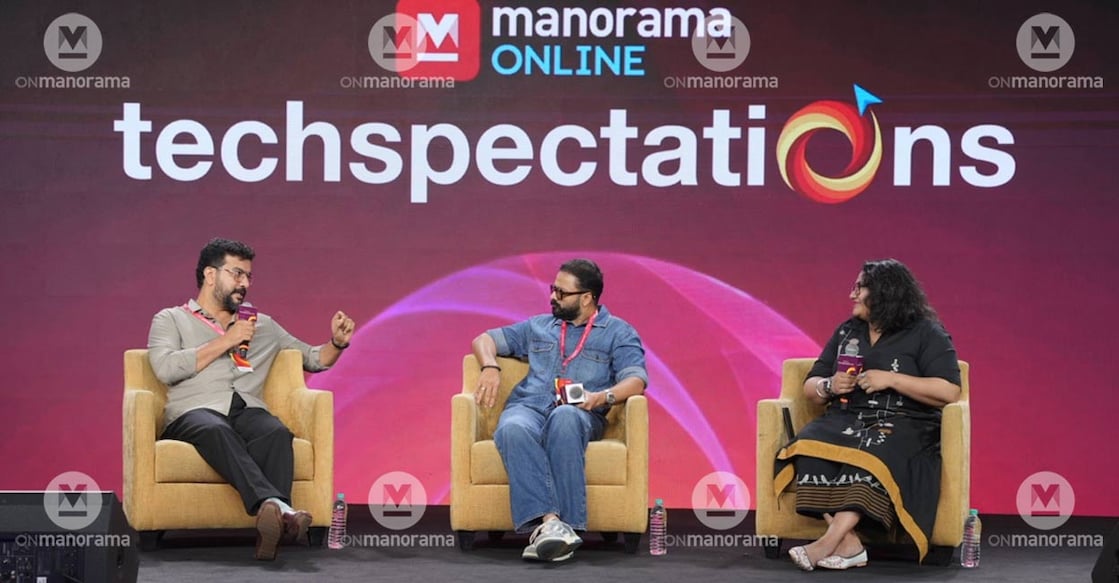
Actor Jayasurya believes artificial intelligence can support filmmaking, but cannot replicate the depth of human creativity beyond a point. Speaking at the ‘Fame to fandom: How movies, stars and screens are evolving towards 2030’ session at ManoramaOnline Techspectations, alongside actor Ramesh Pisharody, Jayasurya said AI is most useful during the pre-production stage.
“Pre-production is where AI helps movies the most. For art direction, costumes or planning, what may take humans a month can be done in seconds with AI. But when it comes to the creative space, I am not sure. Maybe in the future we will see,” he said.

Pisharody pointed out that change has always been a constant in cinema, but the speed of change today is what worries many creators. He compared it to art. A printed mural may cost a little, but a hand-painted original will always be more valuable. According to him, originality builds trust. If audiences know a work is not generated by AI, their faith in it increases.
When asked whether the rise of AI influences the creative process behind films such as Jayasurya’s upcoming Aadu 3, the actor disagreed. He said AI does not trigger creative ideas but can help visualise them faster. “Take Aadu or even Kathanar. AI can help in visualising things and speeding up processes, but the creative spark comes from us,” he noted. Pisharody added that human emotion remains the defining factor and that technology is ultimately meant to assist, not replace, human expression.
He stressed that AI cannot truly bring diversity in art because it does not genuinely feel emotions. “Each of us experiences emotions differently, and that shapes how we create and respond. AI can assist on the creative front, but it cannot replace the depth of human feeling,” he said.
On whether AI can surpass the quality of cinema, Jayasurya described it as a powerful tool but not a substitute for human creativity. He said the kind of emotions AI attempts to replicate can only be fully embodied by an artist or actor. Transforming an instruction into a blissful moment requires lived experience and imagination. “We are at a stage where we have to clarify that it is not AI, rather than assume that it is,” he said. Pisharody added that AI can be used across mediums as long as audiences trust the authenticity of the work.
Addressing concerns about identifying what is real and what is AI-generated, Jayasurya said such awareness will grow with time. However, he also warned about the potential misuse of AI. He pointed out that the industry still relies heavily on VFX for large-scale transformations and that these are expensive. Creating a realistic animal, for instance, can cost more than ₹50 lakh, something filmmakers have already experienced.
During the discussion, Jayasurya reflected on performance and audience connection. He said stage performances offer instant reactions, while films require patience, but actors ultimately carry an “inner audience” to evaluate their work. Speaking about Kathanar, he explained that heavy use of green screens demands strong imagination. Visualising a scene near the sea, for example, requires the actor’s mental space to align with that environment.


On the possibility of AI replacing actors, Jayasurya was clear that performance remains central. If a script demands a character and AI can assist in certain aspects, it is acceptable, he said, but the core of entertainment still lies in human performance. Pisharody echoed this view, noting that originality will always hold value in cinema and graphics as long as talented artists continue to create authentic work.
Jayasurya also observed that Malayalam audiences are particularly aware and discerning. For him, the effort that goes into performance makes both satisfaction and fair compensation important. Ending on a lighter note, Pisharody joked that he would happily send his AI double to attend events on his behalf, adding that while Jayasurya may have the luxury, he still needs to earn his living the old-fashioned way.
 Add as a preferred source on Google