

Trump makes modest gains by his best behavior in China
Mail This Article


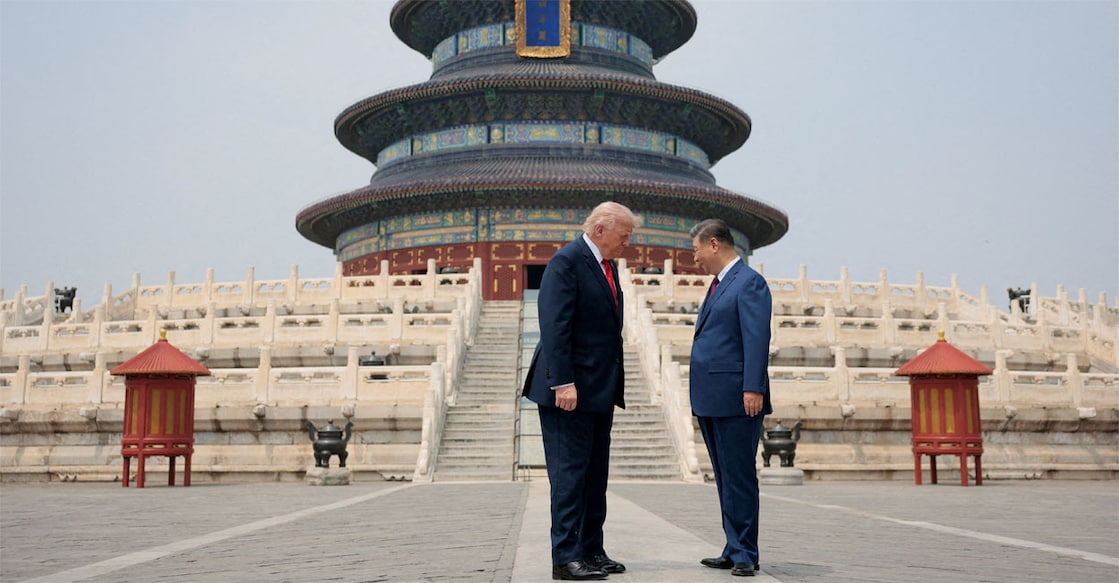
President Donald Trump was not his usual arrogant and abrasive self when he visited China from May 13 to 15, 2026. He was on a mission to improve his image before the mid-term polls in November by seeking a vision of constructive China-US strategic stability, to highlight the might of American industry and to secure as many orders as possible for beef, beans and Boeing. He tried to ingratiate Xi Jinping by praising him to the skies, though the latter was more restrained in complimenting Trump.
A concept had developed in 2000 of a “G2” by which the US and China, who were more or less equal in power and influence, would get close enough to work together for peace, stability and global development. But the idea was not championed by either side because the anxiety around the world about a condominium of the two dominating the world. President Trump referred to it casually in South Korea before his meeting with Xi, but it was not mentioned in his conversation with the Chinese President. Perhaps, since President Trump had his own expanding agenda, including Panama Canal, Greenland, Canada, Venezuela, Iran and Cuba, there was no question of a consensus between G2. He preferred to act according to his on whims and fancies without discussing his plans even with his own advisers. JD Vance and Marco Rubio were more their master’s voices than his advisers.
Another reason for the neglect of G2 was that Trump initially had plans to get close to President Putin to confront China. His quest for a Nobel Prize also had to be a solitary effort. He had not yet discovered the potential of Pakistan as a mediator. No wonder, therefore, most of his objectives had no role for a tie up with China.
Trump’s visit to China in May 2026 was prompted by a change of his priorities on account of his failure to accomplish most of his missions in the world. Panama Canal was too much in China’s grip to annex it. The Canadian PM had no desire to become the Governor of the fifty-first state of the United States. Prime Minister Mark Carney wanted to unite the “Middle Powers” against economic integration with the US and wanted strategic autonomy not only in politics but also in economic relations. A war with Denmark for Greenland would have meant taking on his NATO allies. President Trump claimed that he had obliterated Iran’s nuclear capability by bombing reactors deep under the ground, but Iran appeared to be right in its claim that they did not lose much in the bombing and Trump decided that some reactors over ground like the Natanz Nuclear facility, which were subject to inspection by the International Atomic Energy Agency (IAEA) were also a threat. Moreover, removing uranium enriched beyond safe levels stored in Iran had to be removed out of Iran.
The US invasion of Iran a day after the mediator, Oman had announced a deal, had the objective not only to destroy Iran’s nuclear capability, but also to bomb Iran to the stone ages. At one point, he even threatened to wipe out a 5000-year-old Iranian civilisation in one night. Then the target shifted to the Hormus Strait, which was open when the war started and a resolution in the UN Security Council, demanding that the Hormus Strait should be kept open was vetoed unexpectedly by China and Russia because they did not want the US to use that resolution as a justification for military action in Hormus.
The bombing by Iran of some GCC countries to force the American bases out of their countries widened the war and no amount of bombing could break the will of the GCC countries not to lose the protective shields of the US bases.
Having been frustrated by the failure to achieve military victory over Iran, the US used Pakistan as a mediator to end the war, but Iran remained firm with sufficient capability to continue the war. The failure of the chaotic tariff war to attain its objectives also added to Trump’s frustration.
Against this backdrop, President Trump went to China in the hope that a new understanding with China will secure China-US strategic stability. He tried to ingratiate the Chinese President by praising him to the skies. China received Trump with pomp and splendour, but there was not even a Joint Statement to reflect the shift in US-China relations with a view to prevent conflict. They resorted to respective read outs from the two countries, which had common elements in them. The US Statement merely said that Trump had a good meeting with President Xi. China expressed interest in buying American oil. Both countries agreed that Iran can never have a nuclear weapon, but China would not support any military action to attain that objective.
China brought up the issue of Taiwan, but there was no indication of any change in the Chinese position that Taiwan would be reunited either peacefully or by use of force. Trump indicated a dilution of its obligation to protect Taiwan by saying that he was not interested in a war 9000 kilometers away from the US mainland. The US even hinted that a USD 14 billion military package for Taiwan might be held back.
The US, in return for the political concessions, secured commercial benefits in agriculture, aerospace, manufacturing, and critical mineral supply chains. China approved purchase of 200 American made Boeing aircraft for Chinese airlines. This is the first time that China purchased such a large number of American aircraft since 2017.
President Trump made some modest gains by being on his best behavior in China, but his standing with China stood diminished as a result. But as Ambassador Shyam Saran, a leading China expert told Asianet News show, ‘Around and Aside’, “the trend line is towards the balance shifting towards China, but if we take the situation today, the US still remains the most powerful country in the world.”
The US-China rapprochement, however tenuous, is not without implications for India. Both China and Pakistan have become closer to the US. The US is already opposed to BRICS and it may lose interest in Quad, which has been characterised as the Asian NATO by China. A rethinking on our neighborhood has become imperative for India in the new circumstances.
