

Onmanorama Explains | What is FCRA Amendment Bill? Why it sparked controversy?
Mail This Article


The Foreign Contribution (Regulation) Amendment Bill, 2026, was introduced in the Lok Sabha by Minister of State for Home Affairs Nityanand Rai on March 25. It proposes key changes to the Act originally enacted in 2010. The NDA government’s amendment bill seeks to establish a comprehensive statutory framework for the vesting, supervision, management, and disposal of foreign contributions and assets through a ‘designated authority,’ including provisions for both provisional and permanent vesting.
According to the Central government, the amendment aims to bridge legal gaps in the management of assets created through foreign funds and to streamline the accountability of NGO functionaries.
Foreign Contribution (Regulation) Act, 2010
The FCRA, 2010 was enacted to regulate the acceptance, utilisation, and accounting of foreign contributions and foreign hospitality received by individuals, associations, and NGOs.
The Act was enacted in 2010, came into force in 2011, and has since been amended in 2016, 2018, and 2020. Approximately 16,000 associations are registered under the FCRA, receiving around ₹22,000 crore annually.
The Act aims to ensure that foreign funds are not misused for anti-national, political, or religious conversion activities in India. Under its provisions, accepting foreign contributions without prior registration or specific permission from the Central government is illegal.
Key Changes Proposed in the New Amendment Bill
The bill proposes the insertion of a new Chapter IIIA to provide a comprehensive statutory framework for the supervision, management, and disposal of such assets. Currently, while Section 15 of the Act provides for the vesting of assets, it lacks clarity on the procedures for their management, leading to administrative uncertainty and potential misuse, the government claims.
The amendment also seeks to:
- Introduce timelines for the receipt and utilisation of foreign contributions under prior permission
- Regulate the handling of assets during suspension of registration
- Provide for the cessation of certificates in cases of expiry, non-renewal, or refusal
It further proposes rationalising penalties and mandating prior approval from the Central government before initiating investigations, aiming to streamline enforcement and reduce inconsistencies.
According to the government, these changes are intended to address challenges such as multiple investigations, ambiguity in asset handling, and the lack of clear timelines, which have complicated the implementation of the existing law.
CBCI's concern and political controversy
A political controversy erupted after the Catholic Bishops' Conference of India (CBCI) expressed “grave concern” over the proposed amendments, describing the bill as 'dangerous and alarming' in its implications.
In a press statement, the CBCI said the proposed changes, 'brought under the pretext of licence renewal,' could enable 'executive overreach' into constitutionally guaranteed freedoms, raising serious concerns about undue interference in the functioning of minority institutions and civil society organisations.
The CBCI objected to provisions that would empower the Central government, as the licensing authority, to deny renewal or cancel licences and, through a newly proposed mechanism, assume control over institutions, funds, properties, and assets of NGOs and minority bodies.
According to the statement, provisions enabling the Centre to take control of foreign funds and assets of organisations upon expiry of their FCRA registration are “undemocratic, unconstitutional, and contrary to the principles of natural justice.”
The CBCI described the amendments as an attempt to bring minority institutions under an excessively stringent regulatory framework, arguing that such steps undermine democratic principles.
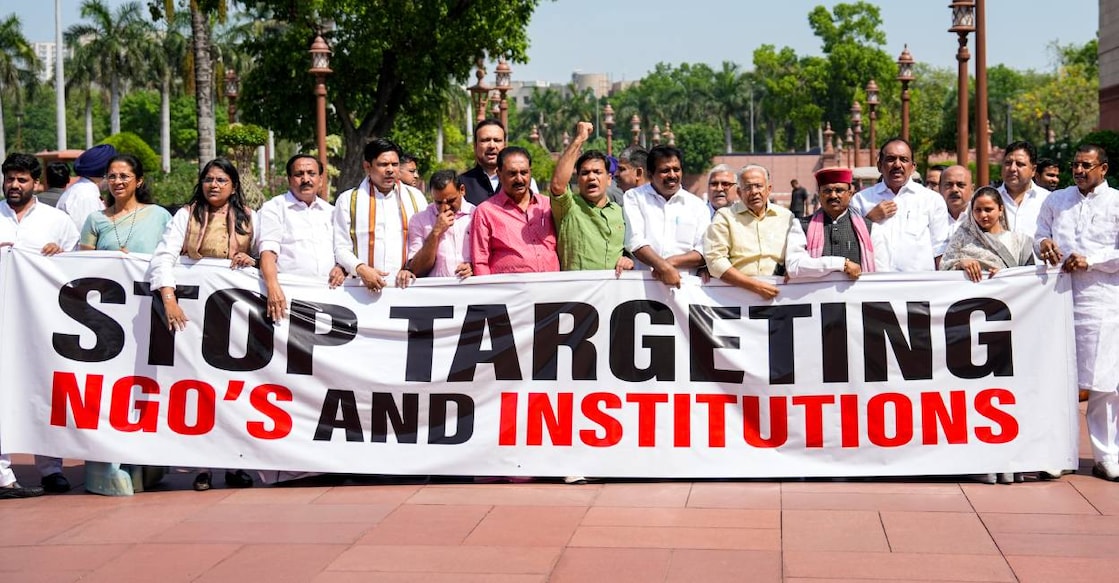
Following the CBCI’s criticism, political parties, including Congress, CPM, and the Samajwadi Party, opposed the bill and demanded that the Centre withdraw it.
Kerala Chief Minister Pinarayi Vijayan wrote to Prime Minister Narendra Modi seeking his intervention to withdraw the amendment provisions. He noted that a review of the bill’s clauses suggests that authorities could be granted powers to take over assets even in cases of minor or technical omissions.
Meanwhile, Union Minister Kiren Rijiju defended the bill, stating that it aims only to prevent the misuse of foreign funding against national security and interests, and is not intended to target any religious organisation. Speaking to reporters at the BJP headquarters, Rijiju also accused the Congress and Left parties of spreading misinformation about the proposed amendments.
