

The CJP movement: From the Supreme Court to Pradhan’s Resignation

Mail This Article


"There are youngsters like cockroaches, who don't get any employment and don't have any place in the profession. Some of them become media, some of them become social media, some of them become RTI activists, some of them become other activists, and they start attacking everyone."
A statement made by the Honourable Chief Justice of India, Surya Kant, on May 15, 2026. The Supreme Court was hearing a petition seeking directions to the Delhi High Court regarding the process of Senior Advocate designation. The bench found the petition frivolous and expressed strong disapproval during the proceedings. The oral observations arose during a side discussion regarding individuals infiltrating professional spaces through illegitimate means. The Bar Council of India had previously flagged massive concerns over unrecognised credentials.
Even though the CJI later clarified that his remarks on the oral characterisation of "cockroaches" were strictly an analogy for how these fake degree holders "backdoored" their way into the legal system and became highly problematic within the institutional machinery, the damage was done.

Social media was soon flooded with many accusing the Chief Justice of being insensitive to the problems faced by the youth. Specifically calling those who pursued a career in media, activism and social media as ‘cockroaches’ could not be dismissed easily, they said.
At that time, no one predicted these ‘cockroaches’ would go on to become one of the biggest movements the country had ever seen.
Political communications strategist Abhijeet Dipke, who was in Boston at the time, decided to create a meme based on the CJI’s statement. He created an Instagram account — Cockroach Janta Party, which took a dig at the Bharatiya Janata Party. The number of followers for the CJP shot to around 20 million on Instagram. Some even noted that this number was double the number of followers of the BJP.

This ‘satirical social media organisation’ soon became an internet sensation and one of the biggest generational movements that even shook the Central government. Dipke even said that he received death threats for creating the account. Around this time, news of the NEET question paper leak spread like wildfire across the country. Some of the aspirants who had attempted the exam committed suicide.
Though some may consider committing suicide for a paper leak to be an extreme step, the students cannot be blamed completely in this regard. Their blood, sweat, and tears that went into the exam preparation had become futile with the question paper leak. In a moment of desperation, they might have thought there would be no solution to this issue, which led to them taking their own lives. Their suicides became instrumental in what came to be known as the Gen Z movement.
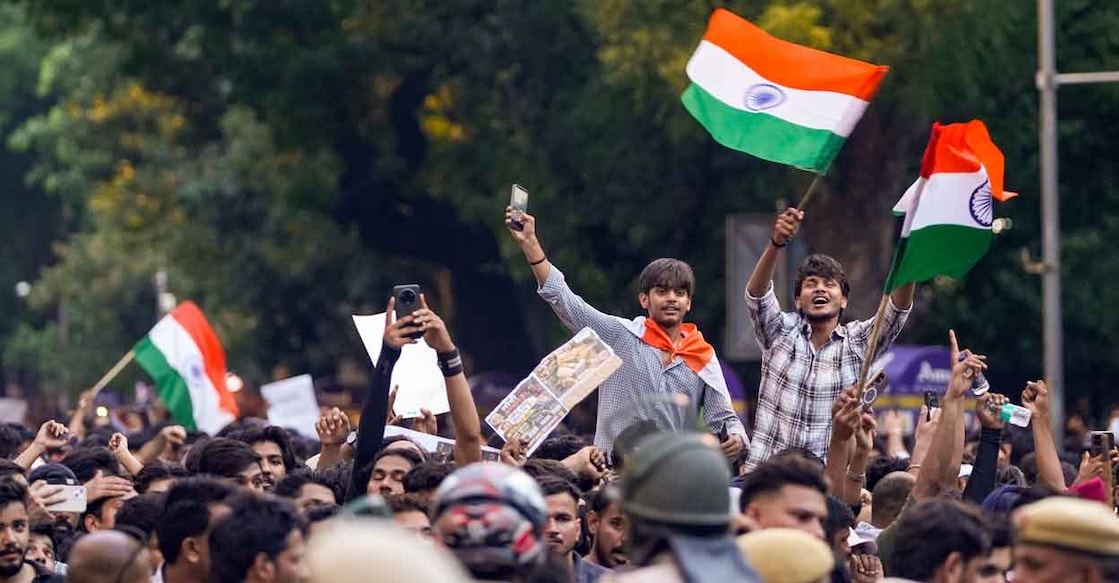
Abhijeet Dipke returned to India to spearhead the CJP movement against the paper leaks. The group held its first offline demonstrations in early June. Thousands of student protesters gathered in Jantar Mantar. They wanted the government to take accountability— through the resignation of Education Minister Dharmendra Pradhan. Though many supported this initiative, the movement also received criticism. The protesters were labelled as anti-nationals. Is fighting for accountability the new norm of anti-nationalism was how the protesters retorted.
Security personnel were deployed in Jantar Mantar to control the protesters. Political parties had joined in support of the students. Amidst all this, the government was still not ready to approach the protesters.
-
1 HOUR 26 MINUTES AGO
Honda ZR-V review: The sleek Japanese hybrid crossover with Civic DNA

The situation escalated on July 20, the first day of the monsoon session in Parliament. The protesters marched towards the Parliament, where they clashed with the security personnel. People across the country witnessed the situation in Delhi. Thousands offline and millions online demanded Dharmendra Pradhan's resignation. The first meeting between the CJP and the government had proven futile. The protests had reached such a scale that Parliament sessions were disrupted.
With no options left, government ministers met with the CJP. The group repeated their demands—resignation of Dharmendra Pradhan, withdrawal of FIRs registered against the protesters, and ₹1 crore compensation to the families of aspirants who committed suicide. Eventually, after another round of discussion, the final decision was made: Pradhan’s resignation. The government also assured the CJP of fulfilling the other two demands.
Thus, on July 25, Dharmendra Pradhan resigned. According to sources, a new bill will also be introduced in Parliament on Monday.
To many, this generation has proved that the youth cannot be subjugated anymore.
 Add as a preferred source on Google