

Architect-turned-pig farmer in Wayanad demonstrates unique profit model
Mail This Article


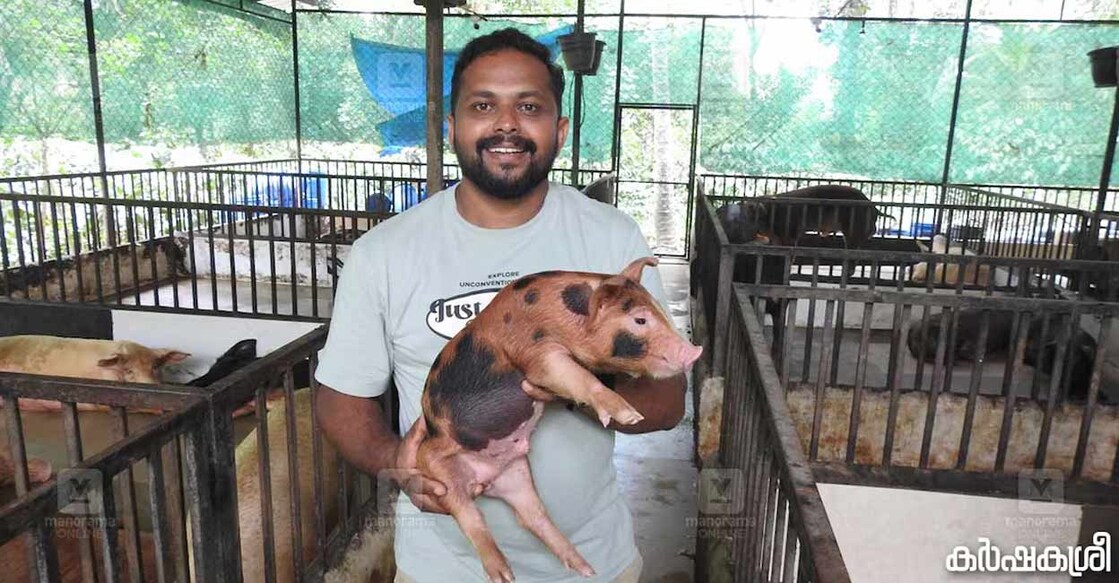
Bibin Chacko of Bathery in Wayanad, who is a leading young architect in Kerala, pursues a unique alternate profession – pig farming. “When I started my pig farm four years ago, a mature pig fetched Rs 80 per kg and a piglet Rs 3,500. The current price for pigs is Rs 200 per kg and a piglet Rs 6,500. Similarly, the price of pork has increased from Rs 220-240 per kg to Rs 380-400 during the same period,” he says.
Bibin says that the price has shot up due to a decline in the arrival of pork in the market. “Similarly, the popularity of pork has increased. Several entrepreneurs and farmers are interested in taking up pig farming. However, the society’s attitude to pig farms and entrepreneurs prevents them from venturing into this sector. My farm is an attempt to change such perceptions,” says Bibin.
Incidentally, as an architect with a BTech in Architecture and plenty of projects in Kerala and other states, Bibin too had faced much opposition when decided to start a pig farm. “What is the need for him to engage in such work?” many people asked him. Bibin still faces the query.
Bibin’s 6.5-acre ancestral farm at Poothikkad Valli in Bathery has been traditionally growing coffee. On the demise of his father, Bibin had to take up the responsibility of managing the farm. Bibin soon realized that coffee cultivation would be harmed if he focused entirely on his work as an architect, and decided to pursue both professions simultaneously.

His first priority was to seek measures to reduce the farming cost and enhance the yield. As the annual cost of organic fertilizer needed for growing coffee was quite high, Bibin searched for a method to source the fertilizer from his own plantation land. During this time, another entrepreneur, attracted by Bibin’s large land holding, approached him with a proposal to start a pig farm. Bibin also invested in the venture considering the availability of organic fertilizer for his coffee crop from the pig farm. But, the partnership venture had to be abandoned soon, as it faced a loss. Bibin said that the main reason for the loss incurred in the venture was its failure to adopt scientific methods.
After the partnership ended, Bibin considered starting the venture on his own and participated in a training programme of the Animal Husbandry Department. He also conducted a cost-benefit analysis based on his experience and knowledge. “I soon recognized that the biggest advantage of pig farming was that it needed little effort and time. I could engage in it even while working as an architect,” says Bibin.
Pig farming also was more profitable than rearing any other animal. Similarly, only a single worker was necessary even in a pig farm of 100-200 animals. “Cleaning the pens and washing the pigs are the only physical tasks at the farm. But such work could be easily done with a good power sprayer costing Rs 20,000,” says Bibin.
He says pig farmers generally don’t invest a share of their profits in the venture to make it more scientific and environment-friendly. “This is one of the reasons for people’s opposition to pig farms,” he says. Resolving to change this public impression, Bibin initially modernized the shed of the pig farm and purchased high-quality piglets from reputable farms. When these piglets attained maturity, he kept aside the animals with the best pedigree to create a male-female breeding pool. The remaining animals were sold for meat on reaching a growth of 10 months. I found while raising the first batch itself that good profits could be earned if the animals are given proper care,” says Bibin.
Soon, he expanded the facilities at the farm. “When you start a venture with high investment and scientific facilities, you should earn a proportionate income over a particular period. This can be possible only if a breeding unit is set up along with rearing pigs for pork,” he says. Bibin has built a farm spending Rs 18 lakh which has both facilities and is a model for all pig farmers.
The main attraction of the farm is an efficient waste management facility. The refuse from the pens are cleaned with a power sprayer and reach a storage tank, where it gets separated into slurry and solid waste. While the solid component is turned into compost similar to the Thumboormuzhi model and applied as fertilizer to coffee and other crops, the slurry is used to make biogas. The remains after making biogas are spread below the coffee plants. By carrying out these processes in a timely manner, Bibin ensures that waste is completely eliminated. “Coffee grows better and gives a better yield with pig waste than with poultry waste or cow dung as fertilizer,” attests Bibin.
Currently, Bibin’s farm has 40 sows for breeding. Each animal delivers twice a year and around 10 piglets are born during each delivery. Breeding at Bibin’s farm is planned in such a way that piglets are received throughout the year, with the sows divided into four batches of 15 animals each. The best piglets are given good care and sold after 55 days. During the first 35 days, the piglets remain with their mother, following which they are weaned and familiarized with artificial feed and leftover food. Meanwhile, female pigs which are less fertile and display poor care of their young ones are removed from the breeding pool. Bibin says profits could be earned when rearing pigs for meat and selling piglets are carried out together.
One factor that makes pig farming profitable is the use of leftovers from hotels and restaurants as feed. While pigs reared for pork are fed entirely with leftovers, those kept for breeding are given artificial food and limited amounts of leftovers to preserve their health and weight. Leftover food in Bibin’s farm is exclusively sourced from Ooty, which is 100 km away. “The leftovers from hotels and restaurants in Ooty have a better quality than what is received from Kerala. Moreover, even a shred of plastic will not be present in the leftovers from Ooty, as it is a plastic-free area,” says Bibin.
He now wants more young people to take up farming activities such as rearing pigs. “Agriculture can be made profitable simply by changing attitudes,” says Bibin.
 Add as a preferred source on Google