

2 deaths & 30-hour risky mission after Pathanamthitta quarry collapse flag serious safety concerns


Mail This Article


A rescue operation that spanned 30 hours in a granite quarry in Kerala's Konni, Pathanamthitta, to save two stranded workers and retrieve crushed bodies of two migrant labourers has thrown up questions related to safety during mining activities in the state. It was a mission fraught with danger at every step, according to the team members associated with the Special Task Force of Kerala Fire and Rescue services who eventually pulled off the operation.
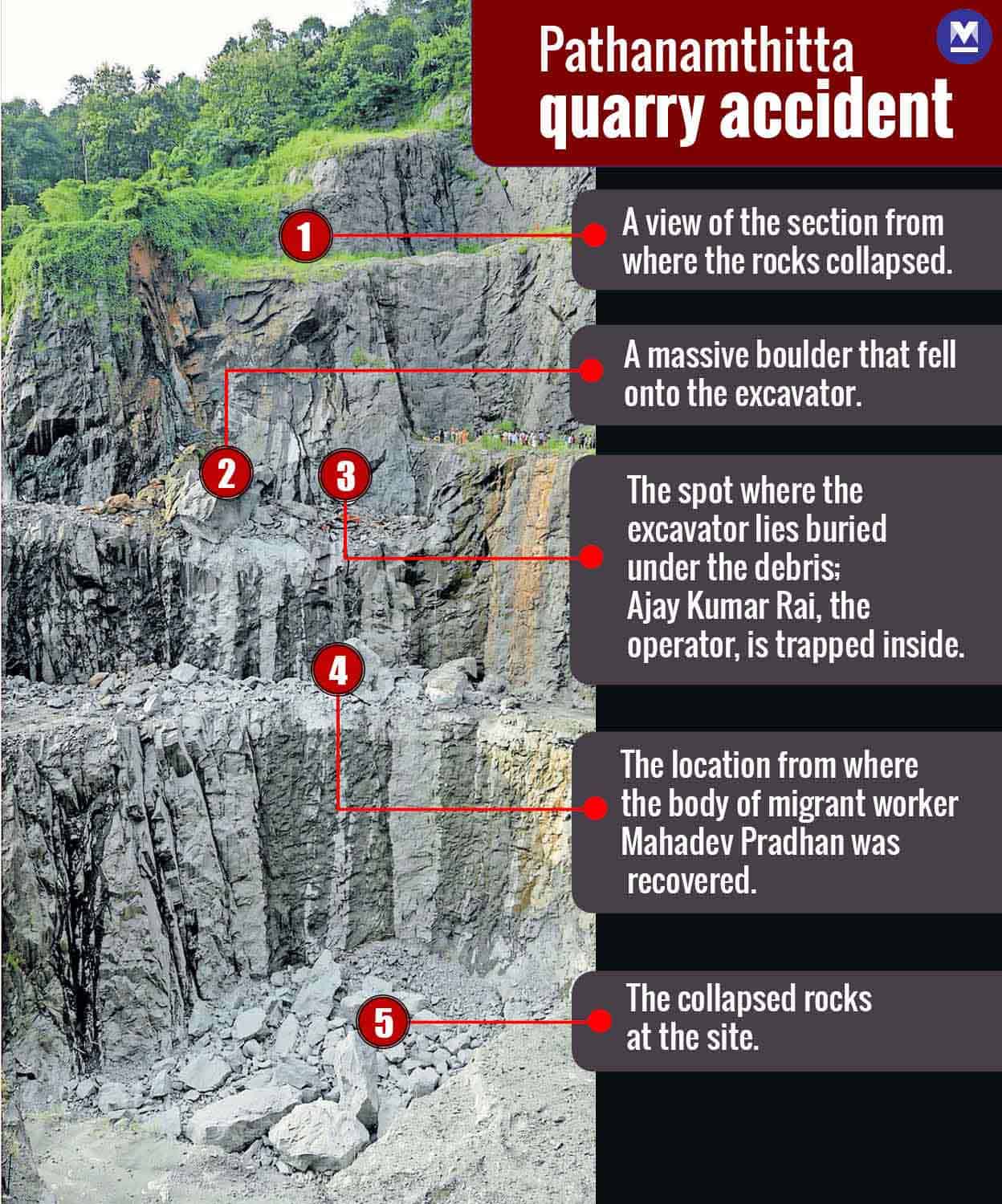
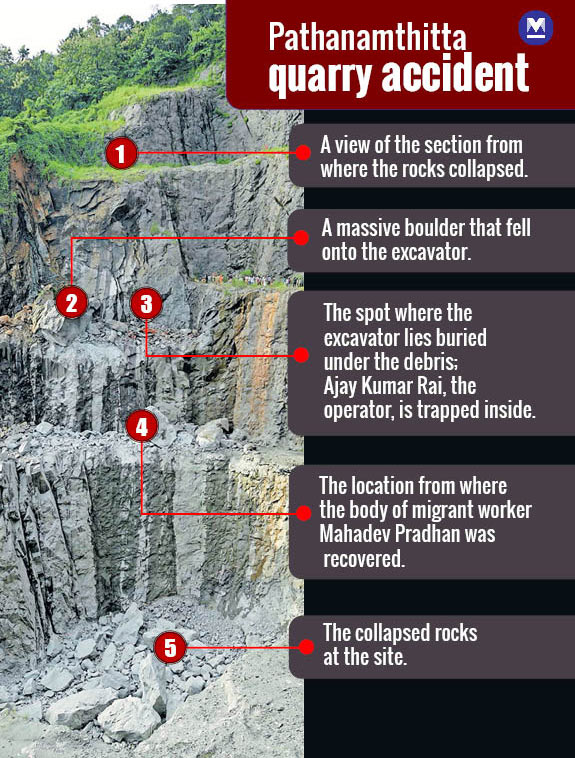
The incident, which happened on Monday evening, involved four migrant labourers working in the quarry that follows the benching method, regarded as one of the safest mining practices. A sudden collapse of massive granite blocks from the top led to the accident: two workers were killed while two others were stranded on a higher bench level.
The Konni fire station, located just 7 km from the site, received the alert at 3:30 pm. A seven-member team rushed to the spot and managed to rescue the stranded workers — Jyothish (23) from Odisha and Raju Barma (35) from Bihar — in a high-risk operation. They also recovered the body of Mahadeva Pradhan (50), another Odisha native. However, rescuers struggled to reach the fourth worker, Ajaykumar Rai (36) from Bihar, who was trapped inside an excavator buried under tons of granite.

Using high-mast lights, the long boom operators, with the advice of quarry workers, carefully removed the granite slabs covering the excavator. Once exposed, three STF members descended and broke open the cabin. Ajaykumar Rai’s body was found inside, still seated, crushed under the rocks. “There were no external injuries. The 7-foot cabin had been completely flattened,” said Jith, an STF official. His body was secured in a polythene bag and hoisted using the excavator bucket — the entire process taking nearly 1.5 hours.
Though the quarry is located just 5 km from the main road in the Athumpumkulam ward of Konni grama panchayat, rough terrain limited vehicle access to within 200 meters of the site. According to officials, each bench level in the quarry is approximately 50 feet high, with a total of six layers. The fire force attempted to use excavators with standard boom lengths but found them insufficient to reach the second bench. “The law specifies that benches should be six meters in height and width to allow vehicle access in emergencies. Many quarries, however, violate this by opting for high-wall mining for greater output,” said a retired official from the Mining and Geology Department.
The excavator was trapped on the second bench, but fallen boulders blocked access. Fire officials could walk up from the base to the third bench and reach the stranded workers, but couldn’t descend from the top to the second bench due to the absence of a road. “When we arrived, we couldn’t even see the excavator — only the detached bucket was visible. It was buried under at least two truckloads of granite,” said Santhosh, a Konni fire officer.
Additional teams from Pathanamthitta fire station arrived within 30 minutes. The rescue operation was further delayed by three minor landslips. “We spotted Mahadeva’s body under a massive boulder — his body was crushed, only his leg and head visible on either side,” Santhosh recalled. Using the excavator that was available on the site, the team managed to recover his body and safely evacuate Jyothish and Raju.
The former official, who was associated with mining practices, pointed out that mining must be done top-down, ensuring that no loose material is left above working levels. "If officials faced accessibility issues, it reflects a violation of the Central government’s Metalliferous Mines Regulations, 1961, under the Mines Act, 1952,” he noted.
The Directorate General of Mines Safety (DGMS), responsible for enforcing mining safety under the Ministry of Labour and Employment, has the nearest regional office in Bengaluru. According to the geologist, they rarely conduct regular inspections in Kerala. “Usually, they visit only after major accidents. Until then, workers’ safety depends entirely on the quarry owners,” he added.
The rescue personnel had to evade rock pieces falling off the steep, craggy surfaces throughout the operation. On the first day, as darkness fell, a rockfall narrowly missed the officials, and the operation was suspended for the night. The Fire Force’s Special Task Force (STF) — a 30-member elite team — was summoned and camped overnight in Konni and Pathanamthitta.
Early Tuesday morning, two STF members descended to the site using rope systems anchored to granite and nearby excavators. Armed with safety gear, they assessed the situation but soon realised manual removal of the granite was impossible. “If anything went wrong, we would have had to jump off the edge. It was that risky,” said Jith. Each rescuer was supported by five team members handling the pulley system.
Realising they needed a long-boom excavator, the team arranged for one to be brought from the Thottappilly spillway in Alappuzha. With the help of District Collector Premkrishnan and a police escort, the 23-meter-long arm excavator reached the site by 6 pm.
The STF also explored using iron ropes to drag the boulders but found it impractical. “Dragging from 100 meters wouldn’t have worked. Our chosen method was the safest,” said Dinumon, another STF member. The team credited their prior training in granite quarry rescues for the successful operation. “We practised for such scenarios. That’s what helped us avoid any serious injuries,” he added.
The quarry, which has been in operation for over 40 years, is unusually deep because it naturally drains water downward, according to fire officials. According to the geologist, this feature contributes to its dangerous depth. “High-wall mining was common across Kerala before 2015, when the state revised its rules mandating bench mining for safety. But enforcement remains weak. Many sites still lack designated mining engineers,” he added.
Workers had warned officials about the risk of frequent soil collapses. “When soil collapses, it creates air pockets, increasing pressure and triggering further rockfalls. Every person at the site was at risk,” Dinumon added.
Local residents have long raised concerns. “Our Athumpumkulam ward alone has five quarries — two are active. These activities have affected our drinking water, air quality, and health,” said Lalu K, a local resident. He alleged that quarry operators purchased adjacent land to suppress opposition. “There are houses within 400 meters, though road access makes it seem farther. Water from the stream is often contaminated. We’ve held several protests,” he said.
Excessive use of explosives for greater profits, in violation of regulations, was also flagged. “Such blasts cause invisible cracks in rocks far away. These can collapse anytime,” a former geologist warned.
Panchayat president Ani Sabu Thomas questioned why quarry licenses are being issued in ecologically sensitive zones. “Only two are active now; the others are crushers. But it’s like they are carving and consuming our entire hills,” she said.
 Add as a preferred source on Google