

Broken backbone: Kerala’s govt Medical Colleges in deep crisis
Mail This Article


(This report refers to several patients currently receiving treatment at medical colleges. None have approached us with complaints, and some have expressed fear that revealing their identities could lead to denial of medical care. Therefore, all names have been withheld to protect their privacy)
Government medical colleges, expected to be the backbone of Kerala’s healthcare system, are falling short of expectations. A surprise audit across six institutions exposed alarming lapses, validating Health Minister Veena George’s recent remark about “errors in the system."
Malayala Manorama reporters carried out a ground-level investigation across six government medical colleges, and what they uncovered was deeply concerning.
Kottayam Medical College
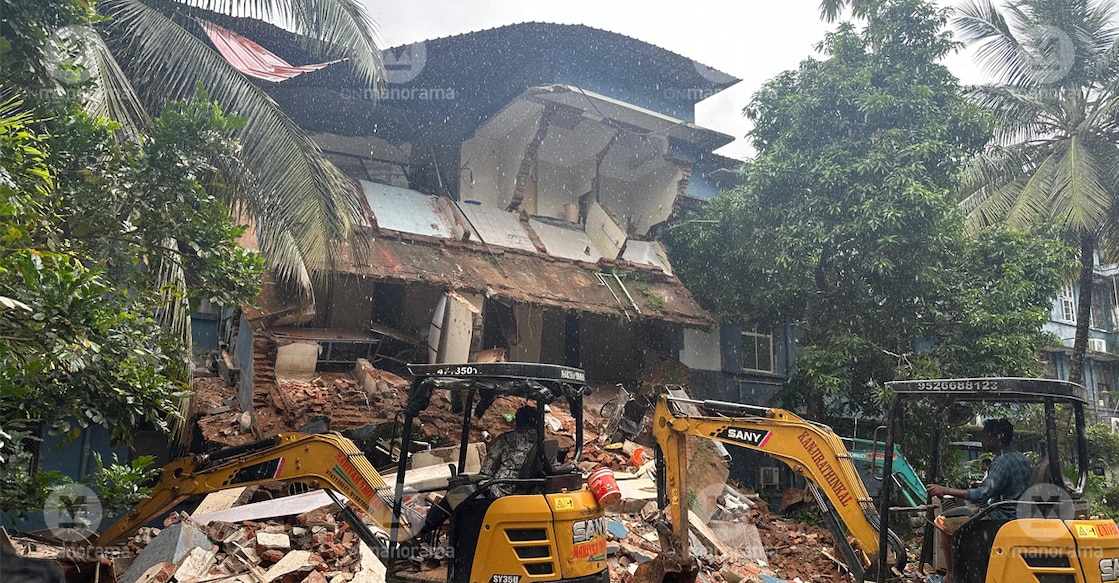
Sukumaran, whose wife underwent knee replacement surgery at Kottayam Medical College, was shocked after receiving a bill of ₹1.75 lakh. Of this, ₹1.15 lakh was for surgical instruments and implants alone. The surgery was reportedly at risk of being postponed if instruments weren’t arranged. Sukumaran managed the amount by pawning gold and borrowing money. A day after the operation, the toilet block of Ward 10, where his wife was admitted, collapsed. She was then moved to the hospital’s new block.
Alappuzha Medical College
Thilothaman stood in a long queue at Alappuzha Medical College’s Radiology Department, hoping to book an urgent ultrasound scan for his wife, who has been suffering from severe abdominal pain. But when his turn finally came, he was shocked to be given an appointment two months away—on September 15. The delay has been linked to a severe shortage of doctors in the department, where only four of the required twelve radiologists are currently available.
Manjeri Medical College
A 63-year-old man from Ozhukur, Malappuram, who sought treatment for severe stomach pain and bloating at Manjeri Medical College, died on Tuesday after spending a week in the ward without receiving the necessary diagnostic tests or timely ICU care. The hospital lacked an endoscopy facility, and a shortage of ICU beds delayed his transfer. Blood samples were taken hours before his death, but results were expected only five days later. The man, who had walked into the hospital on his own, left in an ambulance, lifeless, wrapped in a white cloth.
Wheelchair treatment at TVM Medical College
Ratheesh from Vilappilsala suffered a paralytic stroke and was admitted to Thiruvananthapuram Medical College Hospital on Sunday night. The next morning, he was still confined to the same wheelchair he arrived in, with no access to a proper bed. Ratheesh is not alone; other patients, including a snakebite victim, are also being treated while seated in wheelchairs due to severe overcrowding. These patients are the victims of the "system" the Health Minister has referred to.
Ward No. 1, designed for 80 patients, currently holds 220, forcing patients onto beds, floors, verandahs, and wheelchairs. The staff struggles to provide timely care amid overwhelming workloads. For instance, a nurse who puts a patient on IV fluid does not need to be back on time to stop it due to her workload.
TVM MCH's ward 28- One for unlucky patients
Patients in Ward No 28 fear each other as it houses people suffering from fever, stroke, snakebites, and mental health issues, creating fear and anxiety among those admitted. Surgeons warn patients to avoid catching infections before surgery, but isolation is impossible as contagious cases share the same space. Despite repeated warnings from head nurses about the ward’s critical state, no improvements have been made. Patients were relocated here after three other wards were demolished, with promises of new construction still unfulfilled. As election season nears, patients hope that at least a foundation stone will finally be laid.
When health card becomes a joke
Swapna of Punnapra anxiously waited outside the Cardiology ICU of Alappuzha Medical College Hospital, where her 63-year-old mother, Raji, underwent angioplasty on Monday. Despite being covered under the state’s Karunya Health Insurance Scheme, designed to help low-income families access affordable healthcare, the family had to pay ₹1,06,200 out of pocket for a stent.
The hospital recommended an agency for the stent, but the cost fell entirely on the family. With Swapna’s autorickshaw driver father as the sole earner, the expense has become a heavy burden.
Heart attack: Four days without proper treatment
Thomas Devasiya of Reshma Nivas at Thathampalli in Alappuzha was admitted to the medical college on July 5, after he suffered a heart attack. His relatives had taken him to a private hospital, which referred him to the Alappuzha Medical College for better treatment. Thomas spent one full day in the ward before he was shifted to the Medicine ICU, where cardiologists examined him. However, further treatment or tests could not be conducted since he was not shifted to the Cardiac ICU. Four days later, his relatives took him to a private hospital.
The gastro nightmare
The Gastroenteritis Outpatient (OP) Department of the Alappuzha Medical College functions only once a week, when the doctor in charge comes from Thiruvananthapuram. Normally, tokens are issued to 150 patients, but about 1,000 patients will arrive at the OP. The weekly trip to Alappuzha is tough for the doctor, too. To reach the department at 8 am, the doctor will have to start early. Typically, patients queue up as early as 6.30 am for the OP ticket.
The same consulting room doubles up as the urology room on other days of the week. On the day of our visit, the gastro consultation commenced late since the equipment of the urology OP had to be shifted. Though an assistant professor was earlier posted on a working arrangement basis, the doctor's term was not extended. Subsequently, the OP remained closed for four months.
No medicine for heart diseases
Sajimon of Vellanthengil at Kakkazham was waiting before the pharmacy of the Alappuzha Medical College. He had undergone an angioplasty a month ago. The treatment was free since he had a health card.
He was at the pharmacy to get the doctor-prescribed medicines. Of the six prescribed medicines, the pharmacy had only three. The three medicines unavailable were the costliest. "I don't have money. I will try to get them in the coming days from outside," Sajimon said as he left the pharmacy.
Ambulance stuck in queue
A narrow road and a lack of space often force vehicles bringing seriously ill patients to the Manjeri Medical College to wait for their turn to reach the emergency wing. At 4.30 pm, eight vehicles, including three ambulances, even with their sirens on, were waiting to drop off patients at the emergency wing. Since the hospital lacks an MRI scanning facility, ambulances should return through the traffic block to take them to scanning centres.
Rain or shine seldom matter
Patients at Manjeri Medical College must endure rain or sun while being taken to diagnostic tests, including CT scans, along roads shared with vehicles. Voluntary organisations have donated a few gurneys, but relatives or volunteers often have to push them or wheel patients to testing areas. Hospital staff only accompany patients in critical condition.
Doctor on knees
Besides patients and their bystanders, doctors and nursing staff, too, suffer due to the shortage of basic infrastructure. Their plight was seen at 7 am at the general medicine ward of the Thrissur medical college, which changes the general perception about them. Doctors and nurses were seen kneeling to attend to patients accommodated on the floor for the want of space.
A patient, who suffered injuries after he fell off a building, is awaiting surgery in one of the wards of the Thrissur Medical College. Though he was admitted almost a month ago, the influx of patients requiring surgeries has put him in the waiting list. The injured patient's surgery was further delayed after he developed bedsores. Once the plight of medical colleges became news, surgeries were expedited. This patient, too, will undergo the much-needed surgery soon.
OP or Outstanding Pain
People could be seen walking into the medical college even before dawn, with the intention of getting OP tokens. However, they are allowed into the OP counter only after 7 am. Those who obtain the tokens join other queues in the OP department to meet the doctor. If recommended diagnostic tests are required, their long wait continues at the lab. Still, it's not the end of the trauma. They have to wait for hours again to get the results.
By the time they get the result, the doctor might have left. For them, the process repeats. Hence, many people come with relatives or friends to take turns to wait in the queue.
A failed experiment
The Health Minister's intervention two years ago brought a modern clinical laboratory to the medical college. Collection of blood, testing and issuing results, everything was brought under one roof. The lab also provided the results on WhatsApp.
The facility was functioning well until a few noticed a sudden dip in their "commission". They reportedly put pressure on the Scientific Officer, forcing him to quit. The issue was the commission, running into lakhs, that came along with the purchase of the reagent needed for the lab. It was alleged that once the "extra income" decreased for some officials in the HDS Office, the "system", initiated by the minister, was scuttled.
The result? Bystanders have to run with the blood. If the doctor recommends a blood test for patients suffering from blood-clotting disorders (deep-vein thrombosis), their bystander will have to shuttle between the lab and the ward multiple times, wasting time and energy. At last, the result will be delivered the next day.
Under the open sky
Seriously ill patients at the Thiruvananthapuram Medical College Hospital often have the sky as the roof as they are left outside on gurneys. This is one sight the Health Minister, too, could see if she makes a surprise visit to the hospital.
Patients admitted to Super Specialty, Multi-specialty and Dialysis wards spend hours on gurneys outdoors, without food or water, irrespective of rain or shine, since they have only one ambulance to take them for tests or to the casualty block. The same ambulance ferries patients to the faraway Mental Health Centre or the Regional Institute of Ophthalmology.
Death by walking
The Super-speciality Block houses the Nephrology Ward and the Nephrology ICU, and the Dialysis Unit is half a kilometre away. Some patients, fed up waiting for an ambulance, walk all the way with the help of their relatives. Some others are wheeled into the unit.
Some claimed that instances of patients collapsing and dying while going to returning from the unit, too, have been reported. Even grievously ill renal patients in the Super-speciality block will have to take the ambulance or walk if they are referred to the Cardiology Department.
The long wait for scanning
The Kozhikode Medical College Hospital has only a single MRI scanner for patients admitted to the Institute of Maternal and Child Health, Tertiary Cancer Centre, Institute of Chest Diseases, and a super-speciality hospital. Bystanders have a tough time taking newborns, cancer patients and others to the MRI centre. Additionally, the waiting list is months long.
Another MRI machine, available in the PMSSY building, was damaged in the fire accident two months ago. The MRI scanning machine of the HDS at the Super-speciality wing is defunct and awaiting repairs for the past two years. The only MRI scan machine now available is in the ACR Laboratory run by the Kerala Health Research and Welfare Society.
The list of patients awaiting cardiac surgeries, too, is long. More than 200 heart patients, who do not need emergency procedures, are awaiting surgery. More than 30 patients are on the waitlist for kidney transplants. Undergoing ultra sound, CT, and MRI scans at the Thrissur Medical College is a herculean task. At least two days' wait is required for the scan, while the result will take another 10 days.
 Add as a preferred source on Google