

Five Keralites set out on India tour, they teach how to save lives on the way
Mail This Article


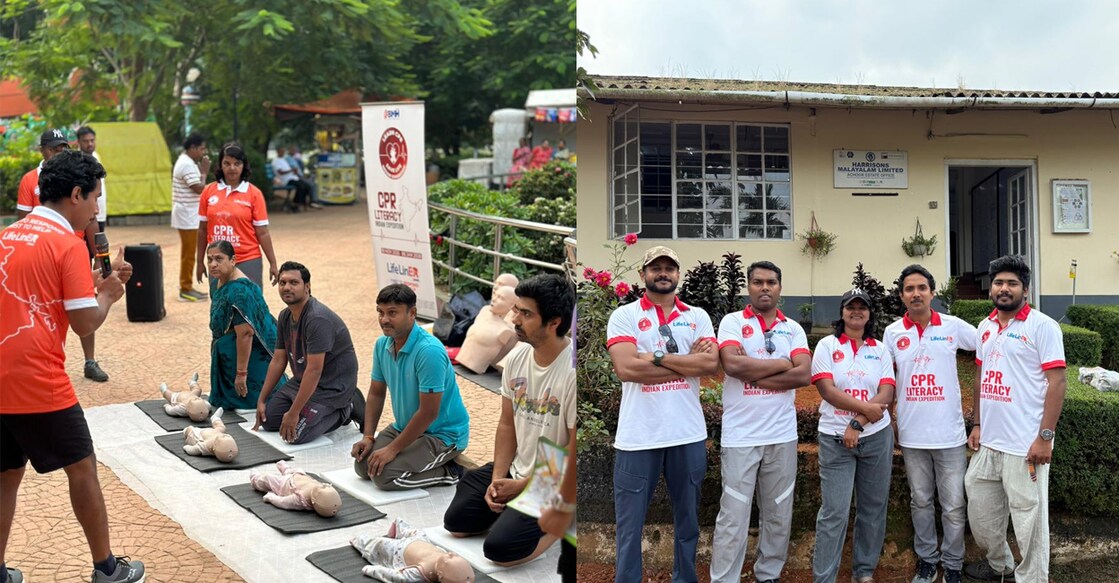
Kochi: What started as a long-planned all-India road trip for five old friends has now turned into something much bigger. The CPR Literacy Indian Expedition, led by three American Heart Association–certified trainers, is on a journey across 25 states, teaching people lifesaving skills like cardiopulmonary resuscitation (CPR), choking management and basic first aid, free of cost, wherever they go. Their motto is simple: "Be a first responder, not a bystander.”
The team is made up of nurses who met during their training years and have stayed close for more than a decade - Aneesh Issac from Ernakulam, Ashik Bobby and Aswin Francis from Kottayam, and the couple Akhil Viswanath and Lijumol TV from Wayanad. Lijumol is the only woman in the group. Among them, Issac, Viswanath and Lijumol are internationally certified Basic Life Support and CPR trainers.
“Going on an all-India trip was always our dream. But when we finally decided to do it, we thought why not give it a purpose too? Since three of us are certified trainers, we felt we could use the trip to spread awareness and train people in CPR and basic life support. When we shared the idea with friends and on social media, a few sponsors also came forward to support us,” said Issac.
The team flagged off their journey from Kozhikode Baby Memorial Hospital on November 10. They are travelling in a Nissan Micra and a Mahindra Thar, both loaded with tents, cooking utensils and LPG cylinders. Most nights, they camp wherever they can, sometimes with permission from institutions where they conducted sessions, and cook their own meals. Their days are split between travelling, conducting three-hour training sessions, sightseeing and responding to an increasing number of requests from people who want them to visit their towns.

The first few stops were in the Nilgiris and Wayanad. On November 11, they trained students at a tribal school in Gudalloor, and also the clerical staff of a nearby tribal hospital. The next day, November 12, they held a session for tea plantation workers at Harrisons Malayalam’s estate in Wayanad. They have since trained groups in Bangalore, Tirupati and several towns on the way and the list keeps growing.
The team does not believe in just talking. They carry infant and adult mannequins so that participants can practice CPR themselves hands-on. They also train people on how to use an Automated External Defibrillator (AED), a small device usually found in public places like airports, malls and railway stations. An AED checks the heart’s rhythm and, if required, gives a controlled electric shock to help restart the heart.
“People are extremely thankful after the sessions. Most of them have seen CPR in movies, but didn’t know how to actually do it. Lakhs of people die every year in India due to cardiac arrest, and the number of successful CPR cases is very low. In many Western countries, CPR is part of the school curriculum. It’s a simple technique, but if done in the first five to ten minutes - considered the golden time - it can restore 30-40% heart function before proper medical help arrives,” Issac said.
Questions and doubts are a big part of every session. The team takes time to address them all. Choking, they say, is one of the most common emergencies people face in daily life.
“People panic during choking incidents. But with correct first aid, they can be saved very easily. We show how to handle choking in babies and adults. Even small awareness can make a huge difference,” said Francis.
Between long drives, training sessions and campsite chores, the five friends are living their long-awaited road trip, just not in the way they first imagined. Instead of being just another travel adventure, the journey is turning into something meaningful.
They are happy that more people now know how to react in those first few critical minutes when every second matters. The team hopes that by the time they complete their 25-state expedition and reach Nagaland for the Hornbill festival, they could train thousands more.
 Add as a preferred source on Google