

This school near Kollam integrates agriculture and cattle rearing in their regular syllabus
Mail This Article


The picturesque countryside of Palliman in Nedumbana panchayat still bears the remnants from the days of yore when paddy cultivation, kannupoottu (cattle yoking) and maramadi (cattle racing on ploughed fields) were common. You need to turn left at Kollam Kannanalloor- Ayoor main road to reach this village that is known for its vibrant agricultural heritage.
Meanwhile, the sprawling campus of the Sidhartha Central School is just 500 metres away before you reach the Palliman junction. The vast courtyard features hundreds of fruit-bearing trees offering cooling shade and rows of blooming plants. A towering statue of Prince Sidhartha stands in regal splendour, carved in meticulous detail and adorned in luxurious ornaments. The statue symbolises the beginning of Sidhartha’s transformation into Lord Buddha.
The school buildings have been built on multiple levels without distorting the land's natural layout. Beautiful vines have made their way onto the walls and verandas, while the thick foliage of the giant trees is like splendid canopies that offer shade. Meanwhile, Sidhartha Central School is exploring the scope of mixed farming by leveraging the vast terrace area of the school buildings and the unique geographical features of the land. The school was started by the Sidhartha Foundation, an organisation of teachers actively working in the educational and cultural sectors, in 2004.
The teachers have focused on promoting agriculture and farming methods since the inception of the school. The school campus has more than 200 trees, some grown naturally and others planted by the authorities. So, the school buildings that are built under the shade of these trees are extremely cool even during the summer. Meanwhile, terrace farming, which has now spread across the entire campus, is an inevitable part of the curriculum here.
Vegetables are grown in more than 100 grow bags using the wick irrigation method near the dance mandap on the terrace of the LP section. Meanwhile, the oyster mushrooms grown in a dark room, using thick layers of green net, are ready for harvest. More than 6 kg of oyster mushrooms are harvested daily. The income from selling the mushrooms is divided among the students who are active participants in its farming, after deducting production costs.
The open area beside this has rows of over 150 grow bags in which vegetables are organically grown. Turmeric varieties such as Varada, Sona and Shoba are grown in 25 grow bags here. Ginger farming, too, is done like this on the school campus. Cattle fodder is grown in the five-cent plot next to the school. Plump dragon fruits hang from the thick vines that climb on the old fence. Three emus walking around in their cage look ready to lay eggs.
The main farmland, a bit away from the school campus, has many varieties of plantains; some have thick bunches ready for harvest. Meanwhile, pepper vines tightly embrace the areca nut trees.
Sidhartha Central School has been successfully following the mixed farming method. It grows 105 ducks, 20 country chickens and 35 BV 380 hens in specially made cages at the farmland. Besides, 25 vigova ducklings are also raised in separate cages. Turkeys that lay eggs every day could be seen in the farmland. Proper arrangements have been made to ensure that the vegetables and plants are grown organically at the school farm.
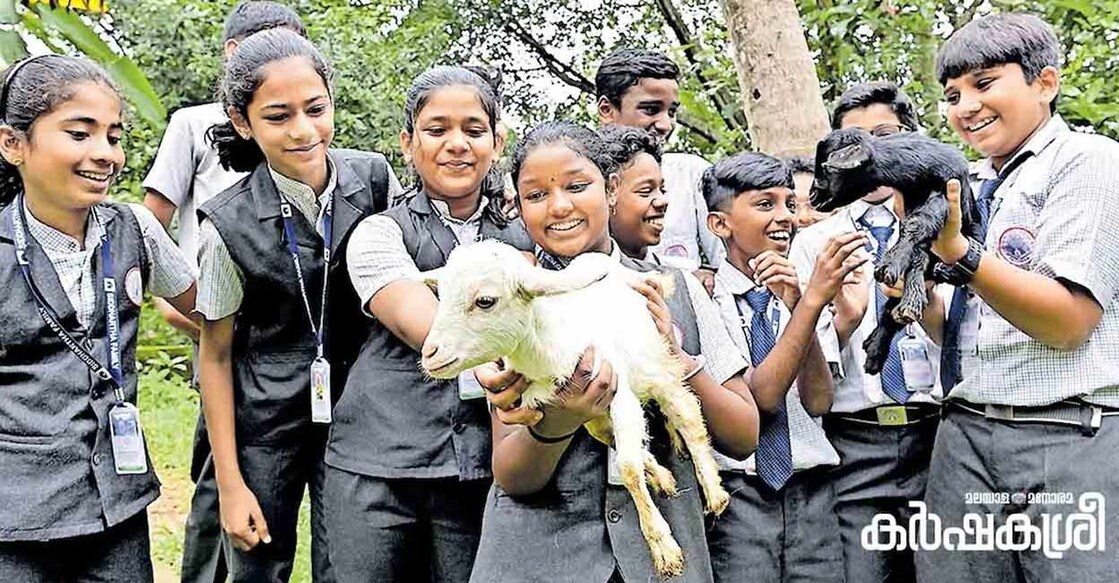
Three Canadian pygmy goats and their kids are kept in the first chamber of the cow shed that was built for rearing cows. Meanwhile, the other two chambers have jersey and Vechur cross varieties of cows. Six pigs of the Yorkshire and Angamaly varieties are in the next chamber of the cow shed. Facilities for making organic manure and vermicompost for the farmland are also arranged here. Besides, rohu and cutla fish are grown in a pond.
Tubers like yam and colocasia, and other vegetables are grown between rows of plantain trees. Meanwhile, hundreds of salad cucumbers are ready to be harvested in the polyhouse setup in two cents. Saplings have already been prepared here for the next cultivation cycle.
Suresh Sidhartha, the founder and secretary of the Sidhartha Foundation, says the school implements wholesome organic farming by utilising every inch of the campus. The school focuses on mixed farming methods without using chemical fertilisers or pesticides to instil an affinity towards the earth and nature among children. He insists that children should learn the nature clock and nature law, which cannot be learned from textbooks. So, more than 80 per cent of the students, from lower primary to higher secondary classes, engage in some form of farming at the school.
A special agricultural department at the school oversees farming activities and cattle rearing. Aashik Dutt who joined the school last year as a Malayalam teacher has voluntarily taken up the responsibility to manage this department. The school’s grand agricultural project includes four clubs with over 600 students participating in various activities. Nature club (175 members), Agriculture (200), Seed (150) and Pets (60) are the four clubs that upholds the school’s vision to promote organic and mixed farming. Besides, the management has appointed three permanent workers for the physical jobs. The trust, as part of its social commitment, also conducts classes on agriculture and farming for the parents and the public.
Meanwhile, Sidhartha Central School is all set to launch a project named ‘Oru Thenga Karyam’ that aims to plant 250 West Coast Toll variety of coconut saplings in the public places as well as houses in Nedumbana panchayat. The school fully funds this project, and the recipients have assured that they will take care of the trees.
 Add as a preferred source on Google