

'Plant it, forget it': Ornamental bromeliads can fetch easy income with minimal care
Mail This Article


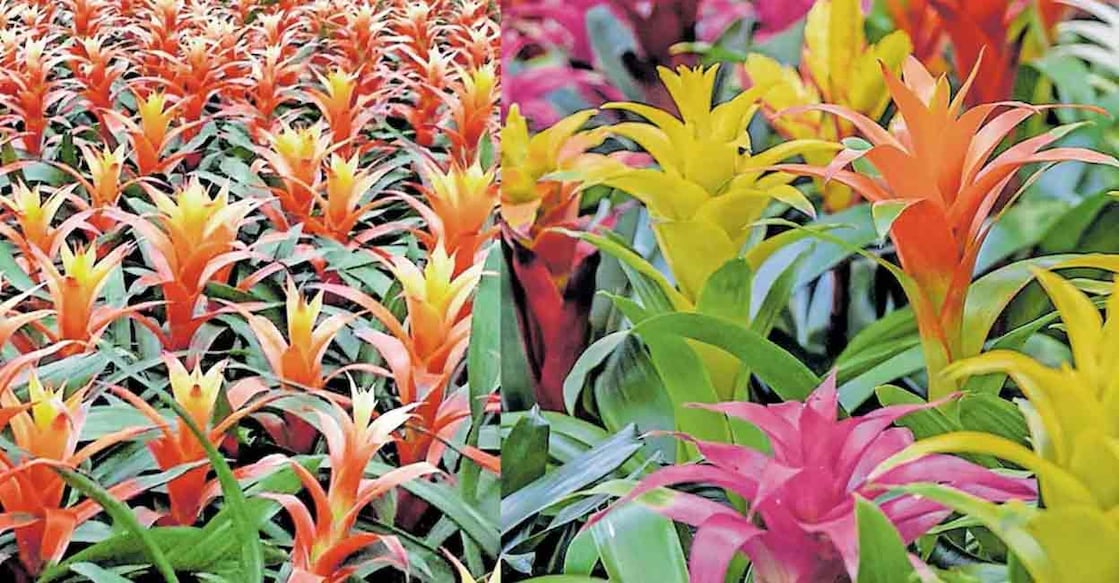
Ornamental plants from the pineapple family (Bromeliaceae), including Guzmania, Neoregelia, Billbergia and Cryptanthus, captivate garden enthusiasts with their striking blooms and richly coloured foliage. Their flowers, which appear in vivid shades of pink, red and yellow, are exceptionally eye-catching. In non-flowering varieties, the leaves themselves rival flowers in beauty, displaying fascinating forms, different hues and near-perfect symmetry.
Bromeliads are ideally suited for growing in pots on semi-shaded verandahs and balconies. The genus Tillandsia, popularly known as air plants, also belongs to this family. In their natural habitat within the Amazon forests, bromeliads thrive on tree trunks, forest floors and decaying wood, flourishing in fertile, moisture-rich environments. Most garden varieties are attractive hybrids developed from these wild species.
One of the greatest advantages of bromeliads is their low-maintenance nature. In fact, excessive care often does more harm than good. They should be planted in a potting mix that provides firm support to the roots. Watering at the base is unnecessary; instead, it is enough to keep the small central cup formed by the leaves filled with water. No fertiliser is required after planting, as the plant grows and flowers well on its own.
As bromeliads mature, the increasing weight of their leaves can cause the plant to topple. To ensure stability, the potting mix should be layered carefully. Adding sand at the bottom of the pot helps prevent it from overturning. Above this, a mixture of crushed coconut husk and a small quantity of organic manure can be added, with the roots set firmly into the mix. Filling the pot up to three-fourths of its height with crushed husk is sufficient to support healthy growth.
These plants can also be grown by tying the roots to tree trunks using coconut fibre. When grown this way, new shoots emerge from the sides and top, gradually forming a large, attractive cluster.
Like in pineapple plants, bromeliads are usually propagated using the offsets, commonly called pups, which emerge at the base of the mother plant. When these young plants grow to about half the size of the parent, they can be cut off along with their roots and replanted. If sap oozes from the cut surface, allow it to dry completely before planting.
A verandah or balcony that receives gentle morning light and remains relatively cool is ideal for these plants. Excessive heat can cause the leaf colours to fade and may even lead to scorching. Interestingly, pups are often produced when the plant experiences some form of stress, such as too much shade or sunlight, pest attacks or other adverse conditions. Even after flowering, the plant continues to produce offsets.
Plants like Guzmania and Billbergia tend to flower more actively during the cool season following the monsoon. The flower spike emerges from the centre of the leaf rosette. As with pineapple, once flowering is over, the parent plant gradually declines and dies.
To maintain the beauty of the leaves, it is best not to apply fertilisers. When plants are shifted from one location to another, both growth and flowering tend to slow down. The leaves of Guzmania are sometimes attacked by grasshoppers, and hence these insects should be removed and destroyed as soon as they are noticed. If the infestation becomes severe, it can be controlled by spraying an appropriate insecticide.
'Plant it, forget it'
Vishnu and Vinu, siblings from Kothamangalam, have been cultivating ornamental bromeliads for the past six years. What began as a casual interest soon turned into a hobby they fondly describe as "plant it, forget it"- a playful twist on the classic Hero Honda tagline, 'fill it, forget it'.
The beauty of these plants lies in the colour of their leaves and their symmetry. The brothers caution that the use of fertilisers can ruin the plant. For Vishnu and Vinu, who juggle busy professional lives, tending to bromeliads offers a calming escape during their limited free time.
They initially grew bromeliads alongside orchids, but learned an important lesson early on. When fertilisers meant for orchids were applied to bromeliads as well, several plants withered. The setback taught them the importance of caring for bromeliads separately, and reinforced the idea that these plants thrive best with minimal intervention.
They began their journey with Neoregelia varieties and gradually expanded their collection to include many other varieties. Today, they boast a wide array of bromeliad plants priced from as little as ₹30 to well over ₹3,000. Most of the new and exotic varieties are sourced from North India and Thailand. Among Neoregelias, the 'fireball' variety is the most sought after, partly because it is affordable. Another popular variety is 'match stick'. Though the plant itself is small, its flowers resemble matchsticks and are strikingly attractive, which is how it earned its name.
According to Vishnu and Vinu, bromeliads, including Neoregelia, are ideal for creating vertical gardens under partial shade. Watering once a week is sufficient. With their compact stems, these plants are far easier to maintain than many others and remain visually appealing with minimal care. Among flowering bromeliads, Guzmania tops the list in popularity and demand. The bromeliad collection of these siblings includes 26 varieties of Guzmania, which feature flower clusters in a range of colours. Contact (Vishnu): 9854760279
 Add as a preferred source on Google