

Kerala doctors use straw & blade to revive an accident victim at crash site, win praise
Mail This Article


Kochi: “Sometimes, you are the only person standing between a patient and imminent death. At that moment, you cannot hesitate.” Those words, spoken quietly by Dr Manoop B, summed up a Sunday night in Kochi’s Udayamperoor that turned three ordinary journeys home into an extraordinary act of courage, skill, and humanity.
On a dimly lit stretch of road near Valiyakulam in Udayamperoor, around 8.30 pm, amid road accident wreckage, blaring horns, and rising panic, three young doctors from Kerala made a decision that would mean the difference between life and death. With no medical kit, no operating theatre, and no sterile equipment, they used a shaving blade and a juice straw to create an airway for a man who was suffocating to death.
The accident was severe and violent. Linu, a native of Kollam, was riding his scooter when it collided with a motorcycle carrying Vipin and Manu at Valiyakulam. The impact flung all three onto the road. Two bikes lay mangled beyond recognition. Traffic slowed to a crawl at those peak hours, and a crowd gathered, unsure what to do.
Dr Manoop B, an Assistant Professor of Cardiothoracic Surgery at Government Medical College, Kottayam, happened to arrive a few moments later. A native of Mavelikkara with nearly 13 years of surgical experience, Manoop was driving back to Kottayam after an exhausting but triumphant day.
That morning, he had completed a 35-kilometre bicycle speed race organised as part of the Cochin Carnival in Fort Kochi. A swimmer, marathon runner, and cyclist, he had rested briefly at a friend’s house before starting his journey home.
As vehicles slowed near Valiyakulam, Manoop sensed something was wrong. “I saw two completely destroyed motorbikes and two people lying on the road. None of them were moving. I realised immediately this was a high-velocity accident,” he recalled while speaking Onmanorama.
He immediately pulled over and got out. Vipin was slightly moving, and Manu was conscious but clearly injured. Then Manoop noticed a third figure, lying beneath an electric post, helmet still on, completely motionless. That was Linu.
“People were crowded and confused. A traffic block had already begun. Since I am trained in trauma care, I decided to intervene,” Manoop said.
Following Advanced Trauma Life Support (ATLS) protocol, Manoop began triage. He gently tapped Linu’s shoulder and called out his name, but there was no response. When he carefully opened the visor of the helmet, the seriousness became horrifyingly clear.
“His face was covered in blood and soil. He had multiple facial bone fractures and severe spinal injuries. More importantly, he was gasping for air. His airway was fully blocked,” Manoop said.
In trauma triage, the red category means immediate danger of death. Linu was firmly in that category. “If the airway is not cleared, it leads to brain injury or death due to lack of oxygen,” Manoop explained.
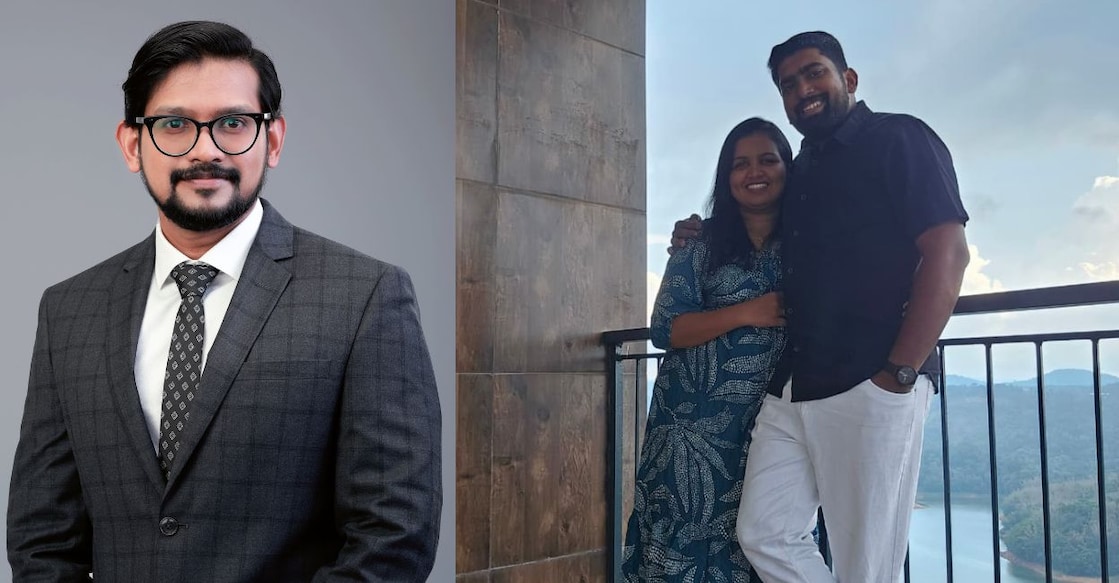
It was at that moment that two more doctors happened to arrive at the spot. Dr Thomas Peter and Dr Dhidiya K Thomas, husband and wife, were returning home after duty as Resident Medical Officers at the Emergency Department of Indira Gandhi Co-operative Hospital, Kadavanthra. Seeing the crowd and damaged vehicles, they stopped instinctively.
“At first, we saw Manu and Vipin. Vipin had managed to stand and limp to the roadside. Manu was conscious but had spinal injuries, so we advised him not to move until an ambulance with a spinal board arrived,” Thomas said.
Then they noticed a small group under the electric post. “That’s when we realised there was a third victim. We saw someone holding his neck in a medically correct way. We immediately knew he was a doctor. When we asked, he introduced himself as Dr Manoop,” Thomas recalled.
A last-resort decision on an open road
The three doctors assessed Linu together. There was no ambulance yet and no trauma centre nearby. And, most importantly, there was not much time left for Linu.
“Manoop sir told us bluntly that Linu was choking and his airway had to be cleared immediately. Without help, he would not survive,” Thomas said.
They all understood what that meant. Linu had to undergo Cricothyrotomy, which is a last-resort, life-saving emergency procedure to establish an airway when intubation (the insertion of an artificial ventilation tube into the trachea) is impossible. It is taught in textbooks, practised in controlled hospital settings, rarely performed outside and almost never on a roadside in unsterile conditions.
“We knew it was the only option. There was no ventilator, no equipment. Still, we decided to do it because every moment counted,” Thomas said.
Manoop, the most senior and experienced, took charge, and Thomas and Dhidiya assisted. Manoop asked the crowd for a sharp object, a straw, and gloves.
A shaving blade was brought from a nearby shop. A paper straw appeared from a soft drink packet.
By then, the police had arrived. Manoop and Thomas explained the situation, and the officers did not hesitate. “They told us to do whatever was necessary to save his life. We asked them to ensure no one took photos or videos, and we needed complete cooperation,” Manoop said.
The police cleared space for them to do the procedure. People switched on their mobile phone flashlights to illuminate the scene, as it was pitch dark where Linu was lying down.
“But, there were no gloves. I had to do it barehanded. It was a risk of infection to the patient and to me. But there was no choice,” Manoop said.
Dhidiya stabilised Linu’s neck, and Thomas assisted Manoop. Under dim lights, surrounded by strangers, Manoop began.
A blade, a straw, and breath returning
“Using the blade, I carefully cut through the skin and the thyroid membrane into the trachea. Then I inserted the paper straw into the windpipe and started blowing air through it,” Manoop said.
For a moment, it worked. Linu’s noisy breathing reduced as air reached his lungs. Then disaster happened again. “The paper straw got soaked in blood. It began to crumble and block the airway,” Manoop recalled.
But someone in the crowd had an idea. A plastic straw from a Frooti juice packet was rushed in, and that worked. Within minutes, though it felt far longer, the airway was cleared,” Manoop said.
The first ambulance arrived by then. Linu was carefully shifted inside, and Manoop went with him. “It was peak traffic hour, but the driver, Althaf and his assistant, Aneez, were exceptional. They got us to Welcare Hospital, Vyttila, in 15 minutes,” Manoop said.
Inside the ambulance, Manoop had to keep blowing through the tube repeatedly to maintain oxygen supply until they reached the hospital. At the emergency department, Dr Veena, who was on duty, was startled to see a plastic straw protruding from the patient’s neck.
“When I explained everything in precise medical terms, she immediately understood the gravity of the situation and took over,” Manoop said. But another crisis followed. Linu went into cardiac arrest. But then again, the medical team performed CPR and revived him quickly, he said.
Linu remains in critical condition, but his immediate death from asphyxiation was prevented by a decision made on the roadside.
Meanwhile, Manu was later shifted safely using a spinal board, accompanied by Thomas and Dhidiya. Vipin was taken to a nearby taluk hospital with police assistance.
“It was never about one person”
Looking back, Manoop is clear that this was not an act of individual heroism. “It happened because the right group of people were at the right place at the right time,” he said.
“I could not have done it alone without Thomas and Dhidiya. The police controlled the crowd, and the public cooperated. The ambulance driver reached on time, and the hospital team did their job efficiently. It was teamwork that saved Linu,” he said.
But he admits the risk was real. “If something had gone wrong, the mob might have turned violent against us. Even in hospitals, surgeons face emotional reactions that too in a controlled atmosphere. But this was uncontrolled, unsterile, unpredictable. Still, we had to choose - do we act by taking the whole risk or do we wait and let fate decide whether he should live or not? And we chose to act,” Manu said.
Manu also said that a memory from his student days guided that choice. “During my postgraduation in Thiruvananthapuram, a young student, a footballer who had played with us that morning, was brought into the hospital with a mangled face after an accident. We tried intubation and failed. Then my professor, Dr Meer Chisty, immediately stepped in, did a cricothyrotomy, and saved him. Later, he sweetly scolded us and said ‘If the face is mangled and the patient is in distress, don’t waste time. Don’t hesitate.’ Those words stayed with me, and I remembered them again when I saw Linu’s mangled face,” Manoop said.
For Thomas and Dhidiya, it was their first experience of such an emergency outside a hospital.
“We are used to crises at work, but this was different. We are a newly married couple. Ending 2025 knowing we could save lives, it means everything. Linu’s family’s gratitude is enough for us,” Thomas said.
The Indian Medical Association (Kerala State Branch), on Monday, congratulated all three doctors, calling them a model at a time when many hesitate to intervene in emergencies.
Manoop hopes the story carries a message beyond praise. “Accidents can happen to anyone, anytime. People should not turn away. Sometimes, you may be the only person standing between a patient and death. You must be ready,” he said.
 Add as a preferred source on Google