

They quit careers to care for their disabled children, a Kerala panchayat found a way to empower them

Mail This Article


Every morning, after dropping her disabled son at the BUDS school run by the Veliyannoor grama panchayat in Kottayam, Rini Shaji stays back. For months, she spent her days in a small room beside the classroom with a few other mothers—keeping an eye on their children, checking meals and medicines, and stepping in whenever care was needed—leaving only when classes ended.
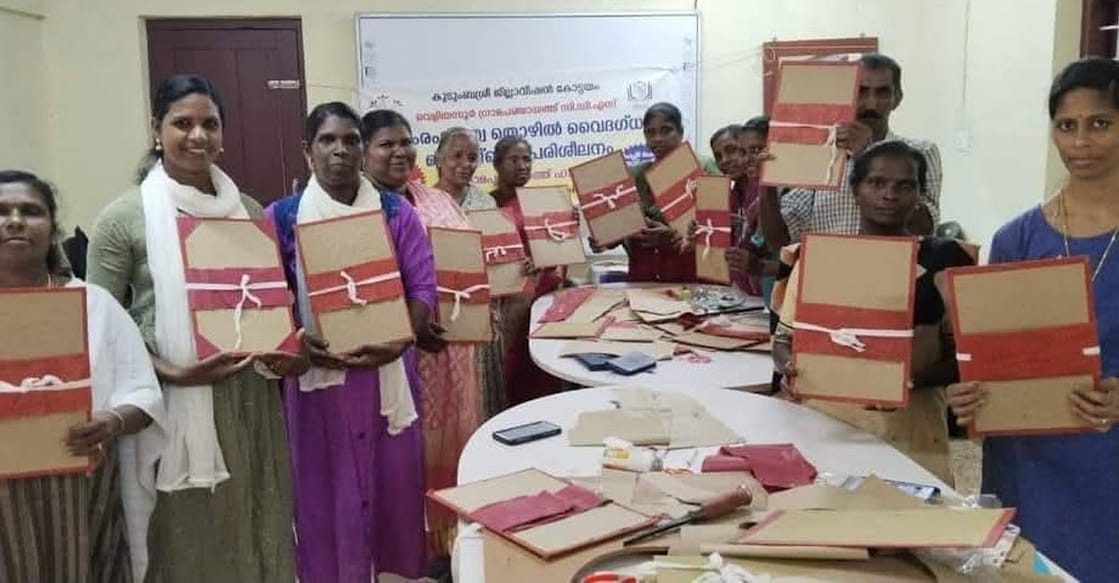
That everyday scene eventually sparked an idea within the panchayat: could these mothers be offered work close to the school, allowing them to stay near their children while earning an income? The answer took shape in 2023 as Kanivu Paper Products, a small stationery unit housed in a panchayat-constructed building next to the BUDS school. Today, 18 mothers—many of whom had been restricted from working due to caregiving responsibilities—work here making notebooks, files, paper, pens and other stationery items.
For Rini, a nurse with nearly three decades of experience in Saudi Arabia and then in New Delhi, Kanivu marked a turning point. She quit her job when her elder son, Albin Shaji, whose condition includes multiple disabilities such as visual and intellectual impairments, worsened and required constant care, prompting the family’s return to Kerala. “In Delhi, even a short walk was difficult. The streets were always crowded. We always stayed inside the flat,” she recalls. Her husband now runs a business in Veliyannoor.
After returning home, Rini spent nearly three years confined indoors, fully devoted to caregiving. “Many parents live in isolation like that. I know it because I was once there,” she says. She learned about the BUDS school through a neighbour who drives the school bus and enrolled her son.
The school, which began functioning in 2019, caters to children with autism, cerebral palsy, intellectual disabilities and other conditions. Simi, a teacher at the school, says the presence of mothers on campus has always been a source of support. “From the beginning, three or four mothers stayed back to help with kitchen work and childcare. That’s how the idea of Kanivu evolved,” she explains. She credits much of the initiative’s momentum to Ambili, a former school helper whose paralysed child was a student at the school. “She dreamt of this unit and worked tirelessly with the panchayat to make it a reality,” Simi says.
Before operations began, the mothers underwent 10 days of training arranged by the panchayat. “A small portion of the profit is set aside to run the unit and support the school, while the rest is shared among the mothers,” Simi says. The initiative offers more than income. “These women are unemployed only because of caregiving responsibilities. This model lets them work without being separated from their children,” she says. It also supports the school, which functions with limited staff, including a cook, helper and driver.
Rini also serves as an informal in-house nurse. She checks blood pressure, sugar levels and temperature, provides first aid and offers medical assistance during emergencies. “Children like ours face health issues more often. If I can help, even a little, I’m grateful,” she says.
Equally important is the emotional support the mothers provide each other. “We no longer feel alone. We’ve formed a community that understands our struggles,” Rini says. The unit operates during school hours, from 10 am to 3.30 pm. Some mothers work from home, sending finished products through their children—mostly those caring for elderly or ailing family members. Students above 18 also assist with production.
“It feels like a joint family now,” Rini says. “Constant caregiving and uncertainty about a child’s future can be overwhelming. This system supports both parents and children. Our children feel secure knowing their mothers are nearby. That peace of mind is priceless.” School trips have added another layer of inclusion. “Travelling alone with such children can be exhausting. But when we travel together, we support each other and enjoy the experience without feeling pushed aside,” she says.
The panchayat funded the building and initial production costs. “We also helped arrange training, identify sponsors and find markets,” says former panchayat president Sajesh Sasi, during whose tenure the unit was set up. Safety was prioritised, especially as students above 18 work at the unit. “All machines are child-safe,” he says. Sales are managed by the BUDS school management committee. Products are supplied to institutions such as the Kerala Institute of Local Administration (KILA), the Kudumbashree Mission and several government offices. “So far, finding a market has not been a challenge,” Sajesh says.
 Add as a preferred source on Google