

Ex-Finance Secretary Subhash Chandra Garg decries hollow project announcements in Union Budget
Mail This Article


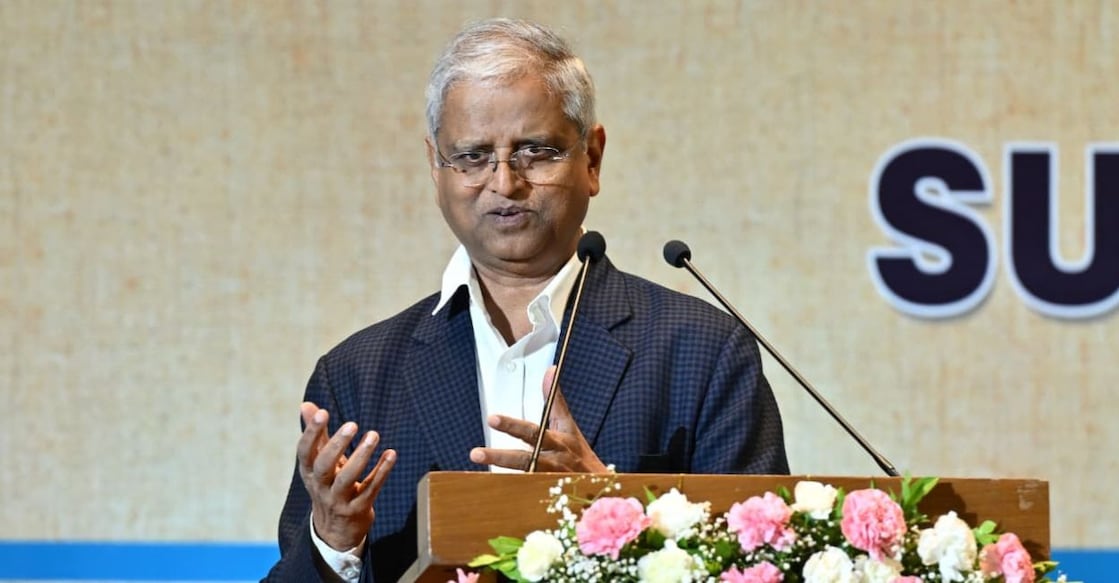
Kochi: Delivering a blistering critique of the Union Budget at the 27th Malayala Manorama Budget Lecture in Kochi on Wednesday, former Union Finance Secretary Subhash Chandra Garg warned that India is increasingly trapped in a cycle of unproductive debt, where the government is essentially “borrowing to pay for past sins”. In a detailed analysis that juxtaposed high-decibel political rhetoric by the Finance Minister Nirmala Sitharaman, against the stark reality of treasury documents, Garg revealed that several flagship projects, including the seven new high-speed railway corridors, have not been allocated “even a single rupee”. He said that while states like Kerala often feel slighted by their exclusion from such announcements, they have little reason for disappointment when the projects themselves are hollow and unfunded.
Garg urged a shift in focus from the Finance Minister’s “feel-good” speech to the actual allocations, noting that the budget remains tethered to a 20th-century mindset of physical infrastructure while the global economy pivots toward technology. He argued that Sitharaman’s claim of “reform, not rhetoric” is contradicted by the documents themselves. “There is always a lot of rhetoric in any budget,” Garg said, pointing out that ambitious concepts like “University Townships” lack sanctioned funds and risk becoming mere “real estate projects” rather than centres of excellence.
He questioned the productivity of current mega-investments, citing the ₹2 lakh crore Mumbai-Ahmedabad bullet train as a prime example. Garg observed that despite a “₹10 lakh crore investment in railways over the last five years, the number of passengers in 2025 was actually less than in 2019”. He also said that BSNL receives ₹50,000–60,000 crore annually without a significant rise in its subscriber base.
The fiscal math behind this stagnation is particularly grim, as Garg highlighted a mounting “debt trap”. With India’s government debt rising to ₹215 trillion, approximately 56 per cent of the GDP, the cost of servicing this legacy is staggering. “Our annual borrowing is roughly ₹17 trillion, and the combined cost of interest payments and pensions is also ₹17 trillion,” Garg said, concluding that “every rupee the government borrows today is essentially used only to pay for past sins -servicing old debt and paying pensions- rather than funding future growth.” This leaves what he called “pathetic” levels of funding for modern necessities, such as the mere ₹3,000 crore for pollution management and ₹4,000 crore for law and justice.
On the revenue front, Garg raised deep concerns over a shrinking tax base and “excessive exemptions” that have caused a significant decline in GST and income tax collections. He pointed out that while India has a population of 140 crore, only about 3 crore people actually pay income tax after accounting for those with zero tax liability. With the exemption limit recently raised to ₹12 lakh, he estimated a further shortfall of ₹1.2 lakh crore in revenue. This has forced the government to rely on a ₹3 lakh crore dividend from the Reserve Bank of India, a “paradox” where the central bank’s profit increases precisely when the “rupee weakens, and the economy falters” due to currency depreciation.
Concluding his lecture, Garg called for a radical restructuring of government spending to prioritise the “three winners” of the 21st century-energy transition, semiconductors, and intelligent machines or AI. He added that while the GDP is growing at over 7 per cent, the 5.5 per cent increase in budget expenditure is strange and insufficient to meet modern challenges like drone-centric warfare.
Prior to Garg’s speech, the welcome speech was delivered by Siji Joseph, Vice President of Malayala Manorama Finance. The vote of thanks was delivered by Mathew T George, News Editor of The Week, with Editorial Director Jose Panachippuram presenting a memento to the speaker.
