

Samastha, IUML's spiritual compass, passes resolution against Jamaat-e-Islami’s 'theocratic ideology', puts UDF in a bind
Mail This Article


Kasaragod: A day after Leader of the Opposition VD Satheesan said Jamaat-e-Islami Hind (JIH) had abandoned the idea of a theocratic state, and would accept its support in the election, Samastha Kerala Jam‘iyyathul Ulama (EK Faction) adopted a resolution sharply critical of the organisation, rejecting what it described as JIH’s theocratic and radical ideological line.
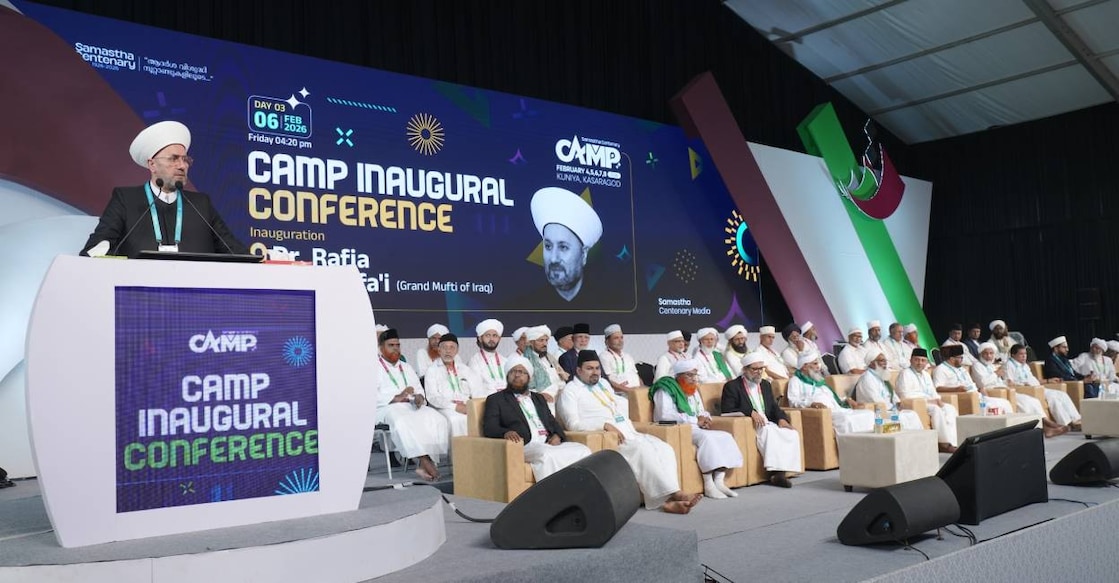
The resolution, passed at the valedictory meet of Samastha’s year-long centenary celebrations in Kasaragod on Saturday, called for vigilance against pan-Islamist extremist ideologies that seek to undermine Islam’s peaceful mode of propagation.
The resolution would place the Congress and its strongest ally, the Indian Union Muslim League (IUML), in a bind, while handing the CPM -- already projecting the UDF as a front aligned with “extremist organisations” -- fresh ammunition for its proxy attack on the JIH.
The resolution would be a bitter pill for the UDF, as Samastha -- an influential body of Sunni scholars -- forms the ideological backbone of the Muslim League. The two organisations are closely intertwined, with leaders straddling key roles in both. Except for the current IUML president, Sayyid Sadik Ali Thangal, every previous president was a member of Samastha’s Mushawara, its highest decision-making body.
Samastha’s resolution stated that radical styles of preaching and ideologies that seek to fuse religion with political power were not in line with its religious path. A resolution adopted at the centenary conference called for vigilance against pan-Islamist extremist currents that, it said, attempt to undermine Islam’s peaceful tradition of propagation and the path laid down by respected religious predecessors.
The resolution warned that Maududist lines of thought -- derived from the ideas of Abul A‘la Maududi, the founder of Jamaat-e-Islami -- pose a serious challenge by appealing to Muslim youth “through emotionally charged rhetoric that subtly promotes the idea of theocracy and the dangerous concept of political Islam”. Such ideas seek to pull young people away from the religious and social mainstream, it said. Maududi, who moved to Pakistan after the Partition, had advocated Islam as a comprehensive political system with the state governed by divine law rather than popular sovereignty.
Intellectual intrusions
Samastha also flagged what it called “intellectual intrusions” carried out through platforms projecting themselves as neutral media, alleging that these were being used to push divisive agendas within the community. Stressing the legacy of tolerance and coexistence associated with the Ahlussunna wal Jama’ah tradition, it urged believers to resist such trends ideologically and safeguard the community’s distinctive character.
Emphasis on the Madhhab tradition
In another resolution, Samastha underscored the importance of relying on long-standing scholarly traditions rather than individual interpretations. It called for strict adherence to the Madhhab path, which acts as a safeguard against arbitrary, politically motivated, or trend-driven interpretations of faith.
Govindan vs Satheesan
The resolutions come amid an intensifying political debate over the role and relevance of Jamaat-e-Islami. While launching the UDF’s statewide ‘Puthuyuga Yatra’ in Kasaragod on Friday, Satheesan cited recent remarks by JIH Ameer (National President) Syed Sadatullah Hussaini, who said the organisation no longer advocates an Islamic state and views India’s Constitution and pluralism as its strength. Satheesan also said the UDF would accept JIH’s electoral support.

On Saturday, he again accused the CPM of hypocrisy, saying it had worked closely with Jamaat-e-Islami Hind for 42 years, and was now “pretending to suffer from amnesia” after the organisation drifted away from the Left.
Satheesan said he could send Govindan clips of speeches made by Chief Minister Pinarayi Vijayan justifying Jamaat-e-Islami, as well as Deshabhimani editorials backing the organisation, even when it has not renounced political Islam.
Over the years, Jamaat-e-Islami Hind has publicly adapted itself to India’s secular democratic framework, a shift reflected in the launch of the Welfare Party of India in 2011 as a secular political platform engaging with electoral politics.
The CPM, however, has stepped up its attack on the UDF, with State secretary M V Govindan accusing the Congress of “whitewashing communal extremist forces”, and branding JIH an extremist organisation.
Speaking in Kozhikode on Saturday, while leading the LDF’s election rally, ‘Vikasana Munnetta Jatha’, Govindan said the Congress was “increasingly relying on communal consolidation” to win the upcoming Assembly election. He said earlier that the Congress and the League joined hands with the BJP to form the Ko-Li-Bi Alliance. “Now the Congress is trying to forge an alliance that includes the JIH as well. The party has effectively granted the JIH a certificate of merit despite its radical theocratic agenda.”
While Jamaat-e-Islami’s actual electoral clout remains limited, its ideological positioning has emerged as a key flashpoint in Kerala’s polarised political discourse, with both fronts using it as a proxy to polarise and consolidate ahead of the Assembly election.
