

India’s first blind judge-select calls for gadgets in courts to make justice accessible
Mail This Article


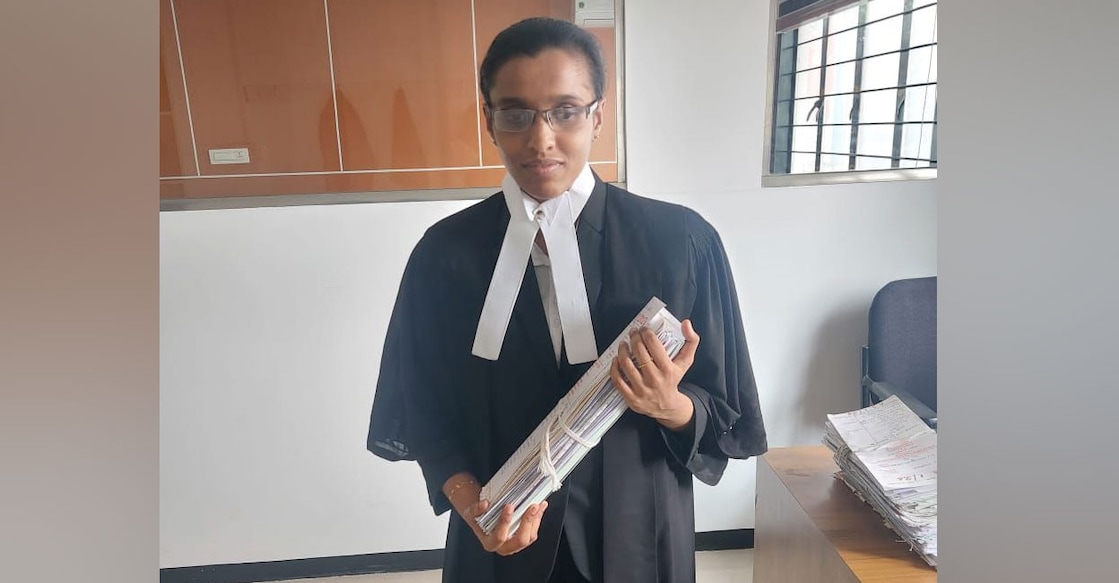
Kannur: Former classmates of Thanya Nathan C, who won the Kerala Women's Commission's 'Sthree Shakthi' award on Monday, are not surprised that she cleared the Kerala Judicial Service Examination on her first attempt, to become, perhaps, the country's first visually impaired civil judge and magistrate.
The women's panel on Monday named her among six recipients for the 2025 'Sthree Shakthi' Award to be presented on International Women's Day
She was the topper of the 2019-2024 batch at Kannur University's School of Legal Studies on Dr Janaki Ammal campus at Palayad near Dharmadom.
"She would have cleared the exam even without a quota. The Supreme Court judgment only removed the barrier imposed on the blind," said a former classmate who now practises in Kochi.
He remembers her as the first to reach class and someone who never missed even one lecture. For five years, she consistently scored 20 out of 20 in internal assessments, the only student in the batch to do so. "It was never sympathy. It was sheer hard work," he said.
For years, Kerala's judicial service reserved a single post in the munsiff-magistrate cadre for persons with 40% and above (benchmark) disabilities under the Rights of Persons with Disabilities Act. But the vacant post was often carried forward for "want of an eligible candidate", according to notifications issued year after year.
This year, out of 56 vacancies, one seat was again earmarked for persons with benchmark disabilities. Thanya was selected.
Her appointment follows a March 2025 ruling of the Supreme Court that struck down a rule in Madhya Pradesh barring visually impaired candidates from judicial service. "No candidate can be denied consideration solely on account of their disability," ruled a bench of Justices J B Pardiwala and R Mahadevan in a case the Supreme Court took up on its own.
"Before the judgment, there was no visually impaired judge anywhere in India, not that I know of," Thanya said. "After the judgment, I am the first person to qualify."
When contacted, another LLB classmate teasingly called her a 'padipist', a bookworm. Thanya prefers another phrase. "It was a craving for knowledge," she said. "You (people who can see) may not understand the extent of our craving." That hunger for knowledge, more than her cracking the judicial exam, is where her story truly begins.
Thanya was born blind and is the second daughter of Jaganathan, a jewellery designer working in Oman, and Babitha, a homemaker. Her elder sister, Thara, is a travel and tourism executive in Dubai.
She picked up the Braille system at a very early age. "I was fluent in Braille when I joined Class 1," she said. It became her window to the world of knowledge.
Thanya studied at the Model School for the Blind in Kannur. By the time she reached Class 10, she was certain of a career in law. "There are no lawyers or judges in my family, not even in my distant family," she said. Thanya said she saw the study of law as a safeguard, a means to defend and assert the rights of marginalised communities, a group she counts herself in.
Her family stood by her. Her friends recalled that her mother, Babitha, and elder sister Thara moved to a house in Dharmadam to stay closer to the law college. Either her mother or sister would come to drop her off and pick her up, they said.
But when she joined the law college, reading material in Braille began to thin out. A regular page is translated to four pages in Braille. Her academic needs made Braille bulky. Technology stepped in to bridge that gap.
She turned to audiobooks and screen-reading software. "Initially, I would download audiobooks onto a pen drive and listen to them on my computer," she said. "But when I joined LLB in 2019, audiobook libraries had become WhatsApp groups."
In these groups, visually abled volunteers read books, chapter by chapter, and posted audio messages. They are clearly indexed for easy access. They would add one or two chapters every day. "Many of us read four to five books a month because of these audio files. I think we end up reading more books than many people who can see," said Thanya, who reads fiction to unwind. "When technology made knowledge accessible, we used it to the maximum.”
Allow gadgets in courts
In class, she took notes in Braille. "She would vigorously punch her notes and use them while making presentations," recalled her former classmate, now practising in Kochi.
That practice travelled with her to court. After enrolling as an advocate, she began practising at the Taliparamba court complex under Advocate Sunil Kumar K. "My senior always created opportunities for me to argue cases, not just file representations," she said.
She would read case documents in her office using screen-reading software such as NVDA and note down the law points in Braille. "In one-and-a-half years, I argued several cases," she said.
The difficulty arose when a document had to be read spontaneously in court. Files are physical. Electronic devices are not permitted inside most courtrooms. "When we are not able to read it ourselves, we have to ask for help," she said. "That is a big accessibility issue."
She believes the judiciary should permit the use of reading gadgets in courtrooms so lawyers with visual disabilities need not depend on a third person. "That's the main issue I faced," she said.
Yet she is optimistic. "When I wrote the entrance exam, I was very hopeful because changes had come in the Bench," she said.
Courts have already begun adopting voice-to-text systems for recording evidence. Judges repeat what a witness or accused says, and the system converts the spoken words into real-time text on a computer before the stenographer, who corrects minor errors. The Taliparamba court introduced this facility last year, she said.
Currently, order sheets -- which record the date of hearing, parties present, proceedings of the day, directions, adjournments and interim orders -- are filled manually. But she expects voice-to-text technology to extend there as well. "That makes the field level," she said quietly. "Technology will break down the barriers."
Just 24 today, she sees herself one day in the higher judiciary.
The constitutional groundwork, she believes, is already being laid. During the hearing of the suo motu case challenging rules that barred visually impaired candidates from judicial service, the Supreme Court of India examined not just eligibility but institutional readiness. Justice Pardiwala asked whether blind judges might require specialised training. Amicus curiae Senior Advocate Gaurav Agarwal responded that sensitisation was necessary not only for judges with disabilities but also for the judicial officers and staff who work alongside them.
Thanya has crossed the first barrier by cracking the entrance exam. Now, the system may have to catch up.
 Add as a preferred source on Google