

Trained in Kerala, French man takes Kathakali mudras to opera
Mail This Article


While pursuing a course in theatre arts at Sorbonne University (University of Paris) in 2011, Mounir Bouabid, 34, who lives in Montpellier in France, went through some study materials, including videos, on performing arts in India. Among them, he found Kathakali and Kalarippayattu, the traditional art form and martial art of Kerala, and Seraikella Chhau, a dance form of north-east India, quite impressive.

After completing his studies, Mounir became a professional theatre artist and went on to form his own theatre company, Oiseau Jaune (Yellow Bird), with his ex-partner in Paris. However, the fascination for Kalarippayattu and Kathakali lingered. Years later, he got in touch with the Ministry of Culture in India and learned about the Kathakali School Society in Cheruthuruthy, Thrissur. Eventually, Mounir landed in Kerala in 2023 and headed for the Kathakali school to enroll himself as a student there. He continued his training in Kalarippayattu through intermittent sojourns in the state.

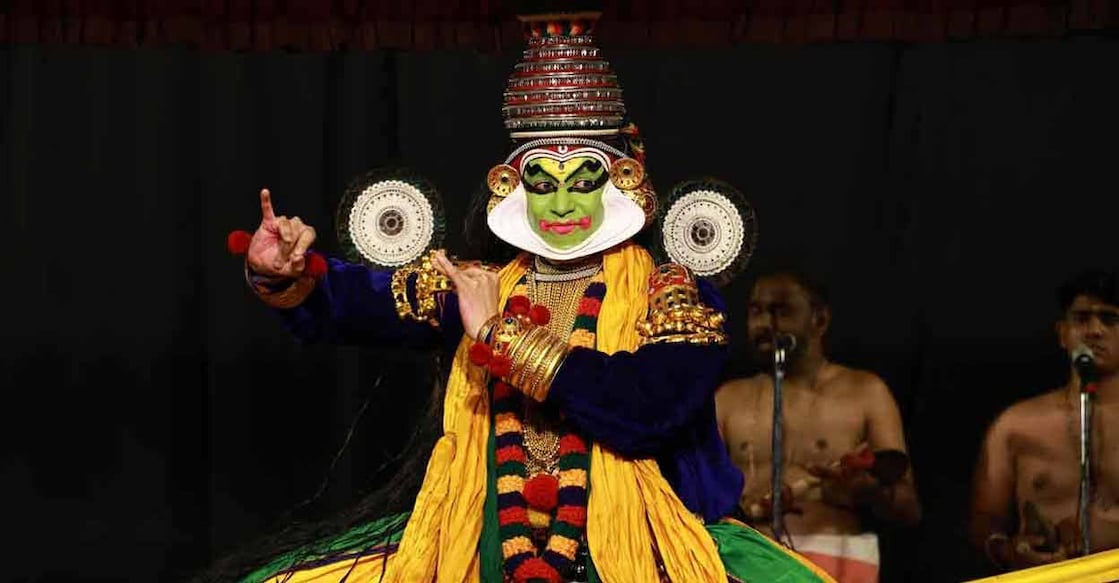
Mounir enrolled himself in Kathakali classes only last year; a couple of months ago, to be precise. In a matter of two months, he learned the basics, enough to conduct the 'arangettam' (the first official or public stage performance of a classical genre) at the Kathakali school recently. It was a dream come true for him when he put on the makeup for the first time for a performance he had been longing for over a decade. "It was a special moment for me. I think it should be so for everyone doing an arangettam. It (Kathakali) gave me a lot of ideas about what we lost in Europe in terms of sacredness," Mounir said.
Mounir, in fact, weaved some of the art elements he assimilated in Kerala into his performance in France. "I had inserted a few Kathakali mudras and Chhau dance moves in a show in Paris after I went back from Kerala a few months back. And it was a success, as the audience enjoyed the mix of English opera with Indian movements," says Mounir.
According to Kalamandalam Gopalakrishnan, director of Kathakali School Society, the arangettam is usually done after two or more years of training. "But Mounir learned the basics, like physical exercise, chuzhippu, ilakiyaattom, thodayam, purappad, and so on, in two months and conducted the arangettam, which means he is exceptionally talented. Of course, he had the advantage of being a theatre artist," he says and adds, "Nevertheless, he has to be trained more to play a full-fledged character."
As to what sort of performances he showcases in French theatre, he says, "I do contemporary theatre. I write, direct, create the costumes, work on opera forms, and sing. I also do some historical theatre, which means we have performances based on 12th and 13th-century medieval French history."
He says that French culture and art are very different from those of Kerala. "In France, culture has been separated from the church since the revolution. In India, culture is very much related to religion. The stories are mainly from Hindu mythology like the Ramayana, Mahabharata, and the Vedic texts, and the shows are performed mostly in temples. In France, the texts have absolutely no relation to religion, and there is no sacred or ritualistic aspect about them," he says.
The Kathakali School Society is run by grants from the Union Ministry of Cultural Affairs and imparts classes to foreign as well as native students. "Apart from Mounir, there are students from Chile and Italy. Besides Kathakali, training on Kalarippayattu, Mohiniyattam, Bharatanatyam, Kuchipudi, and Chenda are also given," says Director Gopalakrishnan, who is the grandson of the great Malayalam poet P Kunjiraman Nair. The school has been conducting the National Kathakali festival for the past ten years in the Nila Campus, around two kilometers from Kalamandalam.
