

'Coming out is hard, the new Bill makes it even harder': Kerala trans community concerned over amendments

Mail This Article


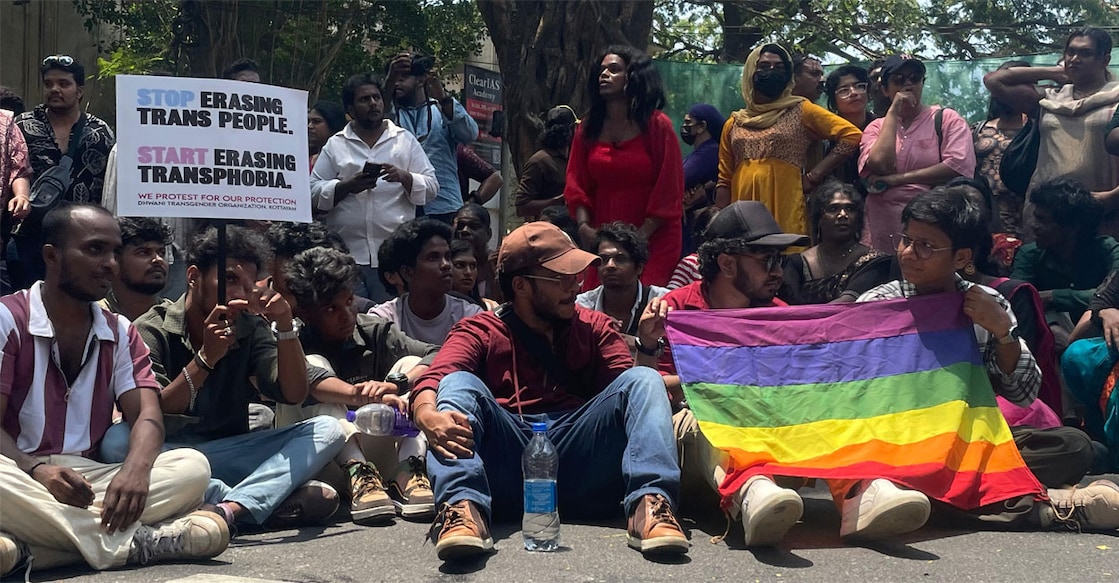
On the streets of Kerala, members of the LGBTQ community have been protesting for days, holding placards that read, 'stop erasing trans people, start erasing transphobia', opposing the new Transgender Persons (Protection of Rights) Amendment Bill passed in Parliament on March 25.
A team from the Kerala Joint Action Committee on Transgender and LGBTQ went to Delhi to take part in press meets and register their protest. Community members, activists and supporters have taken to the roads of various districts, including Thiruvananthapuram, Ernakulam and Kottayam, urging the Centre to withdraw the Bill, which they term as both regressive and unconstitutional.
The Bill has raised fears of exclusion and further marginalisation among members of the LGBTQ community. "The new Bill has not only set back decades of work by the community, but it questions our right to exist," said Arjun Geetha from Ernakulam, CEO of Amigo Transgender Collective and a member of the Kerala Transgender Justice Board.

Arjun says it was unacceptable that self-identity cannot be taken into consideration. "Any person determines their gender through self-identification. But for a person who identifies as trans to not be recognised unless a medical board and a district magistrate's sanction is problematic."
The Bill, introduced in the Lok Sabha on March 13, 2026, by Union Minister for Social Justice and Empowerment Dr Virendra Kumar, was passed by a voice vote amid opposition protests. "The Bill was passed amid protests, without any consultation with the LGBTQ community and without any representation in Parliament," said Rhyan, a member of the Amigo Collective and a content analyst at a UK-based company.
The Rajya Sabha passed the Bill on March 25 and President Droupadi Murmu gave her assent on Monday. The Bill explicitly excludes persons with different sexual orientations and self-perceived sexual identities from its ambit. It also removes the categories of trans-man, trans-woman, and genderqueer that were included in the 2019 Act.
Members of the LGBTQ community say the amendment has brought in a narrow definition based on categorisation. The definition includes persons with socio-cultural identities such as kinner, hijra, aravani and jogta, as well as eunuchs. It covers persons with intersex variations, including congenital variations in primary sexual characteristics, external genitalia, chromosomal patterns, gonadal development or hormone production and persons who have been forcibly compelled to assume a transgender identity through mutilation, castration, or surgical/chemical/hormonal procedures.
"On a base level, when an individual identifies themselves as trans, it is a very complex process marred by confusion, avoidance from friends, family, lack of awareness, isolation, etc. The family most often shuns them. A trans person has very little acceptance in society and is not able to lead a normal life," he said. "Now with the recent amendment and its various penal provisions where an individual can get upto 10 years in jail term for "forcing a person to present as trans gender" even our own community members would be hesitant to come forward and support due to a fear whether such an act will be vilified by the parents or relatives of the individual concerned," Rhyan said.
"It should also be noted that not every person wants to identify themselves in social cultural terms such as kinner, hijra, etc. Also, not all intersex people (as mentioned in the Bill) want to identify as trans. This is a violation of an intersex person's rights," he added.

"The new amendment has further acted like a filtration process, leaving out sections of the community. People who had come forward for documentation may now find themselves stuck. The existing documentation process was difficult in itself with just a tag "transgender". Instead of working on establishing a more efficient system, the process has been made more complex," Rhyan said. He also flagged a rise in harassment following the Bill's introduction.
The Bill also alters the certification process, requiring a District Magistrate to issue a transgender certificate only after considering recommendations from a Medical Board. The Magistrate may also seek opinions from other medical experts, though these are not clearly defined.
"Not everyone wants to undergo gender-affirming surgery due to personal or financial reasons," Arjun Geetha said. "The process is already complex and expensive. Making medical scrutiny mandatory can be exclusionary," he added, raising concerns about discrimination in healthcare settings. "Not just that, India has not become advanced enough to successfully conduct gender affirming surgeries. There are people I know who have to deal with the consequences of a botched surgery," he said.
Activists warn that the changes could deter individuals from openly identifying as transgender. "Coming out is already difficult, with a lack of family support and social stigma. This will only increase fear and isolation," Arjun said.
 Add as a preferred source on Google